
Picture a school at the end of its professional development year. Every teacher completed the required hours. The sign-in sheets are full and the feedback forms are positive. Then the leadership team opens the end-of-term results and finds the same weak areas in the same year groups as last year.
Nothing in the professional development record explains why.
That gap between activity and impact sits behind most of the instructional leadership trends now emerging. The central shift is simple to state and hard to do: leaders are moving from checking whether teaching happened to asking whether it changed learning. Five trends show this most clearly: professional learning judged by impact, coaching at the centre, student evidence as the anchor, AI entering teachers’ work, and leadership shared across teams and campuses.
| Trend | The old default | The emerging shift | The question leaders should ask |
| 1. Impact-judged professional learning | Hours attended, sessions delivered | Evidence that practice changed | What is different in classrooms because of this? |
| 2. Coaching at the centre | One-off workshops | Sustained, practice-based coaching | Can our coaching model survive being scaled? |
| 3. Student evidence as the anchor | Observation checklists alone | Coaching tied to what students can and cannot do | What student evidence is this conversation built on? |
| 4. AI in teachers’ work | Informal, individual use | Guided use with human review | Who checks the output, and against what standard? |
| 5. Shared leadership | Principal as sole instructional lead | Teams and networks reading the same evidence | Do our teachers, principals and group leaders see the same picture? |
Trend 1: Professional Learning Is Being Judged by What It Changes
The most useful recent data on teacher professional growth comes from the OECD’s TALIS 2024 survey. In 2024, 280,000 educators from 55 education systems contributed to the survey, which covers working conditions, professional development and classroom realities. (OECD)
One finding deserves more attention from leadership teams. Almost every teacher takes part in continuous professional learning, yet on average across OECD systems only 55% said the activities from the previous 12 months had a positive impact on their teaching.
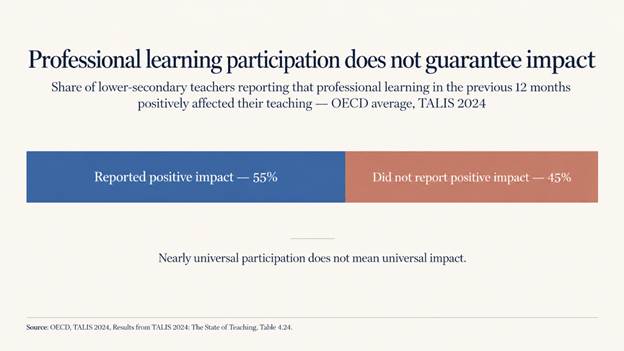
More telling: teachers’ perception of whether an activity had impact predicted whether they met their lesson aims more strongly than the activity’s actual content or focus. (OECDOECD)
These are self-reports, so they measure how teachers experience professional learning rather than proven effects on students. Even so, the implication for leaders is uncomfortable. Choosing the right topic is not enough. The learning has to connect to a teacher’s real classroom problem.
If a teacher completes thirty hours of professional development and nothing changes in what their students can do, what exactly did the school invest in?
Trend 2: Instructional Coaching Moves to the Centre, and the Scale Problem Follows
Instructional coaching has become the default answer to the limits of one-off workshops, and the evidence gives reason for it. A widely cited meta-analysis by Kraft, Blazar and Hogan combined 60 studies with causal research designs and found average effects of 0.49 standard deviations on instruction and 0.18 standard deviations on student achievement. (umd)
Two limits matter. Much of the evidence comes from literacy coaching for pre-kindergarten and elementary teachers in the United States. And average effects from larger programmes were only a fraction of those found in smaller efficacy trials. (umdumd)
For a school group, that second point is the real decision. Coaching that works well in one school with one skilled coach can thin out when it is rolled out across ten campuses without protecting what made it work: time, focus, and a clear link to classroom evidence. Expanding coaching is a design problem, not only a staffing one.
Trend 3: Student Evidence Becomes the Anchor for Teacher Growth
Here is where the first two trends meet. If coaching works best when it addresses a real classroom problem, the most reliable source of that problem is student learning evidence.
Consider a hypothetical example. Two Grade 6 teachers have almost identical class averages in reading. In one class, students struggle mainly with inference. In the other, the weakness is vocabulary. An observation checklist may rate both teachers similarly. A coaching conversation built on [Future internal link opportunity: diagnostic assessment at competency level] would take them in completely different directions.
This is the shift from “How did the lesson look?” to “What did students learn, and what should change next?” It also changes how coaching is judged. The test becomes whether the next assessment shows movement on the specific skill the coaching targeted, which is where [Future internal link opportunity: tracking student growth across assessment cycles] becomes part of teacher development, not a separate reporting task.
If a coaching conversation never looks at student work, what is it actually coaching toward?
Trend 4: AI Arrives in Teachers’ Work Faster Than Guidance Does
TALIS 2024 was the first round to ask teachers about AI directly. Around one in three teachers across OECD systems reported using AI in their work, with the most common uses being learning about or summarising a topic (68%) and generating lesson plans or activities (64%). The least frequent use was reviewing data on student participation or performance (25%). OECD
Training is catching up. Almost 40% of teachers across OECD systems received training on AI in 2024. Concern is high too: seven in ten teachers worry that AI makes plagiarism and cheating easier. (OECDOECD)
For leaders, the pattern says something specific. AI is mostly helping teachers plan, not helping them read student evidence. That is a reasonable starting point, but it leaves the most consequential uses, such as marking and feedback, without clear norms in many schools. The leadership question is less “Should teachers use AI?” and more “Where does [Future internal link opportunity: AI-supported grading with human review] sit in our expectations of professional judgement?”
Trend 5: Instructional Leadership Becomes Shared Across Teams and Campuses
The idea of the principal as the single instructional leader is giving way to something more distributed. Heads of department, coaches, assessment leads and network academic teams now share the work. The OECD’s own summary of TALIS puts it plainly: successful teaching is the product of successful collaboration. (OECD)
Shared leadership only works when people are looking at the same evidence. In many school groups, teachers see one set of results, principals see another and the group office sees a third, often built on different tests. Each layer then makes decisions that do not quite connect. The practical step is agreeing on a common language of evidence, so that a group-level priority, a school’s plan and a teacher’s next lesson all trace back to the same diagnosis. This is the foundation for [Future internal link opportunity: fair school-group benchmarking across campuses].
What These Trends Add Up To
Taken together, the five trends make one argument. Teacher growth and student growth are not two separate agendas. Professional learning earns its place when it changes practice, and practice earns its place when it changes what students can do. Leaders who connect those two things through shared, specific evidence will get more from every coaching hour, every training day and every AI tool they introduce.
Where Scholario Ascend Fits
The thread running through these trends is shared, specific evidence, and that is the problem Scholario Ascend is built around. Its reporting gives teachers a competency-level view of their class against the school and network, BOY-to-EOY growth per learner, and which standards need reteaching. School and network leaders see the same underlying evidence at their own level of aggregation, so a group priority and a teacher’s plan can trace back to one diagnosis. Where AI assists with grading or item creation, the reasoning is shown so teachers can interpret and override it, and AI-generated items wait as drafts until a reviewer approves them.
Frequently Asked Questions
What is instructional leadership?
Instructional leadership is the work of improving teaching and learning directly, rather than only managing a school’s operations. Today it is increasingly shared among principals, department heads, coaches and network academic teams.
How can schools tell whether professional development is working?
Look past attendance and satisfaction. Ask what changed in classroom practice, and whether later assessment shows movement on the specific skills the professional development targeted.
Is instructional coaching worth the investment for school groups?
The research is encouraging, but effects tend to shrink as programmes grow. School groups should protect coaching time, keep a narrow focus and tie coaching to student evidence before expanding it.
Should AI be part of teacher growth plans?
Yes, with clear boundaries. Teachers need guidance on where AI can help, where human review is required, and how AI outputs are checked before they affect students.