

Picture a school group running a mid-year assessment across six campuses. This is a hypothetical example, but a familiar one. Four campuses sit the test on tablets. Two sit it on paper: a primary campus where the youngest learners write by hand, and a campus where the internet drops out most afternoons.
Two weeks later, the network report arrives. The four digital campuses appear with competency breakdowns, learning-gap analysis and growth since the start of the year. The two paper campuses appear as a column of percentages typed in by a coordinator. Or they do not appear at all.
Nobody decided those learners mattered less. The system simply had nowhere to put what they wrote.
That is the real issue with paper-based assessment today. The paper itself is rarely the problem. The problem is what happens to the evidence after the papers are collected.
What It Takes for Paper to Count as Shared Evidence
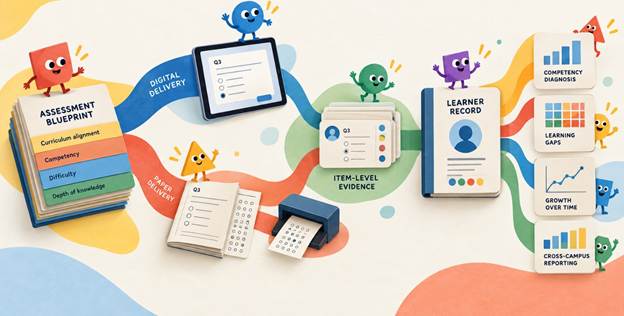
Paper assessments can contribute fully to a shared evidence system when three conditions hold.
First, the paper version is built from the same blueprint as the digital version, with every question carrying the same curriculum, competency, difficulty and depth-of-knowledge tags. Second, responses are captured at item level against a known learner identity, not reduced to a single total on a mark sheet. Third, the results land in the same learner record, on the same reporting scale, as every digital sitting.
If any one of these is missing, paper results become a parallel archive. They can be stored, but they cannot be compared, diagnosed or tracked over time.
Paper Is Often a Deliberate Choice, Not a Stopgap
It is tempting to treat paper as something schools will “move away from” once devices arrive. That view misses why paper persists.
Young learners often show what they know more reliably with a pencil than a touchscreen. Formal invigilated exams are still widely sat on paper. Mathematics teachers value seeing a learner’s working on the page. And connectivity is not a given. According to UNICEF and ITU’s Giga initiative, only around half of the world’s schools are online, a global estimate that will vary widely by country and region. (ITU)
So the useful question for leaders is not “When will we stop using paper?” It is “Why does choosing paper still mean losing evidence?”
A Mark in a Register Is Not the Same as Evidence
The difference between paper that disappears and paper that contributes comes down to what is kept. The table below compares the two.
| What leaders need | Paper result as a mark | Paper result as shared evidence |
| What is captured | A total score or percentage | Each response, item by item |
| Link to curriculum | Usually lost after marking | Every item keeps its competency, difficulty and DOK tag |
| Learner identity | Name on a sheet, typed in later | Learner ID read and matched to one record |
| Diagnosis | “Scored 54%” | Which skills, at which depth, caused the result |
| Comparison with digital learners | Separate spreadsheet, often not comparable | Same scale, same reports |
| Growth over time | Hard to connect across terms | Sits in the same longitudinal history |
| Time from test to action | Weeks of manual entry | Days, once sheets are scanned or captured |
A percentage in a register tells a leader that an assessment happened. Item-level evidence tells them what to do next. The first is a record. Only the second supports [Future internal link opportunity: Diagnostic Assessment at Competency Level | anchor: diagnosis at competency level] or [Future internal link opportunity: Using Assessment Evidence to Plan Interventions | anchor: intervention planning based on assessment evidence].
This raises an uncomfortable question for any network:
If a Grade 2 learner sits every assessment on paper, does your growth report show her standing still, or does it not show her at all?
The Honest Complication: Same Questions, Different Mode
A shared evidence system should not pretend that paper and screen are identical. Research suggests they are not always.
When PISA moved from paper to computer in 2015, its field test included a randomised trial. Analysis of that trial by Jerrim and colleagues found that children who took the computer version scored much lower than peers randomly assigned to paper, with the difference sometimes around 20 PISA test points. The study used field trial data for three countries: Germany, Sweden, and Ireland, and showed that if left unaccounted for, the change to computer-based testing could limit the comparability of PISA test scores. The organisers attempted to adjust the main PISA 2015 results to compensate for such mode effects. Is PISA still a fair basis for comparison?
This finding concerns 15-year-olds in three countries under large-scale testing conditions. It does not tell us how a Grade 3 reading test in one school group will behave. But it does carry a clear lesson for anyone running mixed-mode assessment: comparability has to be checked, not assumed.
In practice, that means recording the mode on every result, watching for items whose difficulty differs noticeably between paper and screen, and being careful when a campus changes mode between cycles. A drop in scores that coincides with a switch from paper to tablets may be a mode effect before it is a teaching problem.
What Leaders Should Ask Before Calling It “One System”
Many assessment tools claim to “support paper.” For a leader, the useful test is whether paper evidence arrives with the same depth as digital evidence. Five questions help:
- Is the paper booklet generated from [Future internal link opportunity: What an Assessment Blueprint Should Include | anchor: the same assessment blueprint] as the digital version, with tags intact?
- How are learner identities captured, and what happens when a sheet cannot be matched?
- Are handwritten short answers scored through the same process as typed ones, and can a teacher review and override the score? This is where [Future internal link opportunity: AI-Supported Grading and Human Review | anchor: AI-supported grading with human review] matters most.
- Can we see the status of every uploaded batch, so missing sheets do not vanish quietly?
- Do paper results feed [Future internal link opportunity: Student Growth vs Attainment | anchor: growth tracking across assessment cycles] and [Future internal link opportunity: Benchmarking Across Multiple Campuses | anchor: benchmarking across multiple campuses] in exactly the same way as digital results?
Implementation matters too. Scanning equipment, image quality, staff time for capture and a clear process for learner concerns about offline results all affect whether the evidence is trustworthy.
A second question worth putting to any leadership team:
when network reports look strongest on the campuses with the best connectivity, how sure are we that we are seeing better learning rather than better data?
Where the Argument Lands
Paper is a way of delivering an assessment. It should not decide whether a learner’s evidence counts. When paper assessments share a blueprint, capture responses at item level, and feed one learner record, they stop being a gap in the data and become part of the picture leaders use to make decisions. Mode effects are real, so the system must stay honest about comparability. But the alternative, leaving paper learners out of analysis, is a far bigger distortion.
Where Scholario Ascend Fits
This distinction between a paper mark and paper evidence is one Scholario Ascend is built around. An assessment is authored once and can be exported as a print-ready booklet with a machine-readable answer sheet, keeping its blueprint, difficulty, DOK and competency tags. Completed sheets can be scanned in bulk, or captured as images where scanning is not available. Learner IDs are read and responses are graded through the same pipeline as a digital sitting, with teachers able to see and override AI scoring reasoning. Each upload shows its status, and learners can raise concerns against an offline result. Paper-sat and digital-sat results then sit in the same longitudinal record and the same growth, competency and learning-gap reports. More detail is on the paper and digital assessment page.
Frequently Asked Questions
Q: Can paper-based assessment results be compared with digital results?
A: Yes, if both are built from the same blueprint and reported on the same scale. Leaders should still record the mode and check for items that behave differently on paper and screen, since research shows mode effects can occur.
Q: What is mixed-mode assessment?
A: It is when the same assessment is delivered on paper to some learners and digitally to others, with all results brought into one reporting and analysis process.
Q: Why not simply enter paper totals into the system manually?
A: A total shows how a learner performed overall, but not why. Without item-level responses, you lose the competency, skill and depth-of-knowledge detail needed for diagnosis and intervention.
Q: How are handwritten answers handled?
A: Scanned short answers and essays can be scored through AI-supported processes, but the reasoning should be visible and a teacher should be able to review and change the score.
Q: Is paper assessment only for schools that lack devices?
A: No. Many schools choose paper for young learners, formal exams or subjects where written working matters.