

Most school visions are not abandoned. They are quietly outvoted.
Picture a familiar September. The leadership team launches the academic plan. The vision promises “curious, independent thinkers,” and the plan lists sensible actions: train staff in questioning, run an inquiry week, refresh the homework policy. By March, the mid-year review looks healthy, with most actions marked complete. Then someone asks a harder question:
Are students actually thinking more independently than they were in September?
The room goes quiet. Nobody knows, because nothing in the plan was built to show it.
This is what drift looks like. It is rarely dramatic, and it is rarely anyone’s fault. It is the slow gap that opens between what a school says it values and what its plan actually causes in classrooms.
Drift Rarely Starts With a Bad Decision
It helps to separate three things that schools often blur together.
The vision describes the destination: the kind of learners and learning the school wants. The academic plan turns that into a year of priorities, actions, resources and measures. Classroom practice is where the vision either becomes real or does not.
Drift happens in the joins between these layers. A vision phrase like “independent thinkers” is never converted into something a teacher could plan for or a leader could observe. The plan then fills up with activities, because activities are easy to schedule and easy to tick off. Meanwhile, the urgent work of a school year (exam preparation, staffing gaps, parent concerns) takes the time that the vision needed.
None of these are bad decisions. Each one is reasonable on the day it is made. Together, they pull the plan away from where it started.
A Plan Moves Toward Whatever the School Actually Checks
Here is the central argument of this article:
An academic plan drifts toward whatever the school actually measures, not toward what it says it values.
If the termly review asks “Did we run the training?”, the plan becomes a training calendar. If the main assessment rewards recall, teaching slowly bends toward recall, whatever the vision statement says. Staff are not being cynical. They are responding sensibly to the signals the system sends them.
Consider a hypothetical school whose vision stresses reasoning and problem-solving. Its end-of-term papers are mostly short recall questions, because those are quick to set and mark. Teachers notice which questions carry the marks and adjust their teaching. A year later, results are steady, the plan is “on track,” and the vision has not moved at all.
If your vision promises deep thinking but your termly assessments mostly reward recall, which of the two is actually steering the school?

What Research Says About Why Good Plans Lose Their Shape
Two recent sources help explain why this happens so often.
The first is the Education Endowment Foundation’s implementation guidance. The EEF published the third edition of A School’s Guide to Implementation on 24 April 2024. It is built around three elements: the behaviours that drive effective implementation, the contextual factors that support it, and a structured process to carry it out. The process runs through four flexible phases: Explore, Prepare, Deliver and Sustain. Among the contextual factors, the guidance names the available systems and structures, such as time, roles and data systems, as conditions that can either enable or constrain change. A central theme is that evidence and data should shape both what a school implements and how it implements it, with ongoing adaptation informed by external research and internal monitoring data. A School’s Guide to Implementation
For school leaders, one implication is that drift should be expected, not treated as failure. A plan without a built-in way to monitor and adjust will lose its shape over time. Note that the EEF guide is a synthesis of evidence and practice. It is not a single trial proving that one planning method prevents drift.
The second source is the OECD’s TALIS 2024 survey, which gathered responses from teachers and principals across 55 education systems. Based on principals’ reports for lower secondary schools, on average across OECD systems with data, 77% of teachers work in schools where teachers have significant responsibility for choosing learning materials. Only 47% work in schools where teachers have significant responsibility for determining course content, and only 33% where they help decide which courses are offered. oecd
This does not measure plan drift directly. It also reflects survey responses, and TALIS relies only on self-reports, which reflect perceptions shaped by social and cultural context. Even so, it raises a useful question for leaders. Teachers often decide the materials through which a vision is lived each day, but many have less say in the content decisions that sit inside a strategic plan. A plan that teachers carry out but did not help translate is more likely to drift.
Six Places Where Academic Plans Drift
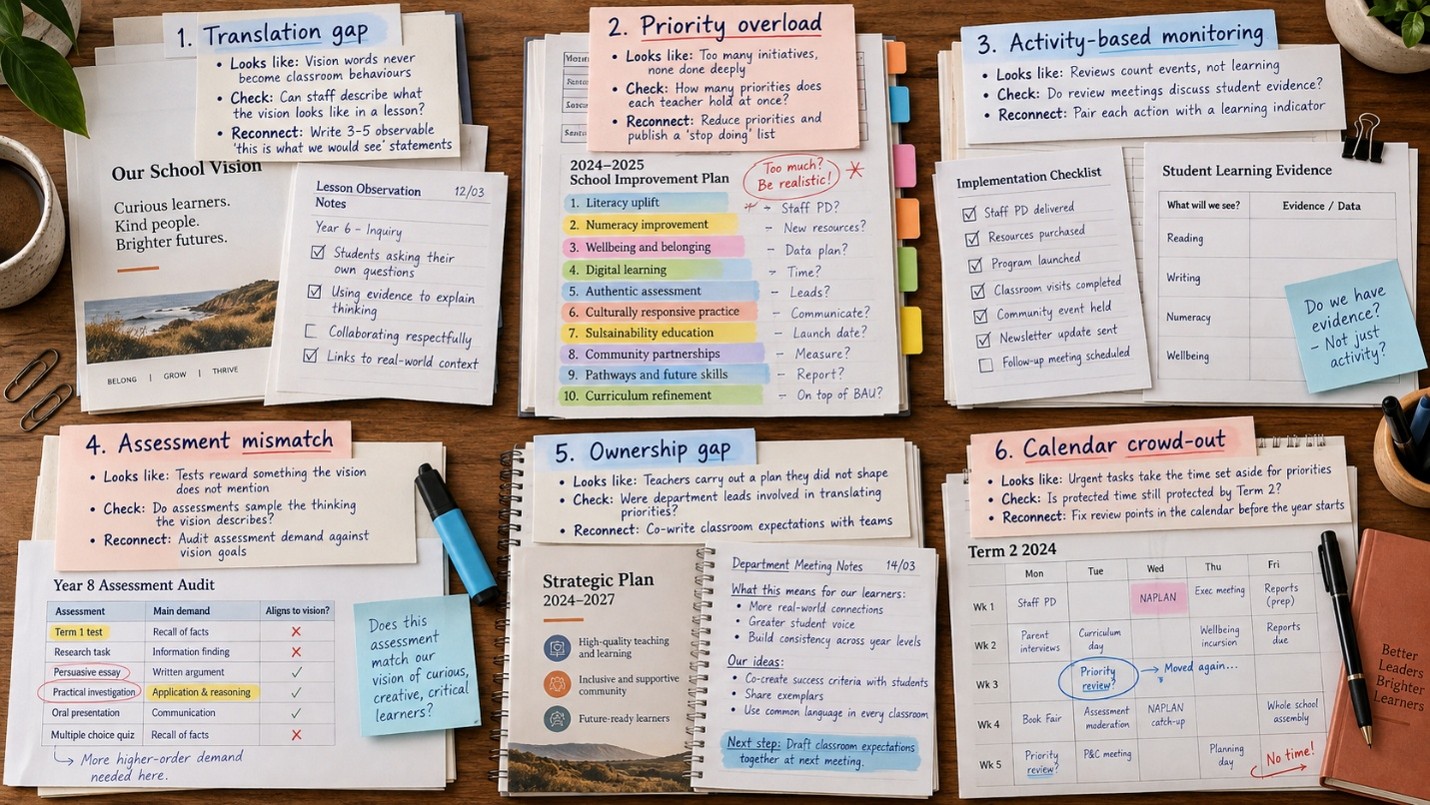
| Where drift happens | What it looks like | What leaders should check | How to reconnect |
| Translation gap | Vision words never become classroom behaviours | Can staff describe what the vision looks like in a lesson? | Write 3–5 observable “this is what we would see” statements |
| Priority overload | Too many initiatives, none done deeply | How many priorities does each teacher hold at once? | Reduce priorities and publish a “stop doing” list |
| Activity-based monitoring | Reviews count events, not learning | Do review meetings discuss student evidence? | Pair each action with a learning indicator |
| Assessment mismatch | Tests reward something the vision does not mention | Do assessments sample the thinking the vision describes? | Audit assessment demand against vision goals |
| Ownership gap | Teachers carry out a plan they did not shape | Were department leads involved in translating priorities? | Co-write classroom expectations with teams |
| Calendar crowd-out | Urgent tasks take the time set aside for priorities | Is protected time still protected by Term 2? | Fix review points in the calendar before the year starts |
Reconnecting the Plan: Five Moves for Leadership Teams
1. Translate before you plan. For each vision phrase, ask: what would we see in a lesson, in student work and in assessment results if this were true? If no one can answer, the phrase is not yet ready to guide a plan. A shared teaching and learning effectiveness framework gives these statements a stable home.
2. Choose fewer priorities. Every new priority competes for the same staff time. Two priorities pursued deeply will usually move a school further than six pursued lightly. Decide what will stop, not just what will start.
3. Check your assessments against your vision. If the vision values reasoning, look at what share of assessment questions actually require reasoning. This is often the quickest way to find hidden drift, because assessment shapes teaching more strongly than any policy document.
4. Monitor learning, not just activity. Pair every action with an indicator of change in student learning, and agree in advance when you will review it. The KPIs for leadership teams you choose will decide what the plan drifts toward, so choose them on purpose.
5. Bring teachers into the translation. Department leads and teachers know where the vision breaks down in practice. Involving them in writing classroom expectations turns compliance into shared ownership.
For school groups, there is one more layer. When each campus defines and measures the vision differently, drift becomes invisible at network level. A shared framework and common review cycle let leaders see whether one school, or every school, is moving away from the plan. That kind of oversight belongs within an academic quality assurance framework, not a once-a-year compliance check.
If every action in your plan was completed on time, but nothing in students’ learning changed, did the plan succeed?
Reconnection Is a Habit, Not a Relaunch
The instinct when drift is noticed is to relaunch: a new vision workshop, a new slogan, a new plan. Usually the vision was fine. What was missing was the connection between the vision, the plan, the classroom and the evidence.
Schools that stay aligned do not have better vision statements. They have shorter plans, clearer classroom expectations, assessments that match what they value, and regular moments where leaders ask whether learning has actually moved. If you are rebuilding your plan from scratch, school improvement planning process covers the practical steps. If you need to choose where to focus first, using assessment evidence to choose a priority is a natural next read.
Frequently Asked Questions
Why do academic plans drift away from a school’s vision?
Plans usually drift because the vision is never translated into observable classroom practice, so the plan fills with activities and is judged by completion rather than learning. Over time, the plan follows whatever the school actually measures.
How can school leaders tell if their academic plan has drifted?
Ask whether review meetings discuss student learning evidence or only action status. If most actions are complete but nobody can show a change in learning linked to the vision, the plan has likely drifted.
What is academic strategy alignment in schools?
Academic strategy alignment means the school’s vision, yearly priorities, classroom practice and assessment evidence all point toward the same goals. Each layer should make the next one more concrete.
How many priorities should a school academic plan have?
There is no fixed number, but fewer is usually better. Each priority competes for the same staff time, so a small number of deeply pursued priorities is more likely to change practice than a long list.
What role does assessment play in keeping a plan aligned with the vision?
Assessment shapes teaching strongly. If assessments reward skills the vision does not mention, teaching will drift toward those skills. Auditing assessments against vision goals is one of the fastest ways to find and fix drift.