Picture a hypothetical Year 8 science teacher. On Monday evening, she uses an AI tool to build three versions of a worksheet in about four minutes. On Tuesday morning, she teaches the same lesson to the whole class. Last week’s quiz averaged 58%, and nobody has checked which questions caused that result.
Is that classroom future-ready?
Most schools would say yes, because the teacher uses new tools. This article argues the opposite. Future-ready teaching is less about using new tools and more about making better judgements with them. Those judgements cover what the evidence says, what the AI produced, and what should happen in the next lesson.
Future-Ready Talk Has Mostly Been About Students
Most “future-ready” frameworks describe students: critical thinking, collaboration, digital literacy, adaptability. Those goals are sound. But they hide an assumption. They assume teachers already have the capability to build these skills, or will pick it up along the way.
In practice, teacher readiness is usually where these plans break down. A school can buy devices in a term. Building the professional judgement to use them well takes years. A strategy that names student competencies but never names teacher competencies has left out its most important input.
what must a teacher be able to do, consistently, for students to become future-ready?
What the World’s Largest Teacher Survey Shows
The OECD’s Teaching and Learning International Survey (TALIS) is one of the clearest recent sources on this question. It sampled about 280,000 teachers in 17,000 schools across 55 education systems, with a focus on lower secondary teachers. The findings below are teacher self-reports and OECD averages, so individual countries vary widely. oecd
Four findings matter here:
- AI use is common but far from universal. Across the OECD, an average of 36% of teachers reported using AI in their work.
- AI is now the top training need. 29% of teachers reported needing professional development in using AI, more than for any other area surveyed, and 38% had taken part in professional learning on it.
- The main barrier is capability, not equipment. Among teachers who had not used AI, 75% on the OECD average said they lacked the knowledge and skills to teach with it, while 37% said their school lacked the infrastructure.
- Perceived impact matters more than topic. Teachers’ view of how much a professional development activity affected their practice predicted whether they met their lesson aims better than the activity’s actual content or focus did.
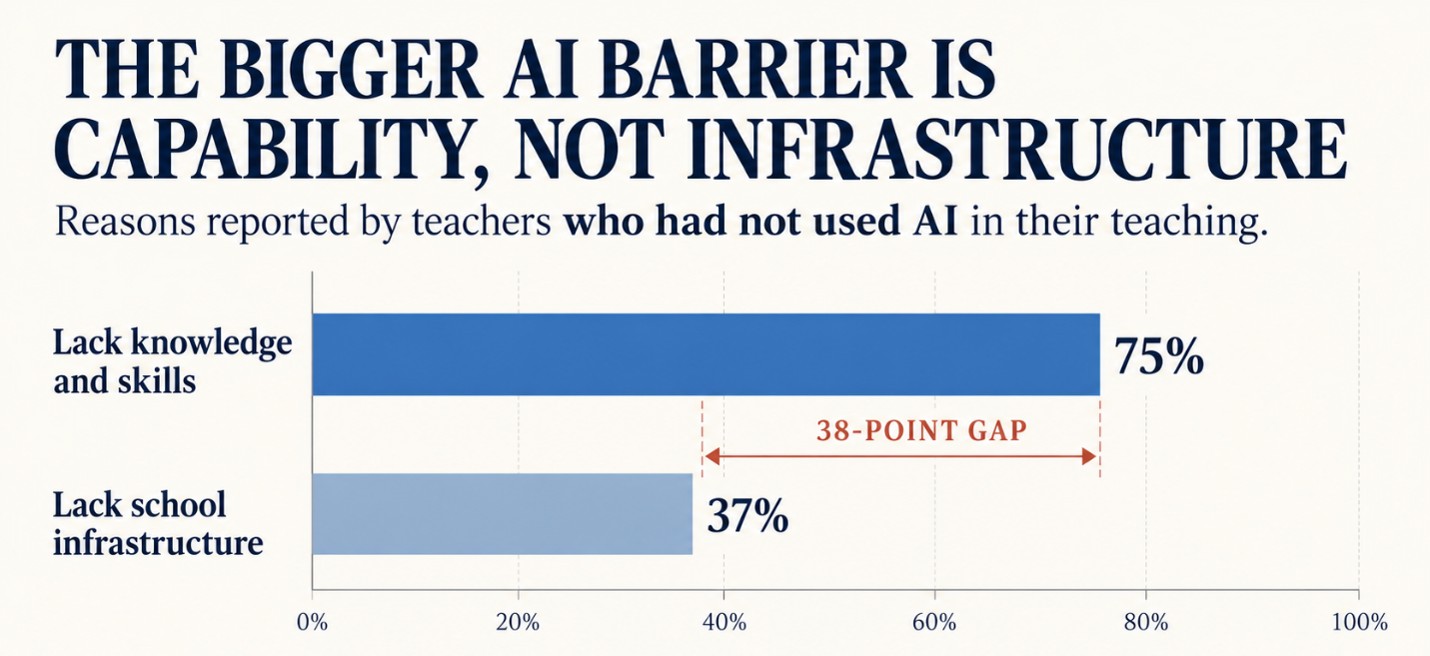
Some care is needed in reading these numbers. TALIS shows associations, not causes. The impact finding does not prove that “good” training improves lessons. It suggests that teachers who experience training as useful also tend to report better-run lessons.
Even with that caution, school leaders can draw one reasonable conclusion. Buying AI tools does not make teachers ready to use them, and running training on a fashionable topic does not show that practice has changed.
Future-Ready Means Better Judgement, Not More Tools
If tool skill were the goal, the answer would be simple: run more training sessions on more tools. But consider what AI actually changes in a teacher’s day.
AI makes producing things cheap: worksheets, questions, feedback comments, lesson plans. Judging whether those things are any good stays expensive. A generated quiz might test only recall. An AI-suggested grade might be confident and wrong. A data dashboard might show a class average that hides three quite different problems.
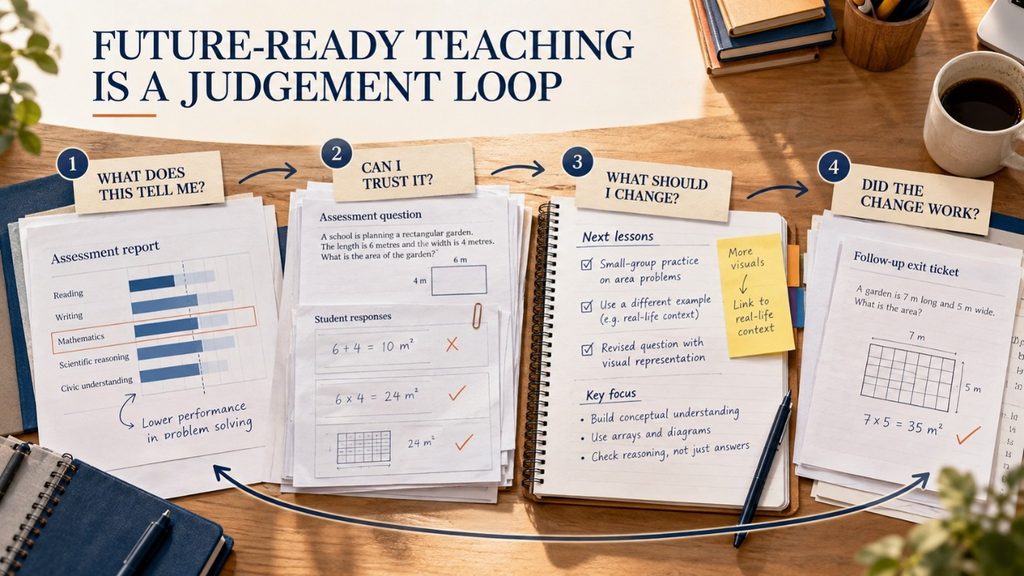
So the scarce skill is judgement. A future-ready teacher can look at an assessment result, an AI output or a new practice and ask four questions. What does this actually tell me? Can I trust it? What should I change? Did the change work?
That gives schools a sharper definition:
A future-ready teacher is one who can turn evidence into a better next lesson, and check whether it worked.
Five Competencies a Future-Ready Teaching Framework Should Name
A framework is only useful if a leader can see each competency in a real classroom. Here is a practical starting point. It builds on teaching quality indicators that work across subjects.
| Competency | What it looks like in the classroom | Evidence a leader can look for |
| 1. Evidence interpretation | Reads results at question and skill level, not only as an average | Lesson plans that name the specific skill a recent assessment showed was weak |
| 2. AI judgement | Checks AI-generated questions, feedback and grades before using them | Records of edits to AI drafts; overridden AI scores with a stated reason |
| 3. Adaptive instruction | Decides whether to reteach, practise or move on based on evidence | Different groupings or tasks after an assessment, not one plan for everyone |
| 4. Assessment literacy | Knows what a question actually measures, including its cognitive demand | Classroom checks that include application questions, not only recall |
| 5. Inquiry into own practice | Tests a change, then checks whether it made a difference | A short “what I tried and what changed” record, discussed with colleagues |
None of these competencies requires a particular product. All of them become more important as AI takes over more of the routine production work. Competency 1 is where most change starts. Teachers who can read a report closely tend to make better decisions with every tool they use. That idea is developed in assessment data literacy for teachers.
What This Means for Professional Development
If the TALIS findings hold, many schools are measuring the wrong thing. Training is often recorded by attendance: who came, how many hours, which topic. The finding on perceived impact points leaders towards a different measure: did practice change?
Here are four practical shifts:
- Plan training around a competency, not a tool. “Checking AI-generated questions for cognitive demand” builds lasting judgement. “Introduction to Tool X” goes out of date when the tool changes. This is where teacher training built on instructional design becomes relevant.
- Ask for classroom evidence six weeks later. Use the right-hand column of the table above as your follow-up checklist.
- Build growth over a whole career, not in one-off sessions. Judgement develops through practice and feedback across years, which is the case made in teacher growth pathways.
- Treat leaders as learners too. A head of department who cannot read assessment evidence well cannot coach others to do it. See trends reshaping teacher growth.
Here is a question worth asking at your next leadership meeting:
Would your professional development calendar look different if every session had to show what changed in classrooms six weeks later?
The Future Arrives One Lesson at a Time
Go back to the Year 8 teacher. Her problem was never a lack of tools. What she lacked was the habit, and the system support, to ask what last week’s quiz showed and to let that answer shape Tuesday’s lesson.
That leads to a harder question for every school:
If a teacher can generate a lesson plan in two minutes but cannot tell whether last week’s lesson worked, how future-ready is that classroom?
Future-ready schools will not be the ones with the most AI licences. They will be the ones where teachers can judge evidence, question AI output, adapt their teaching and check the result. Those are teacher competencies. They need to be named, developed and looked for in classrooms.
Frequently Asked Questions
Q: What does “future-ready” mean for teachers?
A: It means being able to turn evidence (assessment results, AI outputs and classroom observation) into better teaching decisions, and then checking whether those decisions worked. Using new tools is only one part of it.
Q: What should a future-ready teaching competencies framework include?
A: At minimum: evidence interpretation, AI judgement, adaptive instruction, assessment literacy and inquiry into one’s own practice. Each competency should come with observable classroom evidence so leaders can see whether it is developing.
Q: Is AI training the most important professional development for teachers right now?
A: It is the most requested. TALIS 2024 found that 29% of teachers across the OECD reported needing training in AI, more than for any other area. But the training works best when it focuses on judgement, such as checking AI outputs, rather than on how a specific tool works.
Q: Why do many teachers not use AI yet?
A: In TALIS 2024, most teachers who had not used AI pointed to a lack of knowledge and skills (75% on the OECD average) more often than a lack of infrastructure (37%). For most schools, this makes capability building more urgent than buying more technology.
Q: How can school leaders measure whether teachers are becoming future-ready?
A: Look for changes in practice, not attendance figures. Useful signs include lesson plans that respond to specific assessment findings, edited or overridden AI drafts with reasons given, and teachers who test a change and review whether it worked.