Most school improvement plans look strong in September. The priority is clear, the actions have dates, and the training day is booked. By February, many of those same plans are still sitting on the shared drive, mostly unchanged, while the school has moved on to the next urgent thing.
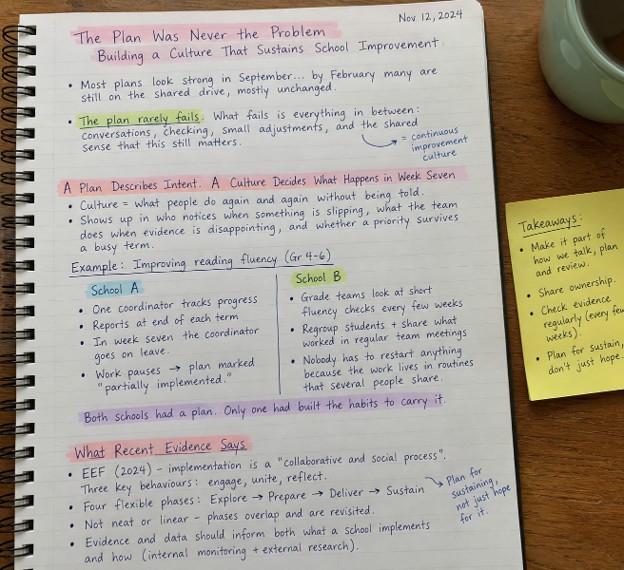
The plan is rarely what fails. What fails is everything that has to happen between the plan and an ordinary Tuesday: the conversations, the checking, the small adjustments, and the shared sense that this still matters. That everyday layer is what we mean by a continuous improvement culture in schools.
The short answer to why some schools sustain improvement is this. They make the work part of how staff routinely talk, plan and review. It is not treated as an extra project run by a few people. Schools that rely on the document alone often see their gains fade when attention, staff or leadership shifts.
A Plan Describes Intent. A Culture Decides What Happens in Week Seven
“Culture” can sound vague. In practice it is simple: culture is what people do again and again without being told. It shows up in who notices when something is slipping, what a team does when early evidence is disappointing, and whether a priority survives a busy term.
Here is a hypothetical example. Two schools choose the same priority: improving reading fluency in Grades 4 to 6. They write similar plans and attend the same training.
- In School A, one coordinator tracks progress and reports at the end of each term.
- In School B, grade teams look at short fluency checks every few weeks, regroup students, and share what worked at their regular team meeting.
In week seven, the coordinator in School A goes on leave. The work pauses, and by the end of the year the plan is marked “partially implemented.” In School B nobody has to restart anything, because the work already lives inside routines that several people share.
Both schools had a plan. Only one had built the habits to carry it.
What Recent Evidence Says About Making Change Stick
The Education Endowment Foundation’s A School’s Guide to Implementation (2024) makes a point that school leaders often underestimate. The guidance describes implementation as a “collaborative and social process” shaped by how people think, behave and interact, and it places three behaviors at the center: engage, unite and reflect.
It sets out four flexible phases: Explore, Prepare, Deliver and Sustain, with the last phase focused on maintaining efforts and deciding on next steps. The report also stresses that implementation is not neat or linear, and that phases overlap and are revisited over time. A running theme is that evidence and data should inform both what a school implements and how, including internal monitoring data as well as external research.
For school leaders, one implication stands out: sustaining improvement is a phase you plan for, not a hope you hold. A note of caution applies, though. This is practice guidance drawn from implementation research, written mainly for schools in England. It is not proof that any single approach will work in every setting.
The OECD’s Results from TALIS 2024 adds an international view of the professional relationships that culture depends on. The survey gathered responses from educators in 55 education systems. Across systems, 31% of teachers reported teaching jointly as a team. Compared with 2018, participation in collaborative professional learning rose in 23 systems and fell in seven. In 32 of 54 systems, teachers who took part in collaborative professional learning tended to report higher fulfilment of their lesson aims.
The TALIS figures need careful reading. They are self-reported and correlational. They do not show that collaboration causes better teaching, since more confident teachers may simply collaborate more. What they do show is that deep collaboration is far from universal, even though it is the kind of routine that makes improvement durable.
Plan-Driven vs Culture-Driven Improvement
| What leaders notice | Plan-driven school | Culture-driven school |
| Who owns the priority | One lead or the senior team | Shared across grade and subject teams |
| How often evidence is reviewed | End of term or end of year | Every few weeks, in normal meetings |
| When results disappoint | The plan is defended or quietly dropped | The approach is adjusted and tested again |
| When a key person leaves | Work stalls | Work continues through shared routines |
| New initiatives | Added on top of old ones | Something is paused or stopped to make room |
| Feedback | An annual event | A regular habit |
| Success is judged by | Actions completed | Changes in teaching and student learning |
Where Improvement Usually Leaks Away
In most schools, momentum leaks through a few predictable gaps.
The review stage gets skipped. Teams move from delivery straight to next year’s plan without asking what actually changed. This is the gap discussed in school improvement planning cycle.
Evidence arrives too late. If the first real check comes at the end of the year, nobody can adjust anything. Shorter evidence loops let teams change course while change is still useful.
Ownership sits with one person. A priority that depends on a single champion is fragile, no matter how capable that person is.
Nothing is ever stopped. Each new initiative takes time from the last. Teachers can usually tell which priorities are real by noticing which ones survive the next new idea.
Feedback stays an event. When feedback only happens at observation time, teaching habits rarely shift. Building a feedback-rich teaching culture is one of the most practical ways to keep improvement visible every week.
Questions Leaders Can Ask This Term
You do not need a new framework to test your school’s improvement culture. Start with honest questions:
- Could a new teacher explain our current priority and why it matters?
- How often do teams look at evidence on it: once a term, or every few weeks?
- What did we change the last time the evidence disappointed us?
- If the lead left tomorrow, who would carry the work?
- What have we stopped doing to make room for it?
If the answers are unclear, the issue may start earlier, with how the priority was chosen and written down. Two related pieces cover that: aligning academic strategy with school vision and building a school improvement plan that gets implemented.
Two questions are worth sitting with longer:
If your improvement priority would quietly disappear the term its lead left, was it ever a school priority, or just one person’s project?
When did your school last stop doing something because the evidence showed it wasn’t working?
Culture Is Built Through Small, Repeated Routines
Sustaining school improvement is less about a better document and more about a few routines that repeat. Teams look at evidence together, decide one thing to adjust, and check again. Over time, that rhythm becomes “how we do things here.”
Well-run professional learning communities are often where this rhythm takes hold. They work best when they focus on student evidence and specific teaching changes, rather than on general discussion.
The plan still matters. It gives direction. But the culture decides whether that direction is still being followed in week seven, in year two, and after the people who wrote the plan have moved on.
FAQs
Q: What is a continuous improvement culture in schools?
A: It is a set of shared, everyday habits through which staff regularly review evidence, adjust teaching and check the results again. It keeps improvement going after the initial plan’s launch energy has faded.
Q: Why do school improvement plans often fail to last?
A: The most common reasons are that the review stage is skipped, evidence comes too late to act on, one person owns the work, and new initiatives are added without anything being stopped. The plan itself is rarely the main problem.
Q: How long does it take to build a school improvement culture?
A: There is no fixed timeline. The EEF’s 2024 guidance treats implementation as phases that overlap and are revisited, so culture is built across several cycles rather than in a single term.
Q: Does teacher collaboration improve teaching quality?
A: TALIS 2024 found that in 32 of 54 education systems, teachers who took part in collaborative professional learning tended to report higher fulfilment of their lesson aims. This is self-reported and correlational, so it does not prove that collaboration causes better teaching.
Q: What is the first step for leaders who want to sustain improvement?
A: Ask whether staff can explain the current priority, how often teams review evidence on it, and what has been stopped to make room for it. The answers show where the culture needs work.