
It is early August, and a middle school leadership team is meeting to write this year’s school improvement plan. Spring state results came out in July. The team picks a reading priority, chooses three strategies, sets a goal, and assigns owners. Then someone asks a simple question: “What happened with last year’s plan?”
Nobody is quite sure. The plan sits in a shared folder that has not been opened since October. Reading scores went up a little, but no one can say which of last year’s strategies helped, which did nothing, and which ones teachers quietly stopped doing by February.
That moment shows the gap this article is about. Schools are good at starting improvement cycles and much weaker at closing them. Without review, a school improvement plan cannot teach a school anything. Each new plan ends up built on hope instead of evidence.
What the Review Stage Actually Is
Most models of the school improvement cycle follow a similar path:
- Assess needs.
- Set a priority.
- Write the plan.
- Implement it.
- Monitor progress.
- Review results.
- Begin again with what was learned.
State templates and district guidance in the US usually describe some version of this loop.
The review stage is often confused with monitoring, but they answer different questions.
- Monitoring happens during the year. It asks, “Are we doing what we said we would do?”
- Review happens at the end of a cycle. It asks, “Did what we did make a difference? What should we keep, change, or stop?”
A school can monitor faithfully all year and still skip review. When that happens, the cycle stops being a cycle. It becomes a line that restarts from zero every fall.
Why Review Gets Squeezed Out
No principal decides to skip review. It disappears because of how the school year is built.
The calendar is the first problem. State assessment results often arrive in summer, and many plans are due early in the fall. Review falls into the few weeks when leaders are hiring, scheduling, and getting buildings ready.
Compliance is the second problem. Accountability systems reward a submitted plan. Nobody files a document called “what we learned.” The new plan has a deadline. The reflection does not.
There are also human reasons. Review can feel like a verdict on people rather than on strategies. Strategies are often written without a clear measure attached, so at the end of the year there is nothing specific to check them against. And when an assistant principal or instructional coach leaves in June, much of the year’s knowledge leaves with them.
What the Federal Evidence Shows About Plan Quality
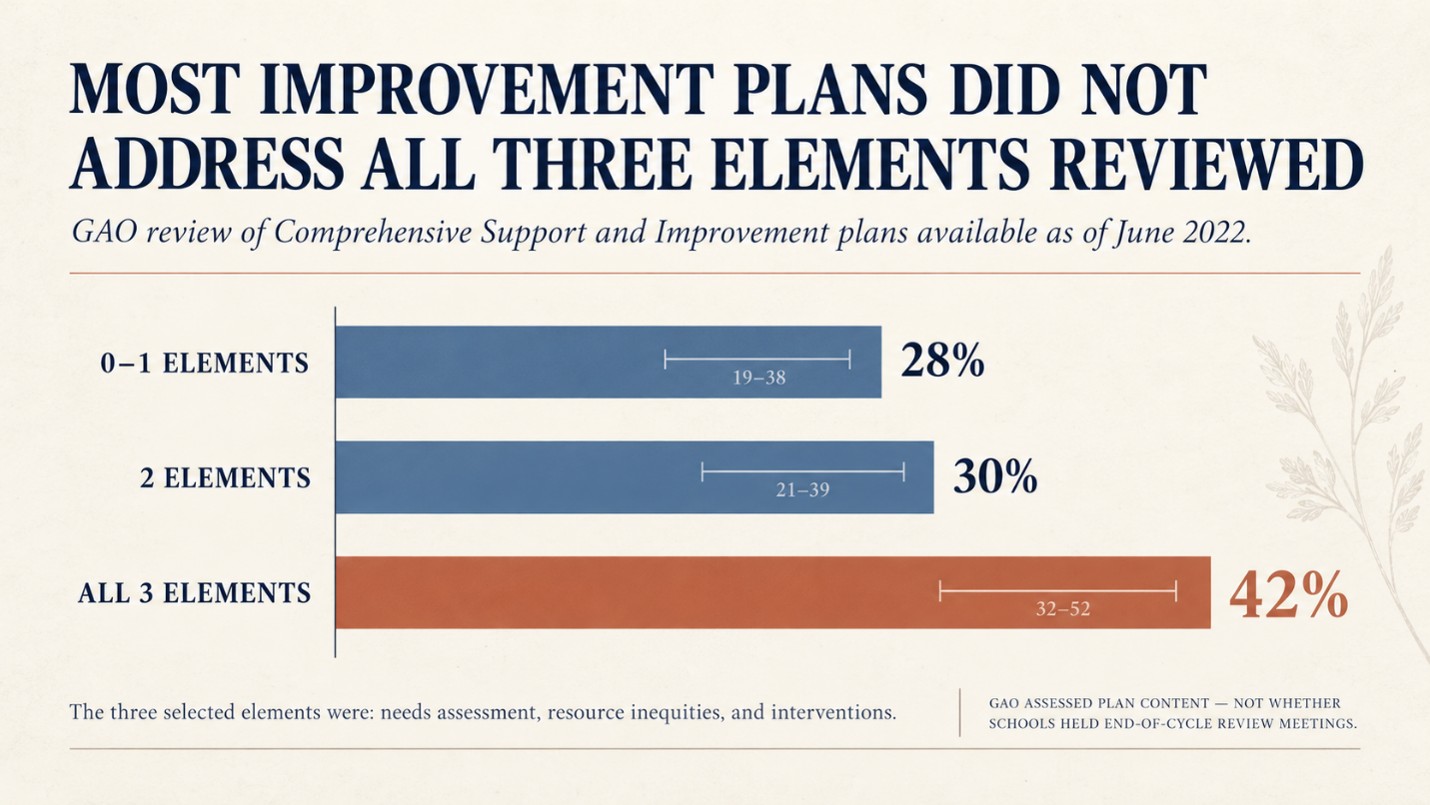
The national evidence on US improvement plans comes from the U.S. Government Accountability Office’s 2024 report, K-12 Education: Education Could Enhance Oversight of School Improvement Activities.
GAO examined a nationally representative sample of plans written for schools identified for Comprehensive Support and Improvement (CSI) under ESSA. It estimated that only 42 percent of those plans appeared to cover all three required elements it checked: a basis in a needs assessment, identification of resource inequities, and evidence-based interventions. GAO also found wide variation in how the plans approached these requirements.
The report also points to a weakness in review at the federal level. The Department of Education did not choose which CSI plans it examined during monitoring. It relied on the states and districts being monitored to pick them. GAO recommended independent selection, and by November 2024 the Department had updated its procedures to do that.
This evidence needs careful reading. GAO studied the content of plans for the lowest-performing schools. It used the recent plans available as of June 2022, and it did not independently assess legal compliance. It did not measure whether schools held review meetings, and it does not show that weak plans caused weak results. gao
Still, there is a reasonable implication for school leaders. Review depends on what was planned in the first place. A strategy with no clear needs assessment behind it cannot be reviewed honestly, because there is nothing to compare it against. And when the people being reviewed decide what gets reviewed, the review will tend to look better than reality. Districts should ask themselves the same question GAO asked the federal government:
who chooses what gets looked at?
What Skipping Review Actually Costs
Go back to the hypothetical middle school. Reading proficiency rose three points. The team keeps all three strategies and adds a fourth.
Several costs are now hidden in that decision.
Money stays on things that may not work. Tutoring blocks, programs, and consultants funded through Title I or the general budget continue because no one checked them.
Teacher energy gets spread thinner. Every year adds initiatives, and almost nothing is removed. Teachers experience this as overload, and they are right.
The three-point rise may not mean what it seems. It could reflect a different group of students rather than better teaching. This is why leaders need to look at student growth versus attainment before giving a strategy credit.
The same problem returns under a new name. Without review, a school can spend three years “focusing on reading” without learning anything new about why students struggle.
If a school writes a new plan every August without asking what last year’s plan changed, is it improving, or just planning?
Five Questions That Make a Review Worth the Time
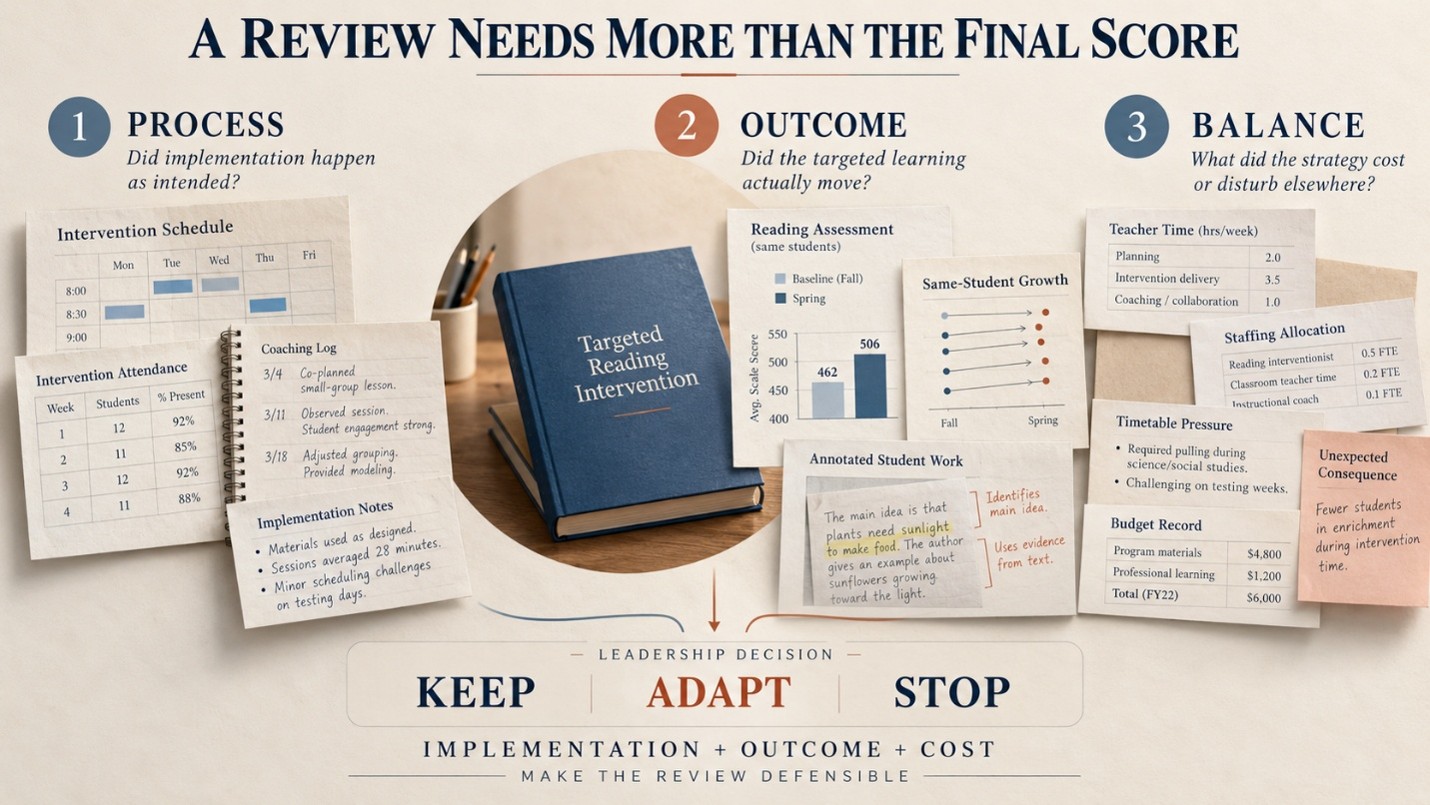
A useful review does not need a retreat or a 40-page report. It needs honest answers to a few questions.
- Did we implement what we planned? If a strategy was dropped by winter, its results tell you nothing about the strategy itself.
- Did the students we targeted actually move? Track the same students from fall through spring benchmarks. Grade-level averages alone can mislead.
- Which strategy can we reasonably connect to that movement, and which can we not? Be honest about uncertainty. “We don’t know” is a valid finding, and it should shape what gets measured next year.
- What will we stop? A review that removes nothing has probably not been a real review.
- What does this tell us about next year’s priority? This is where review feeds the next cycle. Schools that do this well move directly into using assessment evidence to choose a priority.
Two practical changes help a great deal. First, hold the review in May or early June using your own spring benchmark data, instead of waiting for state results. Second, put the review date into the plan itself when the plan is written. Review that is scheduled at the start is much harder to skip.
It also helps to decide early which KPIs show whether improvement is working. Then the review checks against measures everyone agreed on in advance. The rest of the school improvement planning process becomes easier when strategies are written with their review question already attached.
Review Is Where an Improvement Culture Is Built
Schools that improve year after year are rarely the ones with the best-written plans. They are the ones where adults regularly ask, without blame, “Did that work?” Over time, review builds the habits that a continuous improvement culture depends on.
Here is a question worth bringing to your next leadership meeting:
If no one can say which of last year’s strategies worked, on what basis is this year’s budget being spent?
The review stage is short, unglamorous, and easy to postpone. It is also the only stage that turns a year of effort into knowledge the school can use. Skip it, and the school keeps paying for the same lessons it never quite learns.
Frequently Asked Questions
What are the stages of the school improvement cycle?
Most models include assessing needs, setting a priority, writing the plan, implementing it, monitoring progress, and reviewing results. The cycle then repeats using what the review revealed. The review stage is the one most often skipped.
What is the difference between monitoring and reviewing a school improvement plan?
Monitoring happens during the year and checks whether strategies are being carried out as planned. Review happens at the end of a cycle and asks whether those strategies made a difference, and what should be kept, changed, or stopped.
When should schools review their school improvement plan?
Ideally in May or early June, using spring benchmark or interim assessment data. Waiting for state results usually pushes review into summer, when it is often lost. The review date should be set when the plan is first written.
Why do schools skip the review stage?
Common reasons include tight timelines between state results and plan deadlines, accountability systems that reward submitting a new plan, strategies written without clear measures, fear that review will feel like judgment, and staff turnover over the summer.
What should a school improvement plan review include?
It should check whether strategies were actually implemented, whether targeted students showed growth, which strategies can reasonably be linked to that growth, what the school will stop doing, and what the findings mean for next year’s priority.