Consider a hypothetical Grade 10 cohort. After six weeks of past papers, mock scores rise sharply and leadership celebrates. The next year, the Grade 11 teacher finds that many of the same students cannot use that algebra in an unfamiliar physics problem.
Did learning improve? Partly, perhaps. But the mock score and the physics problem were answering different questions.
Exam readiness asks whether a student can perform well on a particular exam format, under its timing and marking rules. Curriculum mastery asks whether the student understands the content well enough to use it in new situations. Both matter. The mistake is treating evidence of the first as proof of the second.
Two Questions, Two Kinds of Evidence
| Topic | Exam readiness | Curriculum mastery |
| Main question | Can this student perform on this exam? | Does this student understand the curriculum well enough to use it elsewhere? |
| Typical evidence | Mocks, past papers, timed practice | Varied tasks across the full curriculum, including unfamiliar contexts |
| Item design | Mirrors exam format and mark scheme | Samples all standards and higher levels of cognitive demand |
| Timing | Close to the exam | Throughout the course and at the end of units |
| Decision it supports | Exam technique, time management, final revision | Sequencing, reteaching, readiness for the next stage |
| Risk if confused | Familiarity with the format looks like understanding | Mastery is not converted into exam marks |
A school needs both columns. The problem starts when the left column is used to answer questions from the right.
What the Research Says About Test Preparation
A meta-analysis published in the Review of Educational Research in 2025 pooled 28 experimental and quasi-experimental studies with 92 effect sizes and found that test preparation raised performance on large-scale tests, with an overall effect of g = 0.26. (Hao, Baird, El Masri & Double)
The interesting findings are in the detail. Preparation focused on the tested subject (g = 0.33) and narrow drilling on test content and format (g = 0.32) both had significant effects, while broad programmes focused on general knowledge and skills showed no significant effect on the target test (g = −0.04). Teaching test-taking skills was also a significant factor. SAGE Publications
When a small number of studies checked whether the gains carried over to a different test in the same domain, the effect was small and not significant (g = 0.06). The authors warn that this finding rests on only four studies and needs more research.
The limits matter here. Most of the included studies involved college admission tests and English proficiency tests such as TOFEL, and most were conducted in the United States. These are not school unit tests. So the findings cannot tell us what happens inside a K–12 school’s own assessment system.
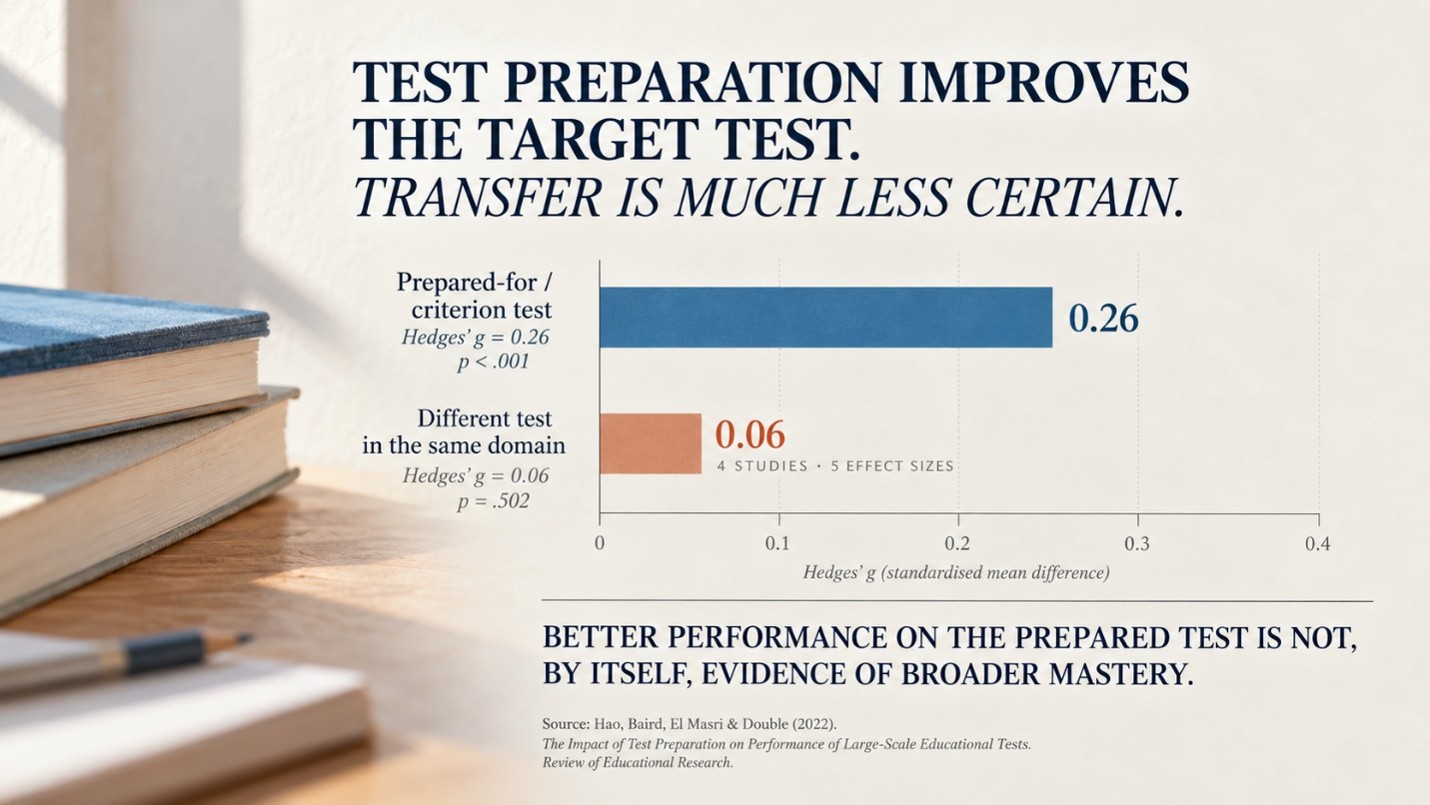
What they do suggest, for school leaders, is a caution. Targeted preparation can raise scores on the test being prepared for. A rise in mock results is therefore expected evidence of readiness. It is weak evidence, on its own, of wider mastery.
A question worth asking:
If a student’s score rises only on questions that look like last year’s paper, what exactly has improved?
Where Schools Get This Wrong
Three patterns come up often:
- Mocks are used as the main mastery evidence. Mock papers sample what the exam tends to ask, not the whole curriculum.
- Past-paper practice grows over the year. Each extra week of exam practice is a week not spent on curriculum depth. That trade-off is sometimes right near exam time, but it should be a deliberate choice.
- Reports merge the two. One grade line hides whether a student is secure in the content or simply well-rehearsed.
The fix begins with design. an assessment blueprint that matches its purpose shows how to set coverage and demand before writing items. Mastery assessments should include items at higher levels of cognitive demand and in unfamiliar contexts. Cognitive demand beyond Bloom’s verbs explains why this matters.
An Audit for Academic Leaders
- What share of assessment time in exam years goes to past papers or exam-format practice?
- Do mastery assessments cover the full curriculum, or only exam-heavy topics?
- Do any assessments test transfer to an unfamiliar context?
- Are readiness and mastery reported separately to teachers and to leadership?
- Is “mastery” defined in a way staff agree on? See mastery thresholds in a school assessment system.
At school-group level, this becomes a question for the outcomes framework itself. Is the network rewarding exam results alone, or tracking mastery as well? Learning outcomes measurement framework takes this further.
Keep Both Lines Visible
Exam readiness is a legitimate goal. Students deserve to walk into an exam knowing its format and pacing. But readiness and mastery need separate evidence, separate reporting, and separate conversations. A rise in mock scores should prompt one question before any celebration: did students learn more, or did they learn the test?
Frequently Asked Questions
What is the difference between exam readiness and curriculum mastery?
Exam readiness is the ability to perform on a specific exam format. Curriculum mastery is secure understanding of the content that can be applied beyond that format.
Does test preparation improve learning?
Recent research shows that it can raise scores on the target test. Evidence that those gains carry over to other tests is limited and inconclusive.
Should schools stop using mock exams?
No. Mocks are useful readiness evidence. They should not be the only evidence used to judge mastery.
How can schools assess mastery separately?
By using assessments designed from a curriculum blueprint that covers all standards, includes higher-demand items and uses unfamiliar contexts, and by reporting those results separately.