

Picture a hypothetical secondary school’s assessment calendar for one term: weekly quizzes, two unit tests per subject, a mid-term benchmark, mock exams, and end-of-term papers. That comes to roughly fourteen assessment events per student per subject. Now ask the head of each department a simple question: which of these changed a lesson?
The answers are usually uncomfortable. The debate about formative vs summative assessment is often framed as a question of proportion: how much time for each. A more useful question is which decision each assessment serves. Balance means every assessment on the calendar is linked to a decision someone will actually make.
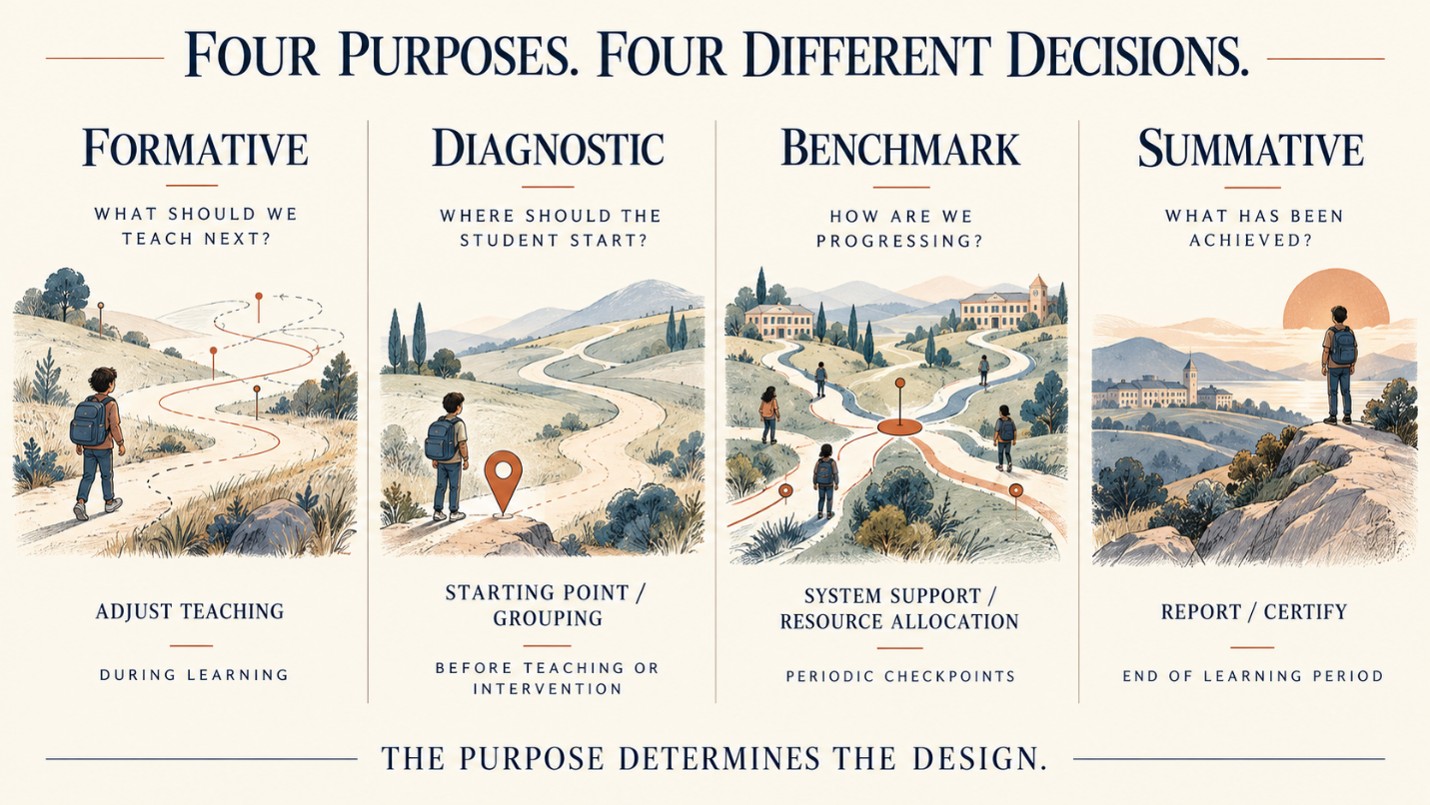
Four Purposes, Four Different Decisions
| Purpose | Main question | Typical timing | Primary user | Decision it should inform | Sign it is being misused |
| Formative | What should I teach next? | During lessons and units | Teacher and student | Adjust teaching this week | Results are recorded but teaching stays the same |
| Diagnostic | Where should this student start? | Before a unit or intervention | Teacher | Grouping and starting point | Reported only as a percentage |
| Benchmark | How are we progressing over time and across schools? | Beginning, middle and end of year | Leaders | Resource allocation and network support | Different test forms make results impossible to compare |
| Summative | What has been achieved? | End of term or year | Leaders, families, boards | Certification and reporting | Repeated so often it replaces teaching time |
For the diagnostic row, see what a diagnostic assessment should tell a teacher. For the benchmark row, see benchmark assessments across a school network.
What Research Says About Formative Assessment
A 2024 meta-analysis in Educational Research and Evaluation analysed 258 effect sizes from 118 studies and found an overall positive effect of formative assessment on K–12 achievement of g = 0.25, and 0.22 for studies conducted in the US. The effect was similar across different types of formative assessment and different subjects. (Yao, Amos, Snider & Brown)
A second study looked across the meta-analyses themselves. This umbrella review in Sustainability examined 13 meta-analyses covering K–12 students and found effects ranging from trivial to large, with no negative effects reported. (Sortwell et al) Together, those meta-analyses included 256,659 students.
The same review adds two important cautions. The certainty of the evidence was rated very low in nine meta-analyses, low in three and moderate in one, which the authors say prevents firm recommendations about which formative strategies work best.
The second caution matters most for school strategy. In one meta-analysis summarized in the review, formative assessment with planned instructional adjustment had a small, significant effect (0.35), while formative assessment with no instructional adjustment had a trivial, non-significant effect (0.16). (MDPI)
For leaders, one reasonable reading is this: the word “formative” on a calendar does not produce learning gains. What seems to matter is whether teaching actually changes in response. A weekly quiz that is marked and filed is, in practice, a small summative test. The research does not establish exactly how much adjustment is enough; that part is professional judgement.
A question worth asking:
If a school removed one assessment from its calendar tomorrow, would any teaching decision be made worse?
Balance Is a Design Question, Not a Timetable Question
A whole-school assessment strategy should start from decisions, not events. In practice, that means four steps.
Map every assessment to a decision. For each event on the calendar, name who uses the results and what they will decide. If nobody can answer, the assessment is a candidate for removal.
Remove duplicates. Two summative tests a fortnight apart often answer the same question twice. That time could protect formative practice.
Protect time to respond. Formative assessment needs planned time to adjust teaching afterwards. The research above suggests this is the part that carries the effect. Linking assessment results to intervention covers that step in detail.
Connect the evidence. When formative checks, diagnostics, benchmarks and summative tests use the same competency framework, results can be read together. A student’s weak spot in a quiz can be traced through to the end-of-year result.
What This Looks Like Across a School Group
For multi-campus networks, the balance question has an extra layer. Benchmark assessments need consistency across schools, so they tend to be centrally designed. Formative assessment needs flexibility, so it should stay close to the classroom. Groups that impose central formative tests often end up with summative tests described as formative. Groups that leave benchmarks to each campus often end up with results they cannot compare.
A sensible split is central control of benchmark and summative design, and local ownership of formative practice, with a shared competency framework linking the two. Feedback culture sits underneath all of it, as discussed in feedback-rich teaching culture.
Every Assessment Should Earn Its Place
The right balance between formative and summative assessment cannot be expressed as a ratio. It comes from asking what each assessment is for and whether anyone acts on it. Formative assessment earns its value when teaching changes. Summative assessment earns its cost when it informs a decision beyond the classroom. Everything else on the calendar should be questioned.
Frequently Asked Questions
What is the main difference between formative and summative assessment?
Formative assessment happens during learning to guide the next teaching step. Summative assessment happens at the end of a period to judge what has been achieved.
What is the right ratio of formative to summative assessment?
There is no evidence-based fixed ratio. A better approach is to link each assessment to a clear decision and remove those that lead to none.
Does formative assessment always improve learning?
Research shows mostly positive effects, but the certainty of the evidence is often low, and effects appear weaker when teaching is not adjusted in response.
Can one test be both formative and summative?
The same evidence can serve both purposes, but schools should be clear about which decision it is informing, because design and timing differ.