

Results day in many schools follows a familiar pattern. The assessment closes and a spreadsheet goes out to heads of department. A meeting agrees that “Grade 8 needs to focus on algebra.” Six weeks later, the next assessment shows much the same picture, and the same meeting happens again.
Nothing was wrong with the test. The problem sat between the result and the classroom. The school measured well and reported well, but the steps that turn a score into different teaching were skipped or left to individual goodwill.
The assessment to intervention cycle is often drawn as a neat circle. In practice, it is a chain of handoffs, and each handoff is a place where the chain can quietly break.
A Result Is Where the Work Starts
A score is an outcome. It tells you something happened, but it doesn’t tell you what to teach on Monday.
“Algebra is weak” is a topic label, not a teaching decision. A teacher cannot plan a lesson from it without knowing which skill is weak, which students are affected, and why.
The research on formative assessment is useful here. In their review, Inside the Black Box, Paul Black and Dylan Wiliam describe assessment as formative only when the evidence is actually used to adapt teaching to what students need. Wiliam’s later work describes assessment as a bridge between teaching and learning: its value lies in the decisions it helps teachers make.( Wiliam, D.)
For school leaders, the implication is direct. If an assessment changes nothing about what happens next, its information has not yet become instruction. That gap is a system design issue, not a teacher effort issue.
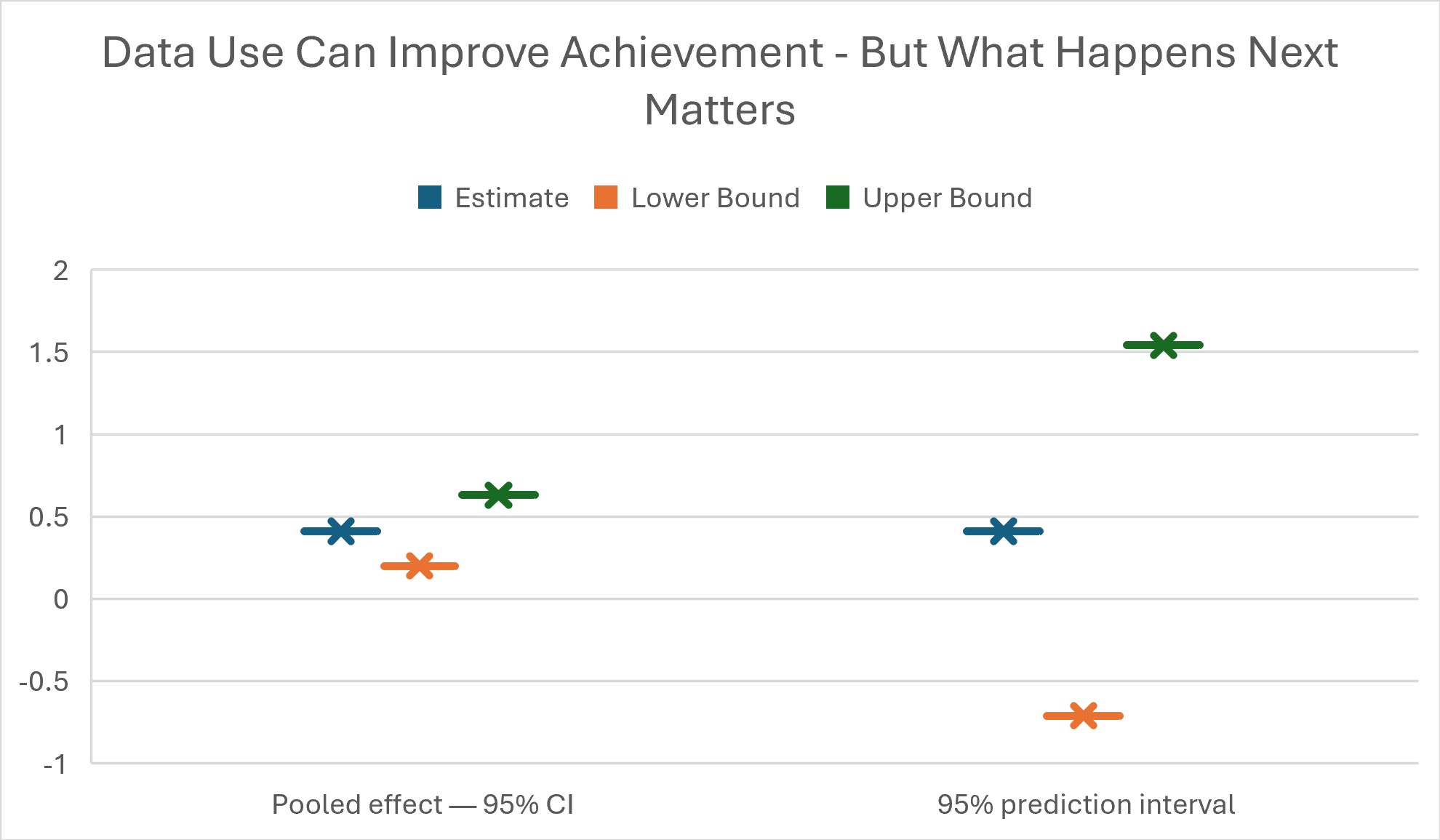
Source: Spiele et al. (2025)
Five Handoffs Between a Score and the Classroom
| Handoff | Question it answers | Typical owner | Where it usually breaks |
| 1. Check the evidence | Can we trust this result, and who does it describe? | Assessment lead | Low participation or a badly pitched paper is treated as a finding |
| 2. Diagnose | Which skill is weak, for whom, and why? | Teacher with head of department | Analysis stops at topic level (“fractions are weak”) |
| 3. Decide | Reteach, consolidate or move on? What comes first? | Teacher and department | Everything becomes a priority, so nothing is |
| 4. Deliver | Who teaches what, to which group, and when? | Teacher or intervention staff | The plan lives in meeting notes, not in the timetable |
| 5. Reassess | Did the support change the result? | Teacher and assessment lead | The next test does not include the targeted skills |
Most schools are strong at the start of this chain (setting the test) and at the reporting stage. The middle three handoffs are where improvement is won or lost.
Diagnosis Is Where Most Cycles Break
The same weak average can come from very different problems, and each one needs a different response:
- Knowledge gap. Students are weak everywhere, including on simple recall. They have not learned the content, so reteaching makes sense.
- Application gap. Students do well on recall but fall away on reasoning questions. Reteaching the content wastes time. What they need is practice applying it.
- Paper pitched too hard. Performance drops only on the hardest items. The problem may be the test, not the class, so check the paper before planning anything.
- Shared misconception. Most students chose the same wrong option. This is one idea held in common, and one focused lesson may fix it.
This is why diagnostic assessment in schools matters so much. Skill-level learning gaps analysis is what turns a topic label into something a teacher can act on.
If four different problems can produce the same weak average, how many of our current intervention groups were built on the average alone?
Deciding Means Choosing What Not to Do
Teaching time is fixed. An intervention plan that tries to fix every gap usually fixes none of them properly.
Good decisions at this stage involve ranking the gaps by severity. They also involve giving teachers explicit permission to move on from skills that are already secure. Grouping students by the specific gap they share, rather than by overall score, is usually more efficient too. Six students missing the same skill can be one session instead of six separate conversations.
A Plan Someone Can Actually Teach From
A plan is usable when it names five things: the skill, the students, the approach, the week and the person responsible. Plans owned by “the department” often don’t happen. Plans owned by a named teacher, in a named week, usually do.
This is the practical work of turning a learning-gap report into a teaching plan. It is also where workload needs attention: the plan has to fit inside real timetables, or it will be quietly dropped.
The Loop Only Closes When You Check
Many schools deliver an intervention and then run a next assessment that doesn’t test the targeted skills. The cycle never closes, because nobody can tell whether the support worked.
Reassessment should be planned at the same time as the intervention. It should include items on the skills that were targeted, and it should be comparable with the first result so the change can actually be read. The same logic applies to individual students, which is why a clear assessment retake policy belongs to the same cycle.
Questions for Leadership Teams
- After our last assessment, which specific teaching decisions changed, and who made them?
- Does our analysis reach skill level, or does it stop at topics?
- Do we check participation and paper difficulty before interpreting a result?
- Is every intervention plan linked to a named owner and a date?
- Did our next assessment test the skills we intervened on?
Better Teaching Comes From the Middle
Testing more rarely improves learning on its own. What improves learning is the quality of the handoffs between the result and the classroom: checking, diagnosing, deciding, delivering and reassessing. Schools that strengthen the middle of the cycle often find they need less assessment, not more, because every assessment they run leads somewhere.
FAQs
What is the assessment to intervention cycle?
It is the sequence that turns an assessment result into changed teaching: check the evidence, diagnose the cause, decide the response, deliver the support, and reassess to see whether it worked.
Why do schools struggle to act on assessment results?
Usually because the analysis stops at topic level, plans have no owner or date, or the next assessment doesn’t test the targeted skills. The data exists, but the handoffs are missing.
How long should an intervention run before reassessment?
There is no universal answer. It should be long enough for real teaching and practice, and short enough to check the result before the curriculum moves on.
Who should own intervention planning?
The teacher closest to the students should own the delivery. A head of department or assessment lead should own the checking: making sure plans are realistic and that reassessment happens.
Is this cycle the same as formative assessment?
They are closely linked. Formative assessment is the principle of using evidence to adapt teaching. The intervention cycle is the school-level structure that makes this happen consistently.