

Two students in the same Grade 7 class score 52% on a fractions assessment. Both are offered a retake, and both score 78% the second time.
On paper, they have made identical progress. In reality, they haven’t. The first student spent two weeks in a small group working out why 2/3 is larger than 3/5. She practised with new problems and then sat a retake built from different questions on the same skills. The second student sat the same paper again four days later and remembered most of the answers.
This example is hypothetical, but most teachers will recognise both students.
The gradebook shows the same jump for both of them, yet only one of those jumps tells you anything about learning. That is the quiet weakness in many assessment retake policies: they are designed around a second chance at a score rather than a second look at the skill.
A Retake Is a Claim That Learning Has Changed
When a school accepts a retake result, it is making a claim. The claim is that this student can now do something they could not do before. That claim is only as strong as the evidence behind it.
A useful test for any retake policy is to ask how the second result could be wrong. There are several familiar ways:
- The student remembered the items rather than learned the skill.
- The retake was easier than the first paper.
- Nothing happened between the two attempts except the passing of time.
- The retake covered only the questions the student got wrong, so it says little about whether the whole skill is secure.
None of these are problems of student honesty. They are design problems, and design problems belong to the school.
Three Things Every Retake Should Be Able to Show
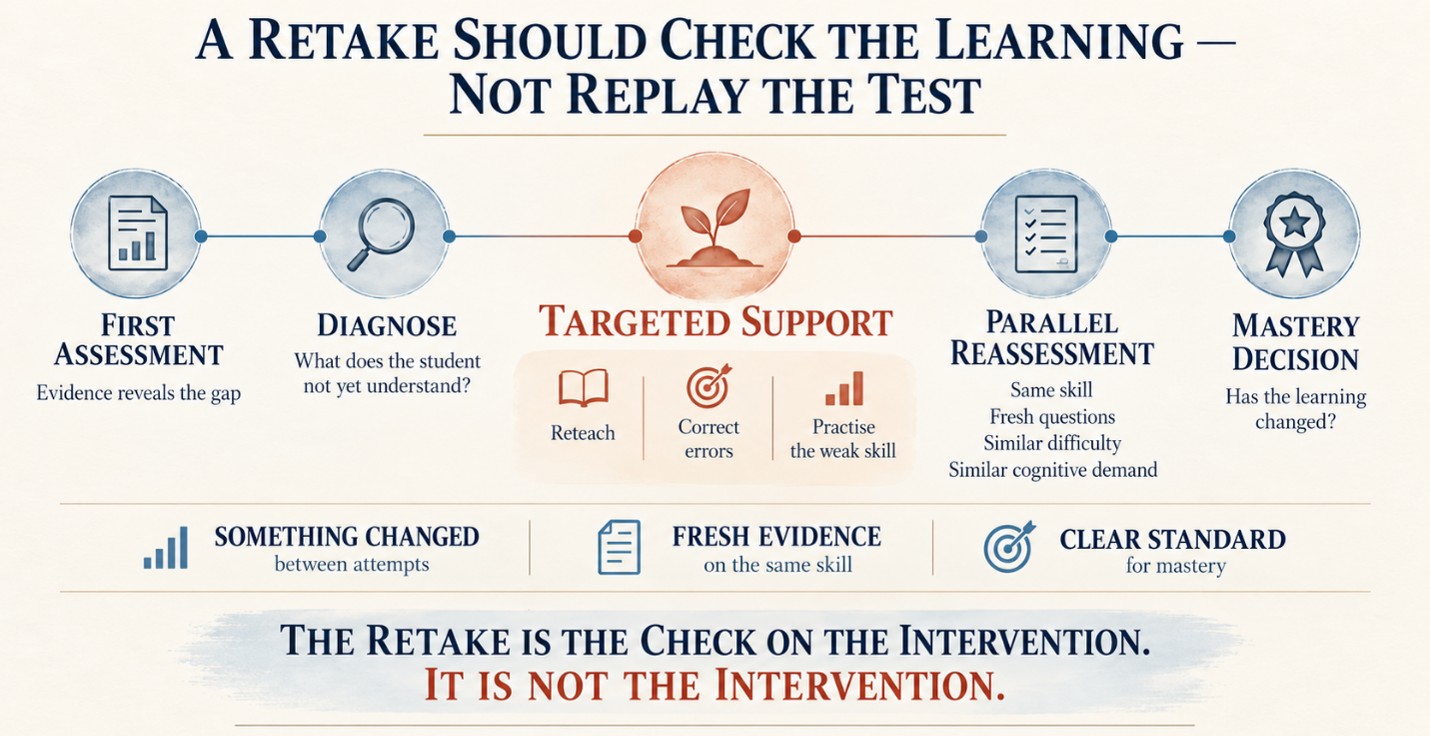
What changed between the attempts? If the honest answer is “nothing planned”, the retake is closer to a lottery ticket than an assessment. Some targeted support should sit between the two sittings, even if it is short. That support only helps if it matches the real cause of the first result. So the decision to reteach, consolidate or move on needs to come before the retake is booked.
Is the retake measuring the same skill with fresh evidence? A good retake uses different items on the same competency, at similar difficulty and similar cognitive demand. If the first paper asked students to apply a concept and the retake only asks them to recall it, the two scores are measuring different things.
What standard is the student trying to reach? Without a clear bar, retakes drift towards “better than last time”. Linking retakes to explicit student mastery thresholds gives teachers and students the same target. It also makes the decision after the retake easier to defend.
| Design choice | Weak version | Stronger version | Why it matters |
| Between attempts | Nothing, or general revision | Targeted support on the weak skills | Without support, the retake mostly measures time and memory |
| Items used | The same paper again | New items on the same skills, at similar difficulty and demand | Repeated items reward memory of the test |
| Coverage | Only the questions answered wrongly | The whole skill, including some secure areas | Shows whether the skill holds in different contexts |
| Timing | Immediately, or on request | After support, with a short gap | Separates short-term recall from learning |
| Recording | The new score overwrites the first | The new score sits beside the first | Keeps the learning history visible |
| Eligibility | Automatic, or on request alone | A teacher decision with the reason recorded | Keeps retakes purposeful and fair |
What Mastery Learning Worked Out Long Ago
Retakes are not a new idea. Benjamin Bloom’s Learning for Mastery proposed that most students could reach high standards if they got feedback and extra help at the right moments.
Thomas Guskey’s review of Bloom’s model sets out the sequence clearly:
- Teach the unit.
- Give a formative assessment.
- Provide corrective activities for students who need them, and enrichment for those who don’t.
- Give a second formative assessment on the same concepts, using different questions.
That second assessment has two jobs. It checks whether the corrective work succeeded, and it gives students a genuine chance to show improvement.
For school leaders, one implication stands out. The retake is not the intervention. It is the check on the intervention. It belongs to the same loop as any other reassessment within the intervention cycle.
This does not mean every retake needs a formal mastery-learning structure. It does mean that a retake with no corrective step in front of it is missing the part that actually does the teaching.
Replace, Average or Keep Both?
Most debates about retakes end up at the recording question. Each common option sends a different message.
Averaging tells students that early struggle counts against them permanently, even after they have learned the skill.
Replacing hides the history. A teacher reviewing the record next year sees 78% and has no idea the skill was ever shaky.
Capping the retake grade protects fairness to students who passed first time, but it can make the retake feel pointless to the student.
A more useful approach for many schools is to report the student’s current level of mastery while keeping the earlier result visible in the record. The reported grade and the learning history do not need to be the same number. Whatever the choice, it should be made deliberately by leadership, not inherited from a spreadsheet default.
If a student passes the retake but cannot answer a fresh question on the same skill a month later, what did the retake actually certify?
Not Every Retake Is About Learning
Some retakes have nothing to do with what a student knows. Illness, a technical failure or an invalidated sitting are fair-access issues. They should be handled as a separate category, decided by a person, with the reason recorded.
Mixing both kinds of retake into one category makes the data hard to read. If retake rates rise, a leader cannot tell whether first teaching is weak or sittings are being disrupted.
Questions Leaders Can Ask About Their Current Policy
- What support is required before a retake, and who plans it? Retakes work best when they are tied to intervention planning using assessment data.
- Are retake items different from the first paper, and checked for similar difficulty and demand?
- Does the retake assess the whole skill, or only the missed questions?
- Can teachers see both attempts in the record?
- Can we separate learning retakes from sitting-related retakes in our data?
The Point of a Second Attempt
A retake earns its place when it shows that learning has changed. That requires something to happen between attempts, fresh evidence on the same skill, and a clear standard to reach. Without these three conditions, a school collects a second number and learns very little from it. With them, the retake becomes one of the most honest pieces of evidence a school has.
FAQs
Should students be allowed to retake any assessment?
Not automatically. Retakes make most sense for assessments linked to specific skills, where targeted support can happen between attempts. For benchmark or network-wide tests, retakes can weaken comparability.
Should a retake use the same questions as the first attempt?
Ideally, no. Repeated items reward memory of the test. A retake should cover the same skills with different questions of similar difficulty and cognitive demand.
Should the retake score replace the original score?
That is a policy choice. Many schools find it useful to report current mastery while keeping the first result visible in the record, so the learning history is not lost.
How soon should a retake happen?
There is no universal answer. The retake should come after targeted support has had time to work, not immediately after the first attempt.
Is a retake the same as reassessment after intervention?
They overlap. A retake is individual and usually requested. Reassessment is usually planned for a whole group after an intervention. Both should check whether the support changed the learning.