

Most schools already have a teaching framework. Ask where it is and someone will find it: a PDF on the shared drive, a poster in the staffroom, a rubric stapled to the appraisal form.
Then ask when it last changed what happened in a lesson. That question usually gets a longer pause.
That pause is the real problem. Schools rarely fail to write a framework. They fail to build one that teachers use when planning, that leaders use when coaching, and that connects to whether students learned anything.
So here is the short answer to the question behind this article. A usable teaching and learning effectiveness framework is a short, shared description of good teaching in your school. It is connected to two other things: the ways you will notice that teaching, and the evidence that shows whether students learned. A framework that only describes teaching is a poster. A framework that only judges teaching is an appraisal form. A useful one helps teachers improve, and shows whether that improvement reached students.
Most Frameworks Describe Teaching. Few Connect It to Learning.
Most school frameworks were built around lesson observation. They list what a leader should see: clear objectives, good questioning, a calm classroom, differentiated tasks.
Those things matter. But observation tells you what the teacher did during twenty minutes. It does not tell you what the students understood a week later.
If a teacher can be rated “outstanding” on every observation criterion while their students’ understanding stays flat, what exactly is the framework measuring?
That question is uncomfortable, but it is the right place to start. A framework that never looks at learning evidence will drift towards rewarding performance of teaching rather than the effects of teaching.
What Evidence Says About the Building Blocks of Good Teaching
One useful recent reference point is the OECD’s 2025 report Unlocking High-Quality Teaching. It focuses on five teaching goals and 20 practices that support high-quality teaching. The five broad areas are Classroom Interaction, Cognitive Engagement, Formative Assessment and Feedback, Quality Subject Content, and Social-Emotional Support.
A few details about how the report was built matter for schools.
First, the evidence base is large but uneven. Some 500 references were considered across the teaching goals, with some duplication. An expert review was then carried out on the 20 practices to judge the strength of the best available evidence and to identify areas needing more research. Some practices are well supported. Others are still described as promising.
Second, the taxonomy does not look at what is being taught but at how it is taught. That makes it a reasonable starting point for teaching quality indicators that work across subjects and curricula.
Third, the report does not treat the practices as a checklist. It argues that teachers need multiple practices they can choose from, matched to the focus and purpose of their teaching. It also notes that some practices, such as metacognition, ensuring appropriate levels of challenge and adapting to student thinking, are seen as harder even for a master teacher.
The report also drew on qualitative insights from more than 150 schools in 40 countries to understand how these practices work in daily teaching. oecd
What this means for school leaders: the OECD structure is a good scaffold to borrow. It is not evidence that ticking all 20 practices in one lesson will raise results. The report itself supports flexible use, honest discussion of evidence strength, and extra support for the practices that are hardest to do well.
Five Layers of a Framework Teachers Will Actually Use
The table below sets out the parts a working framework needs. The first layer is the one most schools already have. The other four are where frameworks usually fall apart.
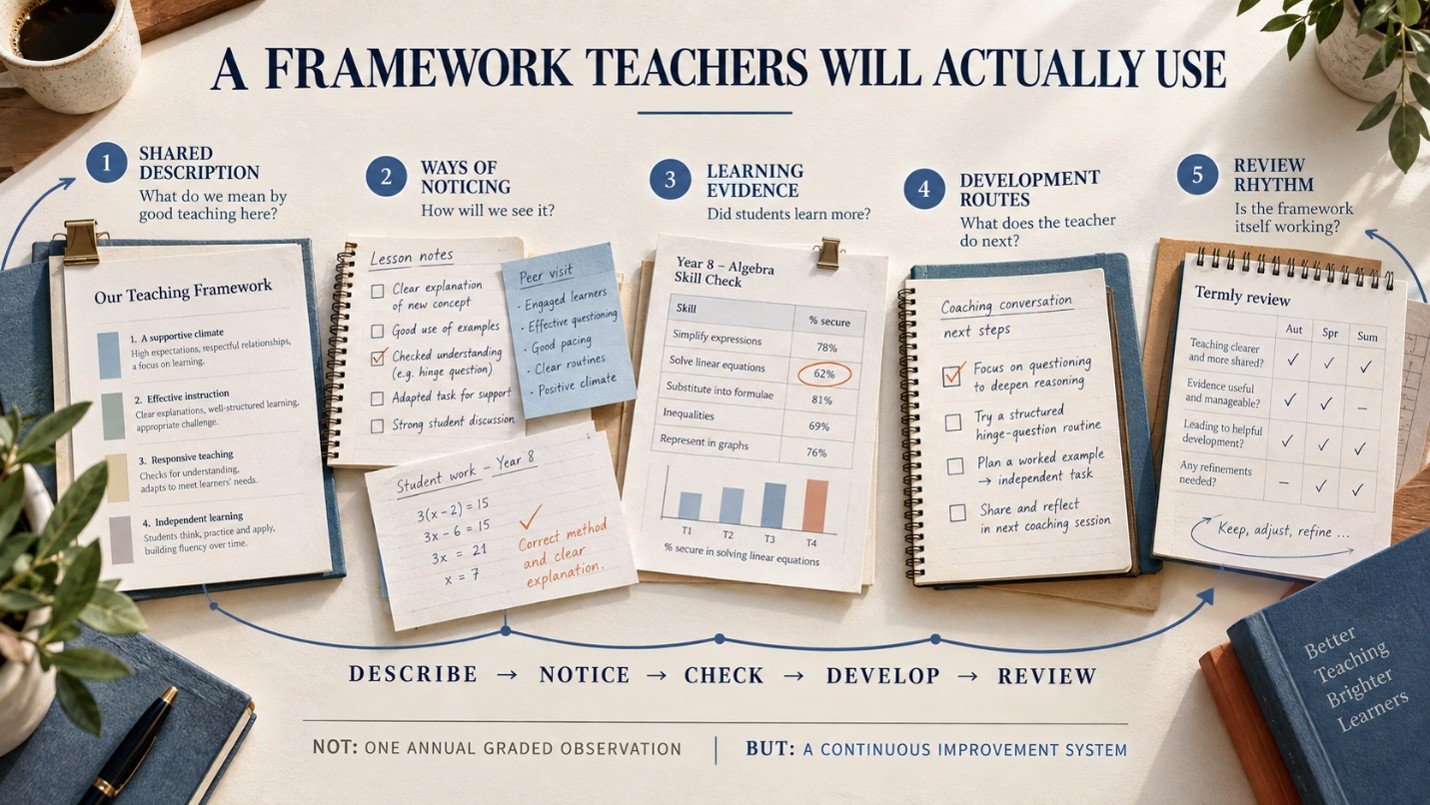
Keep the Description Short Enough to Remember
Here is a hypothetical example. A school writes a framework with 46 indicators across eight domains. It is thorough and well researched. Two years later, teachers can name about four of them. The indicators they remember are the ones that appear on the appraisal form.
A framework only works if people can carry it in their heads. That is why the descriptive layer depends so much on a common pedagogy framework across the school.
Could two of your experienced teachers watch the same lesson and describe it using the same words?
If not, the framework has not done its first job yet.
Separate the Framework From the Appraisal Form
When the same document is used both to judge teachers and to develop them, teachers learn to perform for it. Lessons get planned around the rubric rather than around the students.
The framework can still inform evaluation. It should not be identical to it. For more on this, see teacher evaluation frameworks.
Put Learning Evidence Inside the Framework, Not Next to It
This is the layer most schools skip. Assessment data usually sits in a separate system, owned by a separate team, discussed in separate meetings.
Here is another hypothetical. Two Grade 7 science classes receive similar observation feedback. Both teachers question well and manage time well. But assessment shows something different. One class performs well on recall items and poorly on items that ask students to apply ideas. The other class performs steadily across both. The observation notes alone would never have shown this.
When learning evidence sits inside the framework, a coaching conversation can start from “your students handle recall well but struggle when the question changes context” rather than “your questioning was good.” The first leads somewhere. This is also where the framework links to learning outcomes measurement framework.
One caution matters here. Assessment evidence should open a professional conversation, not replace it. Class results are affected by intake, attendance and the test itself. They are a prompt for inquiry, not a verdict on a teacher.
Questions to Ask Before You Launch or Relaunch a Framework
- Can most staff describe the framework without looking at it?
- Is it used in planning, or only in observation?
- Does any part of it look at student learning, not just teacher actions?
- Does each piece of feedback lead to a defined next step?
- When did leaders last check whether the framework itself needs to change?
If the answers are mostly no, the framework may need a rebuild more than a refresh. Moving from preference to evidence across a whole staff is a longer journey, discussed in adopting evidence-based teaching practices.
A Framework Earns Its Place in the Next Lesson
A teaching and learning effectiveness framework is not proven by how complete it looks. It is proven by whether it changes what a teacher plans tomorrow, and whether that change shows up in what students can do next term.
Describe teaching simply. Notice it often. Check it against learning. Then review the framework itself as seriously as you review the teaching it describes.
Frequently Asked Questions
What is a teaching and learning effectiveness framework?
It is a shared description of good teaching in a school, connected to how that teaching is observed and to evidence of student learning. Its purpose is to help teachers improve, not only to rate them.
What should a teaching and learning effectiveness framework include?
At minimum: a short description of good teaching, regular ways of noticing it, evidence of student learning, clear development routes for teachers, and a schedule for reviewing the framework itself.
How is it different from a teacher evaluation framework?
An evaluation framework is mainly used to judge performance. An effectiveness framework is mainly used for development and school improvement. The two can share language, but using one document for both purposes often leads teachers to perform for the rubric.
Can one framework work across all subjects and curricula?
Yes, if it describes how teaching happens rather than what is taught. The OECD’s 2025 taxonomy takes this approach. Subject departments can then add their own examples of what each practice looks like in their subject.
How many indicators should a framework have?
There is no research-based ideal number. In practice, a framework that staff can remember and use in planning will usually be far shorter than a full observation rubric. A good test is whether teachers can describe it without reading it.
How do we know if our framework is working?
Look for three signs: teachers refer to it when planning, feedback leads to specific next steps, and student learning evidence improves in the areas the framework focuses on. If only observation grades change, the framework is likely measuring performance of teaching rather than its effects.