
Picture a Grade 6 maths test in September. In one class, a handful of students get almost every question right. In another class, a handful get almost nothing right. The class averages look normal. For those two groups of students, though, the test said very little. A paper pitched at the middle of the class measures the middle best.
Now picture the Head of Assessment of a five-school group who wants to know which campus improved most in Grade 6 reading. If every student saw a different set of questions, that comparison needs more than a raw score.
These are two different decisions, and they point to two different tools.
Choose a common paper when the decision depends on comparing groups on the same evidence. Choose adaptive testing when the decision depends on an accurate estimate for each student, especially students far above or below the middle.
Most schools need both at different points in the year.
A Common Paper Answers “How Do We Compare?”
In standard assessment, every student answers the same questions in the same order. That simplicity is its strength. Results are easy to compare across classes and campuses. Teachers can discuss a specific question together. A well-built assessment blueprint design can guarantee that the paper covers the curriculum in the right balance. It also prints easily, which matters where devices are limited.
For school networks, this is why a common instrument is the foundation of benchmark assessment across school networks. When every campus sits the same paper under the same conditions, differences in results are easier to read as differences in learning.
The weakness is precision at the edges. A paper with mostly mid-level questions gives little information about a student who finds everything easy or everything impossible. Two students who both score close to zero may be one year or three years behind, and the paper cannot tell them apart.
Adaptive Testing Answers “Where Exactly Is This Student?”
A computerised adaptive test chooses each next question based on the student’s previous answers. It moves up after correct answers and down after wrong ones, until it settles on an estimate of ability. The goal is to spend each student’s time on questions that tell you something about them.
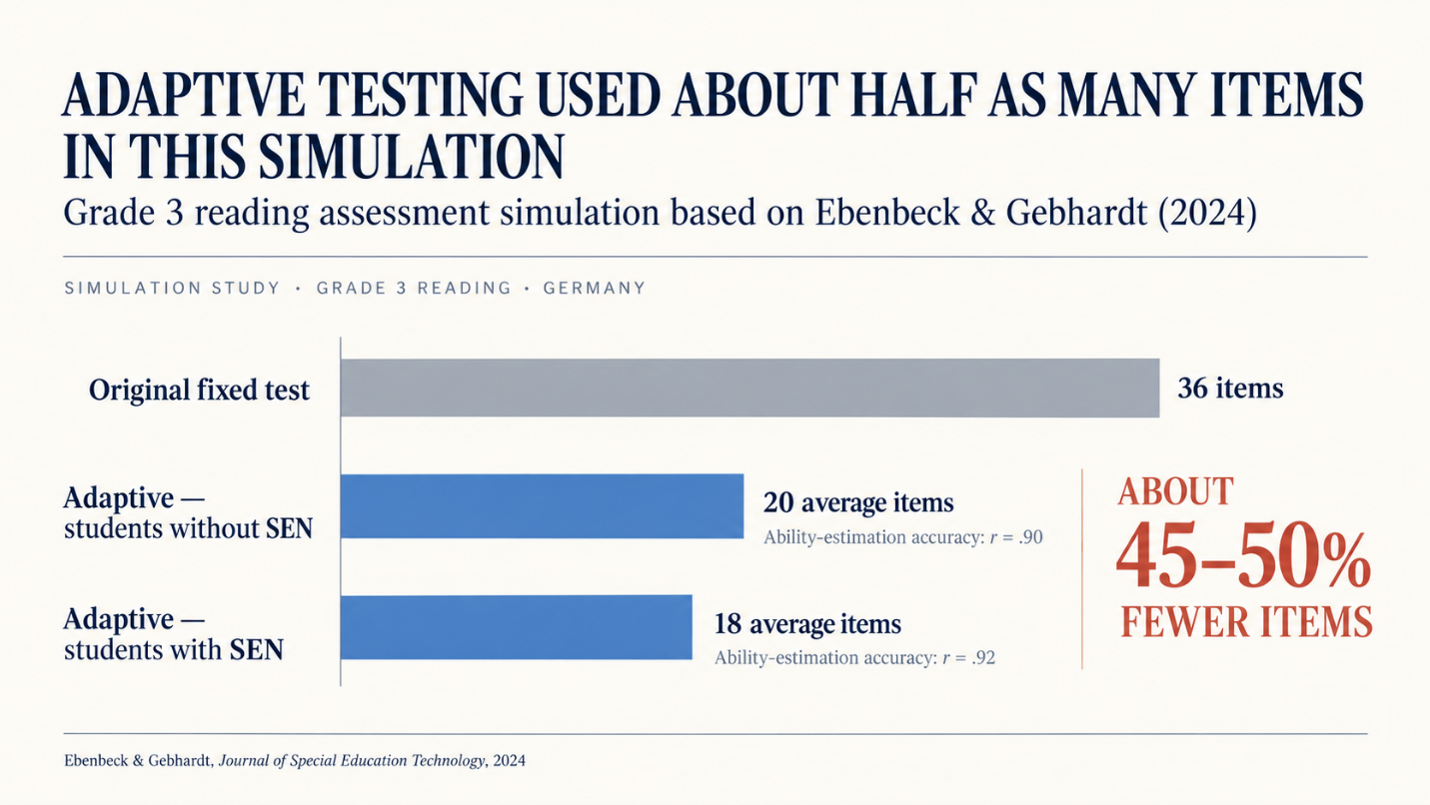
Recent research supports the efficiency argument but also shows its limits. Ebenbeck and Gebhardt ran simulations based on a reading test sat by 709 Grade 3 students in general and special schools in Germany. The adaptive versions estimated ability with high accuracy across all item pools, with correlations between true and estimated ability from .90 to .97, and the tests were on average about 45–50% shorter than the original fixed test. Students with special educational needs were measured with fewer items and similar or better accuracy than their peers, but accuracy fell and test length rose for students whose ability was more than two standard deviations from the norm. Sage Journals
Two points matter for school leaders. First, this was a simulation, and the authors note that real classrooms add factors such as motivation and engagement that simulations do not capture. Second, the study found that having enough easier items in the pool mattered more for measuring weaker students than simply having a larger pool. An adaptive test is only as precise as the questions it has available at each level. “Adaptive” on a product description does not guarantee precision for your weakest readers.
Adaptive results also need a stable reporting scale. Because students answer different questions, a percentage correct means little. This is where scaled scores versus percentage scores becomes essential reading.
Match the Mode to the Decision
Mode and purpose are different questions. Formative, summative, diagnostic and benchmark describe what you want an assessment to do. Standard and adaptive describe how it is built and delivered. A common paper can be formative, and an adaptive test is often used diagnostically. Keeping the two questions apart helps leaders choose well.
When the decision is to compare campuses or classes on the same content, a common paper is the better fit, because every student meets the same items under the same conditions. The same applies when a teacher wants to check coverage of a unit just taught: the blueprint controls exactly what is tested, so gaps in the results point back to gaps in learning rather than gaps in the paper. A common paper is also easier to use in class discussion, since everyone saw the same question and can talk through it together. For board or regulatory reporting, schools usually prefer a common paper too, because it is simpler to explain and audit.
Adaptive testing is the better fit when the decision is about the individual student. Placing a new student or finding a starting point at the beginning of the year calls for a precise estimate in a short time, which is where adaptive testing is strongest. It is also the stronger choice for measuring growth across the full ability range. Because the test moves up and down with the student, it reduces the floor and ceiling effects that make a fixed paper blind to students far above or below the middle. That advantage only holds when results are reported on a calibrated scale, so that students who answered different questions can still be placed on the same measure.
Questions Leaders Should Ask Before Choosing
Start with the decision, not the tool. Who needs to be measured well: everyone, or mainly the middle? If you are buying adaptive testing, ask how many items the bank holds at the extremes, and what rule decides when the test stops. Ask whether teachers will still see which questions students got wrong, because item-level review is harder when every student saw a different test. If some campuses will sit on paper, read comparing paper and online results fairly before combining results.
If your September test cannot tell apart a student who is two years behind from one who is three years behind, whose learning is it really measuring?
One reasonable pattern for a school year is an adaptive assessment at the start of the year for placement and diagnosis, common short papers after units, and a common benchmark across campuses at mid-year and end of year. It is not the only pattern, but it ties each mode to the decision it serves best.
Is your school choosing a test mode because of the decision it needs to make, or because of the test it used last year?
The Choice Is Not Either/Or
A common paper protects comparability. Adaptive testing protects precision for the individual. Problems start when a school uses one to answer the other’s question: ranking campuses on tests nobody sat in common, or diagnosing weak readers with a paper that was never pitched low enough to see them.
FAQs
Q: Is adaptive testing more accurate than a standard test?
A: For estimating an individual student’s ability, it often is, especially for students far from the average. The precision depends on the item bank and the stopping rules, and more precise measurement does not by itself improve learning.
Q: Can adaptive test results be compared across schools?
A: Yes, if results are reported on a calibrated common scale. Raw percentages from adaptive tests cannot be compared, because students answered different questions.
Q: Do adaptive tests work for students with special educational needs?
A: A 2024 German simulation study found that students with SEN were measured with fewer items and good accuracy, although accuracy dropped for students with very low ability relative to the norm. The findings came from simulations, not live classroom testing. Sage Journals
Q: Should a school use only one mode?
A: Rarely. Most schools benefit from common papers for comparison and coverage, and adaptive testing for placement, diagnosis and measuring growth at the extremes.