What Teachers Need to See Before Trusting an AI-Assisted Score
A Grade 9 English teacher gets 120 essays scored overnight. The class average matches her instinct almost exactly. Then she opens one script. The AI has given a 3 to an essay she would give a 5. The student took an unusual structure and argued it well.
Which result should she trust, the average or the essay?
Accuracy on average is not the same as accuracy for a student. Grades are given to individuals, so trust in AI-assisted grading has to be earned at the level where the decision is made: the single script, marked for the single student.
Close on Average, Less Close for Each Student
The research so far supports that distinction. Tate and colleagues compared ChatGPT’s scores on secondary school essays from three existing collections against high-quality human ratings. They found no statistically significant difference in mean scores between human and AI scoring. However, agreement between two human scorers was substantial, while agreement between AI and humans was only moderate to fair. The authors concluded that this level of agreement may be enough for low-stakes, formative use, and that more research will be needed as the models change. ScienceDirectdoaj
A smaller 2025 study points the same way. Researchers compared GPT-4 with three experienced teachers scoring 60 middle school essays. Overall agreement was high (ICC = 0.84) and strongest for high-level essays, but the AI scored creativity lower than the human raters (76.5 against 82.3). The authors suggested a split: AI for standardised scoring, humans for creative judgement. With only 60 essays, this is a useful signal, not a settled finding. Taylor & Francis Online
For school leaders, one implication stands out. A department-level report can look perfectly sensible while individual students receive scores a trained teacher would not give. The scripts most at risk are often the unusual ones, which are exactly the ones where a wrong grade hurts most.
What a Teacher Should Be Able to See
Before a school relies on an AI-assisted score, teachers need visibility, not just a number.
| What the teacher needs to see | Why it matters | Warning sign if missing |
| The reasoning behind each score, tied to the rubric | The teacher can check the logic, not just the result | A score with no explanation |
| The criteria used, including grade level and task demand | Confirms the AI marked the task that was set | A generic rubric for every task |
| A way to override, with the reason recorded | Keeps the final judgement with the teacher and creates an audit trail | No override, or overrides that are not logged |
| Agreement with human markers on your own tasks, per student | Average agreement hides individual error | Only population-level accuracy figures |
| Flags for unusual or low-confidence responses | Directs human time to the scripts that need it | Every score presented as equally certain |
| A clear stakes policy | Stops draft-level scores reaching reports | AI scores flow straight into grades |
The same principle applies to integrity alerts. A flag is a prompt for review, not a verdict. This is why assessment integrity flags that need human review matters alongside grading.
Match Human Review to the Stakes
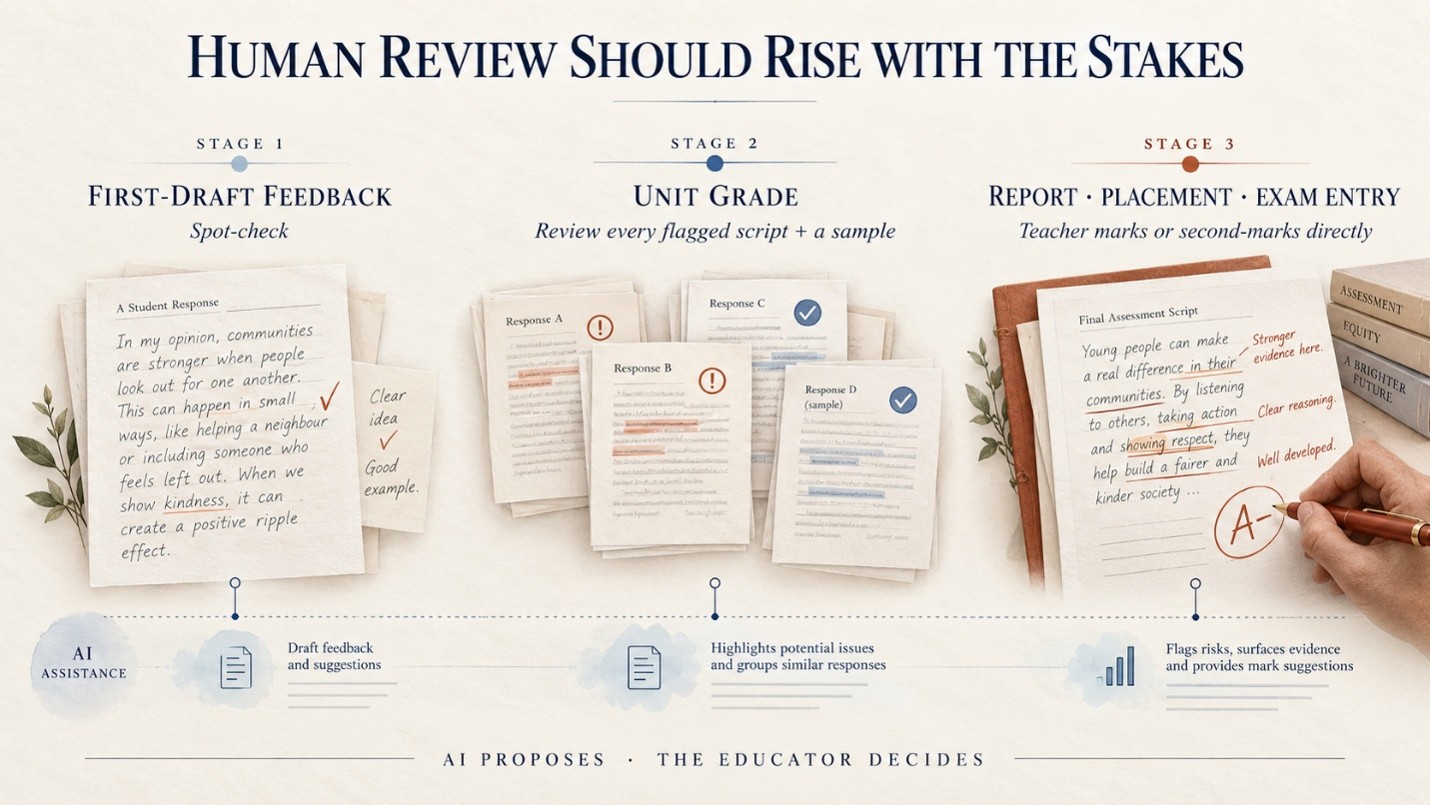
Not every score needs the same scrutiny. For first-draft feedback, a teacher might spot-check a sample. For unit grades, the teacher should review every flagged script plus a sample. For anything that goes on a report, affects placement or decides exam entry, a teacher should mark or second-mark the work directly.
The attraction of AI grading is real: marking is one of the heaviest workloads in teaching. But the honest workload question includes review time. Streamlining assessment tasks without weakening judgement looks at where time can safely be saved.
If a tool saves a teacher five hours of marking but she can no longer explain a student’s grade to that student, what has the school actually gained?
What Leaders Should Put in Place
Three habits make AI-assisted grading safer.
First, run a moderation sample every assessment cycle. Teachers mark a set of scripts blind, and the school compares those marks with the AI’s marks, looking at exact agreement per student, not just averages. Because the underlying models change, one good check at the start of the year is not enough.
Second, govern what goes into the system. If AI also helps create questions or rubrics, the same review discipline applies; see governance of the school item bank.
Third, decide accountability in writing. The teacher who signs off a grade owns it. The AI proposes and the teacher decides.
Who is accountable for a grade: the teacher who approved it, or the model that suggested it?
When schools are evaluating an assessment platform, these questions belong on the checklist from day one.
Trust Is Built Script by Script
AI-assisted grading can take real weight off teachers, and the evidence suggests it is already close to human scoring in aggregate. But aggregate closeness is the easy part. Trust comes when a teacher can see why a score was given, disagree with it, and know her decision is the one that counts.
FAQs
Q: Is AI essay grading accurate enough for schools?
A: Current evidence suggests AI scores can match human scores on average, while agreement on individual essays is lower than agreement between trained human raters. That makes AI scoring more suitable for low-stakes feedback than for final grades. ScienceDirect
Q: Should AI-assisted scores go straight onto report cards?
A: No. High-stakes grades should be reviewed or second-marked by a teacher, who remains accountable for the final grade.
Q: How can a school check an AI grader on its own tasks?
A: Have teachers blind-mark a sample of scripts, then compare their marks with the AI’s marks script by script. Repeat this each cycle, because models are updated.
Q: Where is AI grading weakest?
A: In one 2025 study, GPT-4 scored creativity lower than experienced teachers did, which suggests unconventional writing deserves the closest human attention. Taylor & Francis Online