

A Grade 7 maths team gets back a unit test on percentages, and the class average is 54%. Within ten minutes the department agrees on a plan: reteach percentages next week. A week later, a short quiz comes back with almost the same result.
Someone then looks at the item-level results. Most students answered the direct questions correctly (“find 15% of 240”). Where they failed was on the questions that never said “percentage” at all: a discount applied twice, or a comparison of two phone contracts. The students knew the content. What they could not do was recognize when to use it. The reteaching gave them what they already had.
The short answer to this article’s question is simple. Reteaching content is the right response only when students have not learned the content. You can usually see this because they are weak even on simple recall items. When students do well on recall and routine questions but fall away on questions that ask them to choose, apply or reason, the gap is in application. That gap needs structured practice in using the knowledge, not another explanation of it.
A Low Score Is a Result, Not Yet a Diagnosis
A score tells you that something went wrong. It does not tell you what went wrong. Two students can both score 50% for completely different reasons, and a class average hides even more than an individual score does.
It helps to be precise about the two terms:
- A knowledge gap means the student has not learned the facts, concepts or procedures. They cannot answer even the simplest question on the topic.
- An application gap means the student has the knowledge but cannot yet use it independently, in an unfamiliar context or when the question does not signal which method to use.
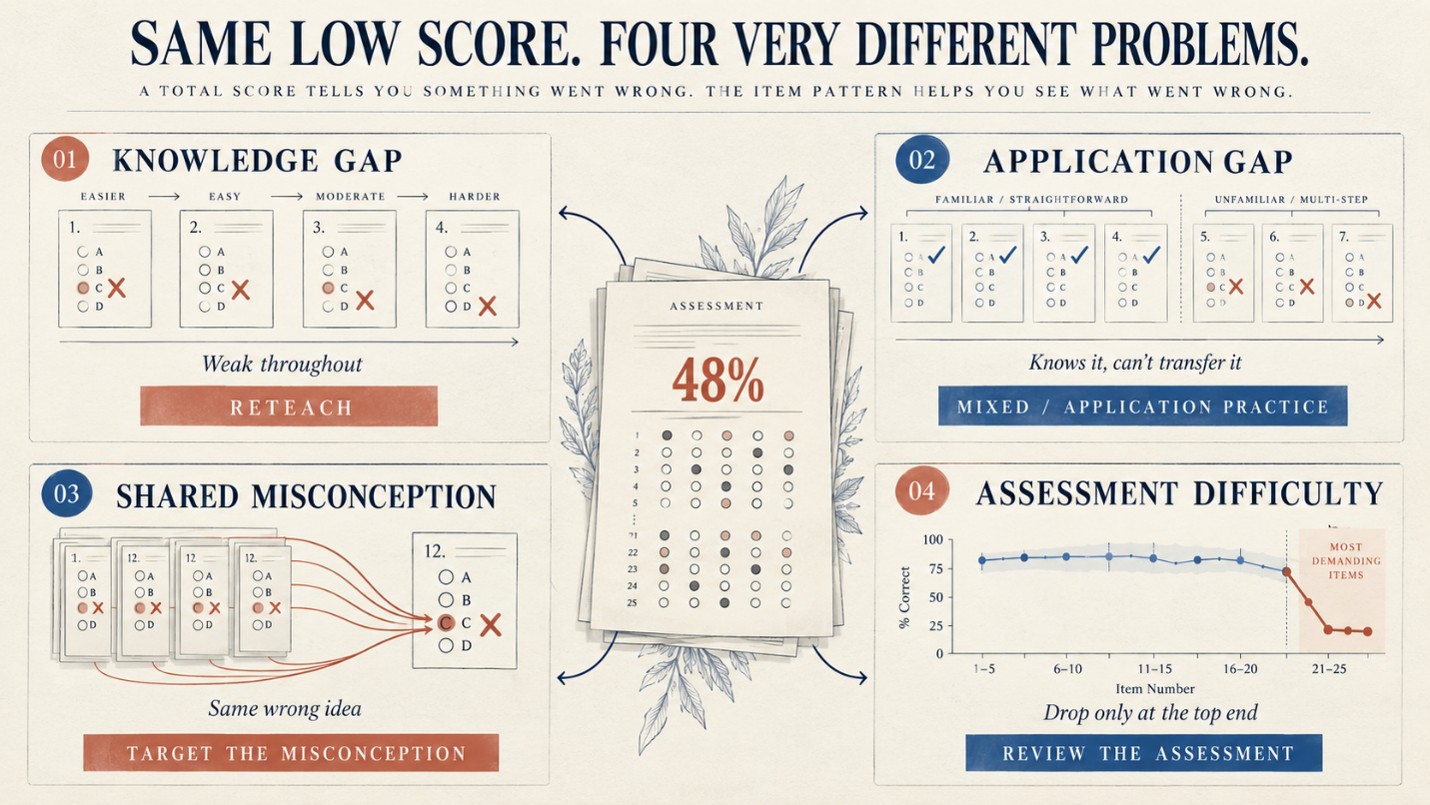
There are also two other causes that produce a low score that looks similar. One is a shared misconception, where many students hold the same wrong idea. The other is a paper pitched too hard. Telling these four apart is the core of a good learning gaps analysis, and it should happen before anyone books a reteaching week.
How Knowledge Gaps and Application Gaps Show Up Differently
The evidence usually sits in the item-level pattern rather than the total score.
| Likely cause | What the item pattern looks like | What it usually means | Better response | Common wrong response |
| Knowledge gap | Weak across all items, including simple recall | The content has not been learned | Reteach the content and check prerequisites | Extra problem-solving practice students cannot start |
| Application gap | Strong on recall and routine items; falls on multi-step, unfamiliar or “choose the method” items | Students know it but cannot yet use it | Mixed practice, faded worked examples, and asking students to explain their choice of method | Reteaching the content from the beginning |
| Shared misconception | Most students chose the same wrong answer | One wrong idea is held in common | One focused lesson that targets that idea | Weeks of general intervention |
| Assessment difficulty | Scores drop only on the hardest items | The paper may be the problem, not the class | Review the blueprint and item quality first | Whole-class intervention |
To read this pattern, the assessment must contain questions at more than one level of cognitive demand. That is why Depth of Knowledge levels matter so much here. If every item is recall, an application gap is invisible.
What Research Suggests About Knowing vs Using
A useful piece of evidence comes from research on how students practice. In a cluster randomized controlled trial in the United States, 787 students from 54 Grade 7 maths classes, taught by 14 teachers at 5 schools in a single school district, took part. Over 4 months, classes did either interleaved or blocked assignments. One month later, students took an unannounced test, and the interleaved group outscored the blocked group, 61% versus 38% (d = 0.83).
The study can be read in the context of this article. In blocked practice, every question on the worksheet uses the same method, so the worksheet heading has already told the student what to do. Interleaved practice mixes problem types, so the student must decide which method fits. That decision is exactly the step that fails in an application gap.
This finding has limits. The study tested a practice format, not reteaching versus practice. It was carried out in one district, in maths, at one grade level, and the authors themselves noted that important caveats remain. For school leaders, a careful implication is this: if a class struggles on mixed or unfamiliar items, re-delivering the content in neat, single-topic blocks may repeat the conditions that hid the problem in the first place. ed
The same tension appears at system level. Across OECD countries in PISA, an average of 69% of 15-year-olds reached at least Level 2 in mathematics. At this level, students can interpret and recognize, without direct instructions, how a simple situation can be represented mathematically. So roughly three in ten students did not reach this baseline. PISA does not separate knowledge gaps from application gaps, and many of these students may lack both. Still, the benchmark itself is about using maths without being told how, and that is a skill reteaching alone rarely builds. oecd
Why Reteaching an Application Gap Costs Twice
The first cost is time. A reteaching week spent on content students already hold is a week taken from somewhere else in the curriculum.
The second cost is quieter. When students who already understand the content hear the same explanation again, they get a message that the problem is their understanding. It isn’t. They leave the week with the same gap they arrived with, and the next test confirms everyone’s belief that the topic is “hard”.
If a student can carry out every step correctly when told which step to use, have they learned the content, or only learned to follow the instructions?
Five Questions to Ask Before Planning Any Reteaching
Heads of Department can use these questions as a short checkpoint before an intervention plan is agreed:
- Did students fail at every level, or only at higher demand? Flat weakness points to knowledge. A drop at higher demand points to application.
- Did most students choose the same wrong answer? If so, plan one lesson on that idea rather than a unit of reteaching.
- Was the paper fair? If scores fall only on the hardest items, check the assessment blueprint before blaming the class.
- Who exactly is affected? A class average can hide one group with a knowledge gap and another with an application gap. These two groups need different sessions.
- How will we know it worked? The reassessment should include mixed and unfamiliar items, not only the question types students just practiced.
These questions connect directly to the wider decision about whether to reteach, consolidate or move on.
What This Means for School and Group Leaders
At leadership level, the issue is rarely one teacher’s choice. It is a habit built into the system. Many intervention templates have only one column, “reteach”, and assessments that are mostly recall cannot show anything different.
Three checks are worth making across a school or network:
- Do our common assessments include items at several levels of demand, so that application gaps can be seen at all?
- Do our reports show accuracy by cognitive demand, or only by topic?
- When we review intervention plans, do they name the type of gap, or just the topic?
If our assessments only ask students to recall, how would we ever know whether they can use what they learned?
Getting this right also helps teachers manage workload. Matching the response to the actual gap is central to targeted support for closing learning gaps: less repetition, and more time for the students who genuinely need the content again.
The Right Response Starts With the Right Question
A low score is a starting point. Before asking “what should we reteach?”, ask “what kind of problem is this?” Sometimes the answer really is that the content was never learned, and reteaching is exactly right. Often, though, students know more than their score suggests and simply cannot use it yet. Treating those two situations differently is one of the simplest ways a school can get more learning out of the same teaching time.
Frequently Asked Questions
Q: What is the difference between a knowledge gap and an application gap?
A: A knowledge gap means a student has not learned the content and struggles even with simple recall questions. An application gap means the student knows the content but cannot yet use it independently, in unfamiliar situations, or when the question does not say which method to use.
Q: How can teachers tell whether a low score is a knowledge gap or an application gap?
A: Look at item-level results by cognitive demand. If students are weak on every item, including recall, it is likely a knowledge gap. If they do well on recall and routine items but fall away on multi-step or unfamiliar questions, it is likely an application gap.
Q: When is reteaching the right response to a low score?
A: Reteaching is right when the evidence shows the content was not learned, for example when students fail basic recall items or lack prerequisite knowledge. It is usually the wrong first response when students handle recall items well but struggle to apply them.
Q: What should teachers do instead of reteaching for an application gap?
A: They should give structured practice in using the knowledge. This includes mixed problem sets where students must choose the method, worked examples that are gradually removed, and asking students to explain why a method fits. Classroom research on interleaved maths practice supports mixing problem types, although that evidence comes mainly from maths.
Q: Can one assessment separate knowledge gaps from application gaps?
A: Yes, but only if it is designed for that purpose. The assessment needs items at several levels of cognitive demand on the same skill. A test made only of recall questions cannot reveal an application gap.
Q: Why should school leaders care about this distinction?
A: Intervention time is limited. If schools default to reteaching, they can spend weeks on content students already know while the real problem stays unsolved. Reporting by cognitive demand helps leaders check that intervention plans match the actual cause.