
A Grade 6 mathematics team receives its end-of-unit results. The class average on fractions is 52%. By the next morning, the plan is set: two weeks of fractions revision, starting again from equivalent fractions.
It feels responsible. For most of the class, it may also be the wrong plan.
Take a hypothetical example. Three students each scored 52%. Aisha cannot reliably find equivalent fractions. John calculates with fractions accurately but loses almost every mark on the word problems. Leena answered the first two sections well and left the final section blank. All three have the same score, but each has a different problem. Reteaching equivalent fractions helps only one of them.
That is the core idea behind good learning gaps analysis.
A weak result tells you where to look. It does not tell you what is wrong.
A Score Points to a Location, Not a Cause
Learning gaps analysis is the process of tracing a low result back to the specific skill that is missing, and to the reason it is missing, before deciding what to do about it. It has two jobs:
- Narrowing: where exactly is the problem?
- Explaining: why is it there?
Many schools do part of the first job and skip the second.
“Fractions are weak” is a topic label, but teachers plan lessons at a finer level than that. They need something like “comparing fractions with unlike denominators” or “choosing the right operation in a two-step word problem.” Until a gap is named at that level, any plan built on it can only be generic.
Narrowing the Problem: From Subject to a Single Response
Narrowing works only if the assessment was built for it. Each question needs to be linked to the skill it actually tests. If a test was not designed this way, no report can recover that detail afterwards. This is why diagnostic assessment for teachers has to be planned before the test is written, not after the results arrive.
A practical check for assessment leads is to ask how many questions provide evidence for each skill. A skill judged on a single question is closer to a guess than a finding. Reports become useful at this level only when the underlying items support them, which is the main argument behind making competency-level reports something teachers can act on.
Explaining the Gap: Five Causes That Look the Same on a Report
Once you know where the problem is, the harder question is why. Several very different causes can produce the same weak result.
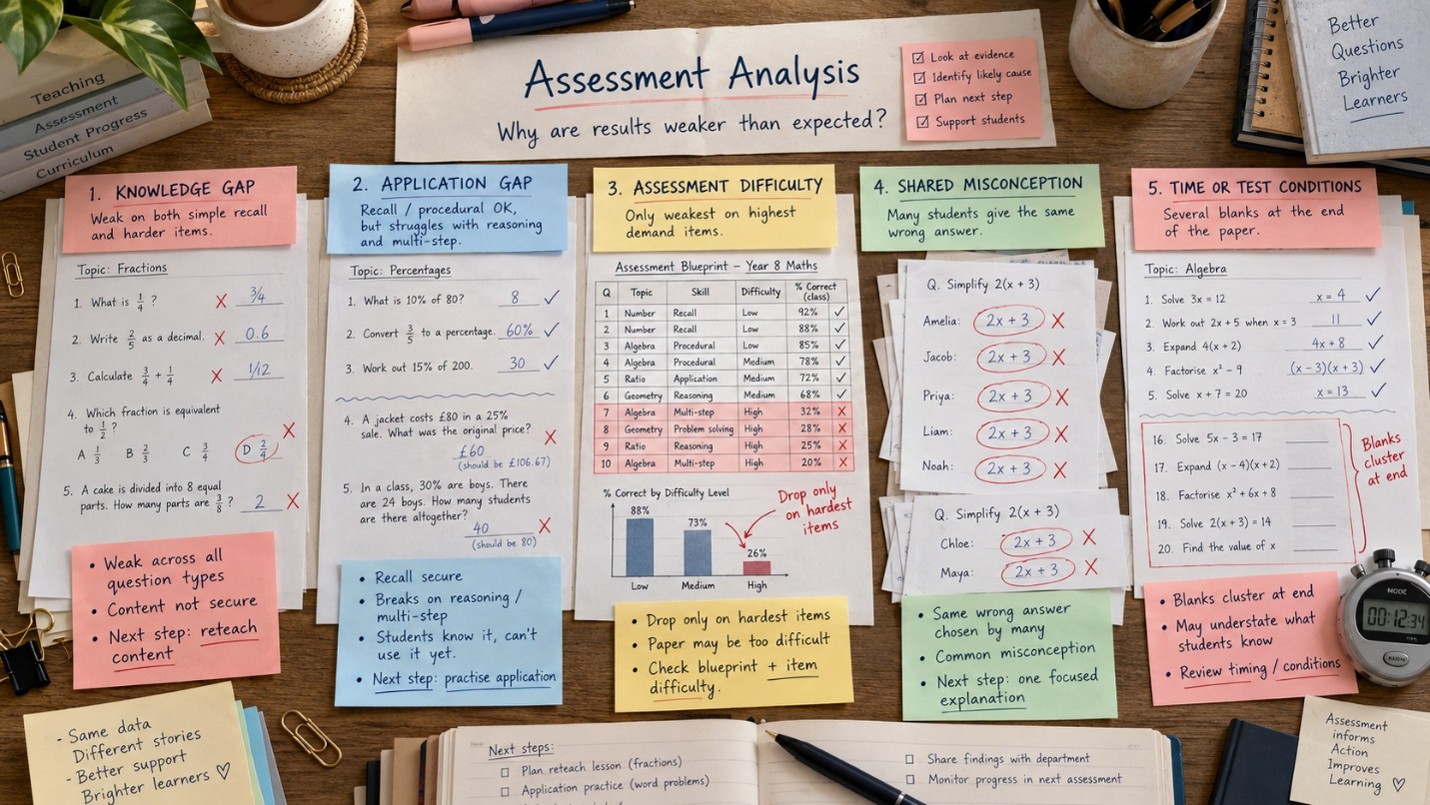
| Possible cause | What the evidence usually shows | What it suggests | Sensible next step |
| Knowledge gap | Weak across all question types, including simple recall | The content has not been learned | Reteach the content |
| Application gap | Secure on recall, but falls away on reasoning and multi-step questions | Students know it but cannot yet use it | Practise application. Reteaching the content wastes time |
| Assessment difficulty | Performance drops only on the hardest items | The paper may be the problem, not the class | Check the blueprint and item difficulty before planning intervention |
| Shared misconception | Most students chose the same wrong answer on an item | One wrong idea held in common | One focused lesson or explanation |
| Time or test conditions | Unanswered items cluster at the end of the paper | The score may understate what students know | Review timing and conditions before drawing conclusions |
This table is a working framework, not a research finding. In real classrooms causes often overlap, and one student can show more than one. Still, asking these questions in order prevents the most common and expensive mistake: treating every low score as a knowledge gap. The difference between the first two rows is important enough that it has its own discussion in knowledge gaps and application gaps.
Go back to the three students who each scored 52%.
If they scored the same for three different reasons, which of them is the class average actually describing?
What This Changes for School Leaders
Intervention time is limited. A misdiagnosed gap does more than fail to help. It uses up weeks that should have gone to a different problem. Before approving an intervention plan, leaders can reasonably ask:
- Can we name the specific skill, not just the topic?
- How many questions provide evidence for that skill?
- Did we check item difficulty and common wrong answers before deciding to reteach?
- Which students share this gap, so they can be taught together?
- When will we reassess, and what result would show the plan worked?
Across a school group, the same logic applies at a larger scale. Two campuses can show the same weak competency for completely different reasons. If one central intervention is rolled out to both, it may fit neither.
A group dashboard showing “Mathematics: 52%” across every school looks like evidence. It is not yet a diagnosis.
That leads to a harder question for leadership teams:
How much of your current intervention time was planned against a subject label rather than a named skill?
From a Named Skill to a Plan Teachers Can Deliver
Once a gap is named and explained, the next decisions become clearer. Teachers can reteach what is missing, practise what is close, and move on from what is already secure. Students who share a gap can be grouped, so one session serves several of them. A short reassessment then shows whether the gap has actually closed. Turning this into a workable schedule is covered in intervention planning using assessment data.
Before You Plan, Diagnose
A weak result is the start of an investigation, not the end of one. Schools that move straight from score to revision often teach the wrong thing to the right students. Schools that stop to name the skill and test the cause give their teachers something better than a revision list. They give them a reason for what they are about to teach.
Frequently Asked Questions
Q: What is learning gaps analysis?
A: Learning gaps analysis is the process of tracing a low assessment result back to the specific skill that is missing, and to the reason it is missing, before planning any intervention. It turns a topic-level result such as “fractions are weak” into a teachable target such as “comparing fractions with unlike denominators.”
Q: Why is a low score not enough to plan intervention?
A: Students can reach the same score for different reasons, such as not knowing the content, being unable to apply it, struggling with a hard paper, holding a shared misconception, or running out of time. Each cause needs a different response, so the score alone cannot tell a teacher what to do next.
Q: How do you tell a knowledge gap from an application gap?
A: Compare performance across question types. If students are weak everywhere, including simple recall, the content probably has not been learned. If recall is secure but reasoning and multi-step questions break down, students know the content but cannot yet apply it.
Q: What should schools check before reteaching a topic?
A: Check four things: whether the skill is clearly named, how many questions tested it, whether poor results appear only on the hardest items, and whether most students chose the same wrong answer. Any one of these can change the right response.
Q: How does skill-level diagnosis help school groups?
A: It shows whether schools with similar weak results share the same cause. Without it, a group may fund the same intervention everywhere when each campus actually needs something different.