

Picture a hypothetical Grade 7 end-of-term mathematics paper. Forty items, ten standards, four items each. Every standard is covered, the marks are neatly spread, and the head of department has signed it off.
The results come back, and one class is weak on proportional reasoning. The teacher asks the obvious question. Do I reteach ratio from the beginning, or do my students understand it but struggle to apply it to an unfamiliar problem?
The paper cannot answer. Of its four proportional-reasoning items, three asked students to recall a fact or run a routine procedure. Only one asked them to reason. One wrong answer on one item is not evidence of an application gap. It is one question that went badly.
Nothing went wrong in the marking or the analysis. The problem was settled weeks earlier, when the blueprint was written to cover the syllabus instead of answering the question the teacher would later need answered.
That is the central idea of this article.
An assessment blueprint is a promise about what evidence will exist after the test, and that promise should be written against a specific decision.
What an Assessment Blueprint Is Actually For
A test blueprint (also called a test specification or table of specifications) is the plan that defines an assessment before any item is chosen. It sets which standards or competencies are included, how many items each receives, the level of cognitive demand, the difficulty range, the item formats and the conditions of the test.
Most schools use blueprints as coverage tools, and that is reasonable. Coverage stops a paper drifting towards whatever is easiest to write. But coverage answers one question:
did we test what we taught? It does not answer a second, more important one: will these results let us decide what to do next?
The measurement field has framed validity this way for a long time. The Standards for Educational and Psychological Testing (AERA, APA and NCME) treat validity as a property of how scores are interpreted and used, not of the test on its own. For school leaders, the practical implication is uncomfortable: a well-written paper can still be the wrong instrument for the decision you plan to make with it.
Different Decisions Need Different Blueprints
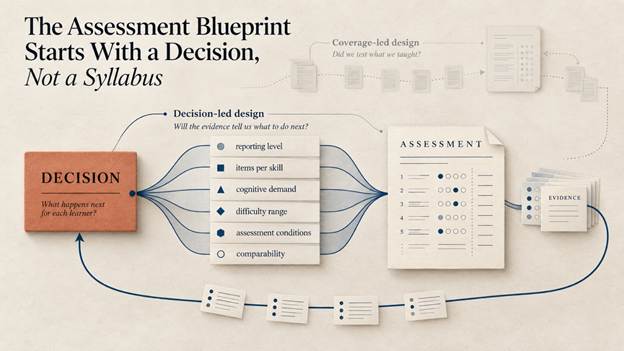
Schools use assessment results to make very different decisions, and each one places different demands on the blueprint. The table below shows how.
| The decision | Who usually makes it | What the blueprint must guarantee | Common blueprint gap |
| Reteach, consolidate or move on | Teacher | Several items for each skill taught, at more than one level of cognitive demand | Many standards, one or two items each |
| Is this a knowledge gap or an application gap? | Teacher, Head of Department | Items on the same skill at recall level and at reasoning level | Reasoning items bunched into a few topics |
| Which students go into which intervention group | Assessment Coordinator | A difficulty range wide enough to separate students at both ends | Paper pitched at the middle, so top and bottom cluster together |
| Did learning grow from beginning to end of year? | School leader | Same content structure and scale across cycles, with the cycle defined in advance | Each cycle’s paper rebuilt from scratch |
| How do our campuses compare? | Group academic leadership | Identical blueprint, timing and conditions across schools | Each campus writes its own paper “to the same syllabus” |
| Is the cohort ready for the external exam? | Principal, exam lead | Content weights, formats and timing that mirror the external exam | Mirrors the school’s scheme of work instead |
One paper rarely serves all six decisions well. With forty items, you can report on ten standards with four items each, or on four skills with ten items each. Both are defensible. They simply support different decisions, and the blueprint is where you choose which one.
The Grain of the Claim Decides the Number of Items
Leaders increasingly want skill-level reporting, and for good reason: skills are the level at which teaching decisions are actually made. The catch is that finer reporting needs more evidence per claim. This is where [diagnostic assessment at competency and skill level] [Future internal link opportunity: Diagnostic Assessment at Competency and Skill Level] depends entirely on earlier design choices.
There is no universal minimum number of items per skill. The general principle holds, though: the finer the reporting unit and the higher the stakes for an individual student, the more items each claim needs. If the paper cannot afford that many items, it is more honest to report at competency level than to present thin skill-level results as a diagnosis.
If a blueprint gives a skill a single item, what exactly is a teacher entitled to conclude when a student gets it wrong?
Cognitive Demand and Difficulty Are Two Different Settings
Depth of Knowledge (DOK), a framework first developed by Norman Webb, describes the kind of thinking an item asks for: recall (DOK 1), skill or concept (DOK 2), strategic thinking (DOK 3) and extended thinking (DOK 4). Difficulty describes how many students get the item right. The two are often confused, but they are independent. A recall item on unfamiliar vocabulary can be very hard. A reasoning item set in a familiar context can be quite accessible.
A good blueprint specifies both separately, because each supports a different reading of the results. The DOK spread is what lets a team tell [knowledge gaps from application gaps] [Future internal link opportunity: Knowledge Gap or Application Gap? Reading Evidence Before You Reteach]. A class weak at every level has probably not learned the content. A class strong on recall that falls away on reasoning needs practice in applying it, and reteaching from scratch would waste weeks.
Difficulty adds a third possibility. If performance drops only on the hardest items, the problem may lie with the paper rather than the class. Before any intervention is planned, someone should check the blueprint.
For a fuller treatment, see [using Depth of Knowledge in assessment design] [Future internal link opportunity: Using Depth of Knowledge to Design Better Assessments].
Comparability Is Decided Before Anyone Sits the Test
For benchmark and growth decisions, the blueprint works like a fixed contract. If the content structure changes between the beginning-of-year and end-of-year papers, “growth” no longer means what the report says it means. The same applies to timing, administration conditions and which cycle a result belongs to. These need to be agreed at the design stage, not reconstructed afterwards. This is the foundation for [tracking student growth across BOY, MOY and EOY assessments] [Future internal link opportunity: Tracking Student Growth Across Assessment Cycles].
The challenge is greatest in school groups. Many networks allow each campus to write its own end-of-term paper, then compare averages centrally.
If two campuses sit different papers built to the same syllabus, are leaders comparing schools or comparing papers?
For [comparing assessment results across a school network] [Future internal link opportunity: Fair Comparison Across Multi-Campus School Groups], a shared blueprint is not a bureaucratic preference. It is the condition that makes the comparison meaningful.
Five Questions to Ask Before Approving a Blueprint
- What decision will this result inform, and who will make it? If the answer is “general monitoring”, the blueprint has no clear target.
- At what level will results be reported? Check that every reporting unit has enough items to support the claim it will carry.
- Does the DOK spread allow knowledge and application gaps to be told apart for the skills that matter most this term?
- Is the difficulty range wide enough to separate the students you actually need to distinguish?
- What must stay constant for this result to be compared with another cycle or another school?
A useful exercise for any assessment team: take last term’s blueprint and write, next to each section, the decision its results were actually used for. Sections with nothing written beside them are worth questioning.
A Blueprint Is Where Assessment Decisions Really Get Made
Schools tend to think of assessment decisions as happening after the results arrive. In practice, many are made earlier, when someone decides how many items a skill gets, which topics get the reasoning questions, and whether next term’s paper will follow the same structure. A blueprint built for coverage produces results that describe. A blueprint built for a decision produces results that can be acted on.
Where Scholario Ascend Fits
The idea that assessment should serve the decision is central to how Scholario Ascend approaches assessment design. Its Standard mode uses a blueprint tool covering DOK, standards and difficulty, with balance warnings that flag an imbalanced item set before the paper goes live. Every item in the question and item bank carries its difficulty on a 100–350 scale, a DOK level, standard codes and competency links. Assessments are labelled with their cycle at creation, so later comparisons rest on a known basis, and paper versions keep the same blueprint and tags as digital ones. Difficulty analysis also helps teams check whether a weak result reflects the class or the paper.
Frequently Asked Questions
Q: What is an assessment blueprint?
A: It is the plan that defines an assessment before items are selected: the standards or competencies covered, the number of items for each, the cognitive demand (such as DOK level), the difficulty range, formats and conditions.
Q: Is a test blueprint the same as a test specification?
A: The terms are often used interchangeably. Some organisations use “specification” for the fuller document, including administration and scoring rules, and “blueprint” for the content-by-demand grid.
Q: How many items should each skill have?
A: There is no single correct number. It depends on the reporting level and the stakes of the decision. One item per skill is too little evidence for a skill-level judgement about an individual student.
Q: Should every campus in a school group use the same blueprint?
A: For benchmark assessments intended for comparison, yes. For classroom formative checks, local flexibility is usually appropriate, because the decision being made is local.
Q: Do adaptive assessments need a blueprint?
A: Yes. Students see different items, but content and cognitive-demand constraints still guide item selection, so the results remain aligned to the intended standards.