
Take a hypothetical science paper. Its blueprint claims a healthy share of higher-order questions, because many of them start with “analyse”, “evaluate” or “explain”.
Look more closely, though. “Analyse the graph and state the highest temperature” asks students to read one value off a chart. “Explain why plants need light” can be answered with a sentence copied from the textbook. Meanwhile, a question beginning with the modest word “describe” asks students to plan a fair test with three variables. That question is the most demanding one on the paper.
The verb tells you what the question says. It doesn’t tell you what the student actually has to do. That gap is why cognitive demand in assessment needs more than a verb list.
Why the Verb Misleads
Verb lists are popular because they are quick. Match the command word to a level, tag the item, and move on.
The problem is that the same verb can hide very different amounts of thinking. “Explain” can mean recalling a memorised explanation, or it can mean building a new argument from evidence. “Analyse” can mean reading a table, or comparing patterns across three data sets.
When items are tagged by verb alone, papers tend to look more demanding than they really are. The school then believes it is measuring reasoning when it is mostly measuring recall.
Two Frameworks Asking Two Different Questions
Bloom’s taxonomy and Webb’s Depth of Knowledge are often treated as rivals. They are more useful when treated as answers to two different questions.
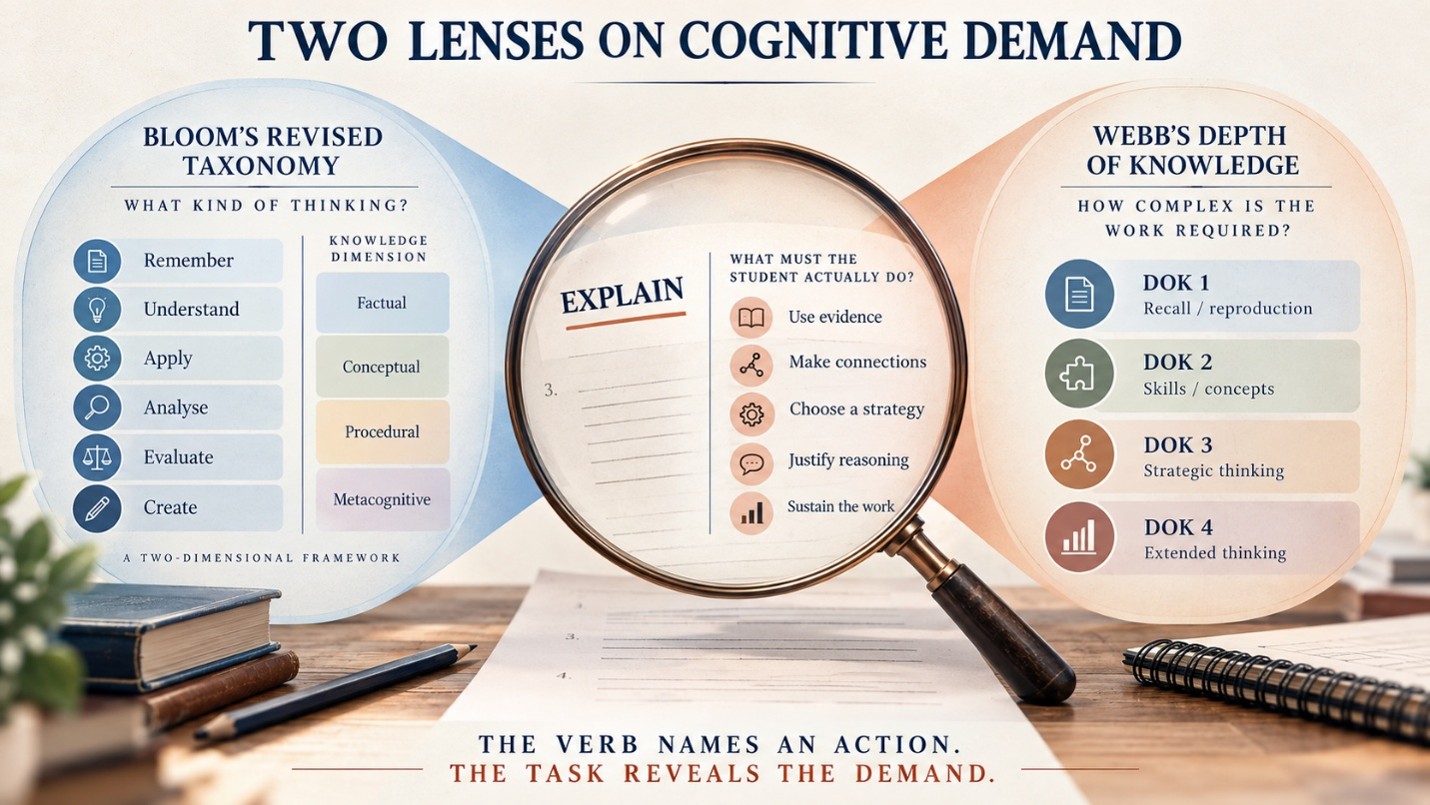
Bloom’s taxonomy was revised by Anderson and Krathwohl. It describes the type of thinking involved: remember, understand, apply, analyse, evaluate and create. The revision also added a knowledge dimension covering factual, conceptual, procedural and metacognitive knowledge. Bloom answers the question: what kind of thinking is this?
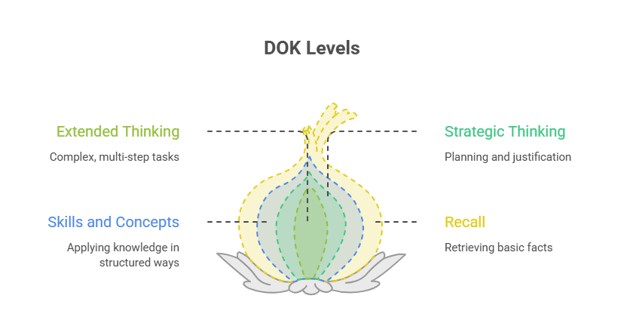
Depth of Knowledge (DOK) comes from Norman Webb’s 1997 work on aligning standards with assessments. It describes the complexity of what the task requires, across four levels:
- Recall and reproduction
- Skills and concepts
- Strategic thinking
- Extended thinking
DOK answers the question: how complex is the work this task requires?
| Topic | Bloom’s taxonomy | Webb’s Depth of Knowledge |
| Core question | What type of thinking? | How complex is the task? |
| Focus | The cognitive process | The demand of the task in its context |
| Levels | Six processes plus a knowledge dimension | Four levels |
| Main strength | Planning a range of thinking in teaching and learning | Checking alignment between standards and assessment items |
| Common misuse | Tagging items by command verb alone | Treating a higher DOK as automatically “better” |
One Topic, Four Levels of Demand
A single topic can be assessed at every DOK level. Here is an example using fractions:
| DOK level | Example item | What the student must do |
| 1. Recall | Which fraction is equivalent to 3/4? | Retrieve a known fact or procedure |
| 2. Skills and concepts | Which is larger, 2/3 or 3/5? Show how you know. | Apply a concept in a familiar, structured way |
| 3. Strategic thinking | A recipe for 4 people uses 3/4 cup of flour. How much is needed for 6? Justify your method. | Plan, reason and justify in a less familiar context |
| 4. Extended thinking | Survey your class over a week and present the results using fractions, explaining what they show. | Sustain reasoning across a complex, multi-step task |
Demand Depends on What Was Taught
There is a further complication that verb lists miss completely. The demand of a task depends on what students have already met.
A DOK 3 problem becomes close to DOK 1 if students practised that exact problem in class the week before. A question that looks routine can be genuinely strategic for students who have never seen that context.
This means item review cannot happen in isolation from the curriculum. Reviewers need to ask whether the task is new for the student, not just how it is worded.
If a paper’s higher-order questions could be answered from memory, is the school measuring reasoning, or rehearsal?
Why Accurate Demand Tags Change Diagnosis
Demand tagging is not just an item-writing detail. It shapes what teachers do after the test.
When accuracy is reported by DOK level, teachers can separate two very different problems:
- Students who struggle at every level may have a knowledge gap, and reteaching makes sense.
- Students who do well at DOK 1 and 2 but fall away at DOK 3 have an application gap. Reteaching the content would waste time; they need practice using it.
This distinction between knowledge gaps and application gaps only works if the tags are accurate. A paper with inflated tags will mislabel an application gap as success, or a knowledge gap as a reasoning problem.
What Assessment Teams Should Audit
- The blueprint. Does it specify the balance of demand, not just topics? Building an assessment blueprint with explicit DOK targets makes the intended profile visible.
- The tagging process. Who approves questions for the item bank, and do reviewers check demand, not just content?
- The purpose of the paper. Assessments aimed at exam readiness and curriculum mastery may need different demand profiles.
- Moderation. Can two reviewers agree on the level of the same item? If not, the definitions need work.
Demand Is About the Task, Not the Wording
Bloom helps teachers think about the kind of thinking they want students to do. DOK helps assessment teams check how complex the task really is. Neither works well when reduced to a verb list. A school that tags items by what students must actually do, in the context they have actually been taught, gets a far more honest picture of what its assessments measure.
FAQs
What is the difference between Bloom’s taxonomy and DOK?
Bloom describes the type of thinking involved, such as remembering or analysing. DOK describes how complex the task is in its context. They answer different questions and work well together.
Is DOK 4 always better than DOK 1?
No. Recall items are useful for checking foundational knowledge. A good assessment has a deliberate balance of levels that matches its purpose and the standards being assessed.
Can a command verb tell you the DOK level?
Not reliably. The same verb can require very different levels of thinking, depending on the task and on what students were taught.
How many DOK levels should an assessment include?
It depends on the purpose. A quick recall check may sit mostly at DOK 1–2, while an end-of-unit assessment usually needs some DOK 3 items. DOK 4 tasks are usually extended projects rather than timed test items.
Who should tag items for DOK?
Subject specialists who know the curriculum, with a review step. Tags should be moderated so that different reviewers apply the levels consistently.