
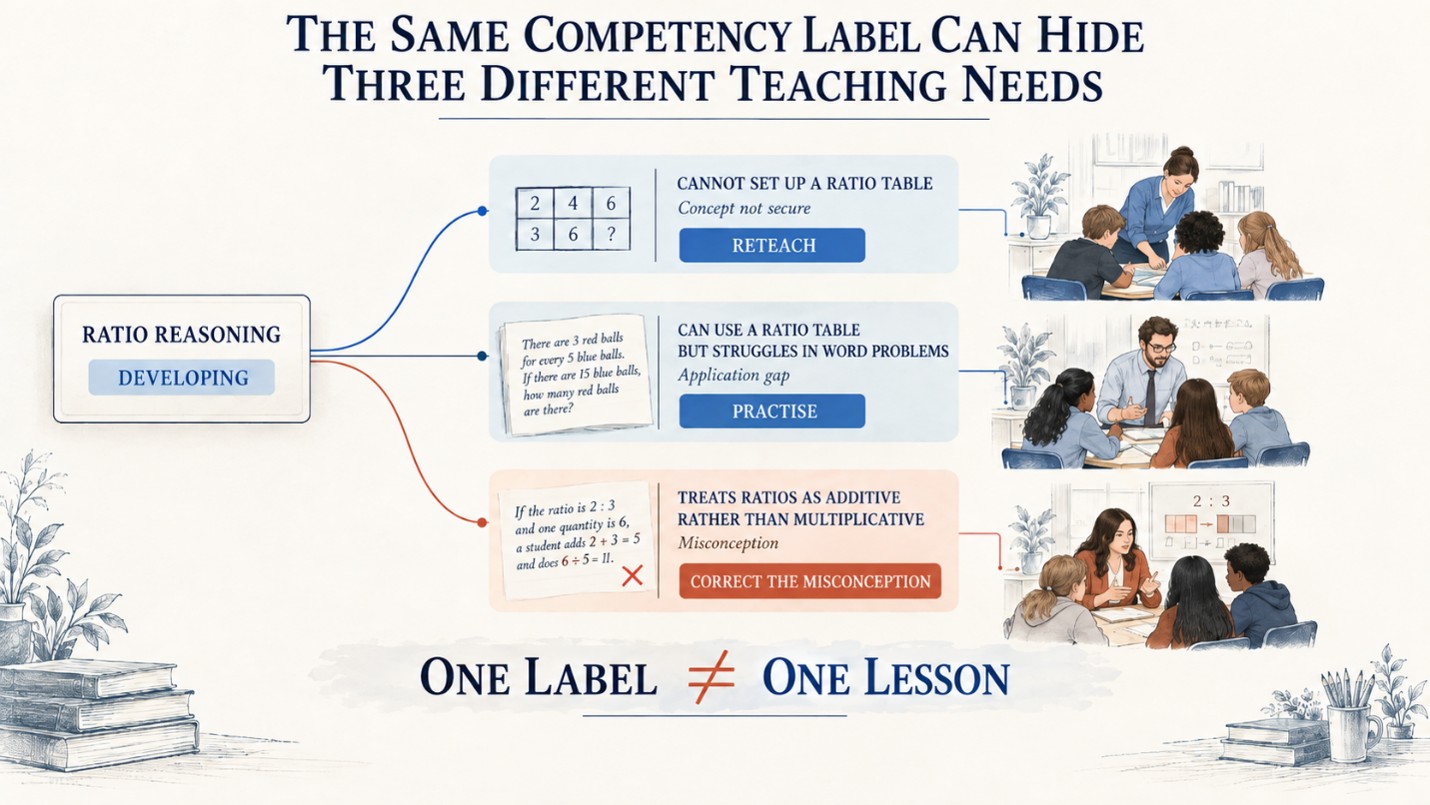
Here is a hypothetical example. A Grade 6 maths teacher opens the end-of-unit report on a Monday afternoon. Next to “Ratios and proportional reasoning” it says Developing, in amber, for 14 of her 31 students. The report is accurate. It is also, for tomorrow’s lesson, almost useless. She still does not know what to teach differently, to whom, or for how long.
This is the quiet problem with a lot of competency-based assessment reporting. Moving from a total score to skill-level results is a real improvement. But a competency label describes a position. It does not yet tell a teacher what to do next. A report earns its place only when a teacher can read it one day and teach differently the next.
A Label Is Not Yet a Lesson Plan
“Developing in ratio reasoning” can hide at least three different problems. Some students cannot set up a ratio table at all. Others can, but fail when the ratio sits inside a word problem. A third group treats ratios as additive instead of multiplicative. All three groups can earn the same label. Each needs a different lesson.
So the useful question for leaders is not “Do our reports show competencies?” It is “Does the report show enough detail for a teacher to choose between reteaching a concept, practising an application, or correcting a misconception?” If it cannot, teachers will fall back on the default response: reteach the whole topic to the whole class. For more on this, see finding the skill behind a weak result.
Reading Data and Acting on It Are Different Skills
The research on teacher data use shows a clear gap between analysing a report and making a teaching decision from it. A 2025 systematic review in Frontiers in Education examined 16 studies published between 2014 and 2023 on data literacy training for teachers and trainee teachers, mostly from the USA, the Netherlands and Germany. It found that the strongest programmes used structured decision-making models, real data, collaboration and long-term follow-up. It also found that many programmes focused on data analysis rather than on turning that analysis into instructional action. frontiersinfrontiersin
One contrast inside the review is telling. A study that gave teachers general training and materials, but no clear decision framework, found no significant difference in decision-making compared with a control group. A short session that gave pre-service teachers a structured decision flowchart produced large gains in decision accuracy. That second study was brief and used trainee teachers, so it should not be over-read. The review’s authors also note that the studies used very different measures and that few tracked long-term effects. frontiersin
For school leaders, one reasonable implication is this: if teachers need a decision structure to act on data, the report itself can carry part of that structure. A report that stops at “Developing” leaves all the decision work to the teacher.
What a Usable Competency Report Contains
| Report feature | What the teacher sees | Question it answers | Weak version to avoid |
| Skill-level detail | Sub-skills below the standard | Which exact skill is weak? | One label per strand |
| Link to evidence | The items behind the judgement, with their demand level | What did students actually do? | A percentage with no items |
| Student grouping | Students clustered by the same gap | Who needs the same lesson? | 31 names sorted by score |
| Clear threshold meaning | What “Proficient” or “Developing” means | Is this ready to move on? | Colour bands with no definition |
| Comparison context | Class vs school or network on the same skill | Is this my class or everyone? | No reference point |
| Recheck point | When and how the skill will be reassessed | Did the response work? | Nothing after the report |
The threshold row matters more than it looks. If staff do not share a clear idea of what a band means, the same report will be read in different ways. See what a mastery threshold should mean.
Leaders Decide What the Report Is For
Report design is a leadership decision, not a software setting. Before a report goes out, someone should be able to answer three questions: who reads it, when do they read it, and what decision does it support.
Timing is often where good reports fail. A detailed competency report that arrives two weeks after the unit has ended can only inform a future year’s planning. That is a different purpose, and it should be designed differently.
The audience changes the view too. A teacher needs to know which students share a gap. A curriculum leader needs to know whether every class in the year group shows the same gap. If six classes are all weak on the same sub-skill, the likely cause is the sequence or the materials rather than six individual teachers. The data is the same; the level of aggregation is different.
A question worth asking: If a competency report cannot tell a teacher which six students need the same ten-minute reteach, what exactly is it reporting?
A Simple Routine: Read, Group, Decide, Recheck
Schools do not need a complex protocol. A short, repeated routine works better:
- Read the skill-level results, not only the headline band.
- Group students who share the same gap or error pattern.
- Decide the response for each group: reteach, practise, or move on. See whether to reteach or consolidate.
- Recheck the same skill with a short follow-up assessment.
This routine also gives departments something concrete to practise together. Helping teachers read assessment reports goes further into building that habit.
The Report Is Finished When Teaching Changes
Competency-based reporting is a real step forward from total scores. But its value is not in the colours or the categories. It sits in whether the teacher reading it on Monday knows what to do on Tuesday. Leaders who judge reports by that test will design fewer, clearer, better-timed reports, and teachers will use them.
Frequently Asked Questions
What is competency-based assessment reporting?
It is reporting that organises assessment results by skill or standard instead of by total score. Each student, class or school sees how secure they are in each competency.
Why do teachers often ignore competency reports?
Usually because the report does not point to a decision. A label without the evidence behind it, or a report that arrives after the unit has ended, gives teachers little they can use.
How detailed should a competency report be?
Detailed enough to separate students who need different teaching. For most subjects, that means the sub-skill level plus a link to the items that produced the judgement.
Should leaders and teachers see the same report?
They should see the same underlying evidence at different levels of aggregation. Teachers need student groups. Leaders need patterns across classes and year groups.