

Consider a hypothetical group dashboard. School A shows 71% in Grade 6 mathematics and School B shows 58%. At the board meeting, someone asks what School B is doing wrong.
Then the details come out. School A used an end-of-term paper written by its own head of department. School B used the group’s common paper, which covered more of the curriculum and included more reasoning questions. School B tested in week 2 of term, while School A tested in week 6. Nearly every student in School B sat the test. School A tested only the students present on one day, and many of its weaker students were absent.
The 13-point gap might be real. It might even run the other way. At this point, nobody can say. The dashboard is comparing two tests, not two schools.
Comparability Is Decided Before Anyone Sits the Test
Benchmark assessment in school networks is only as useful as the decisions made before the test is taken. Statistics can do some repair work afterwards, but only when the assessment was designed to allow it. A comparison that was never designed cannot simply be calculated into existence.
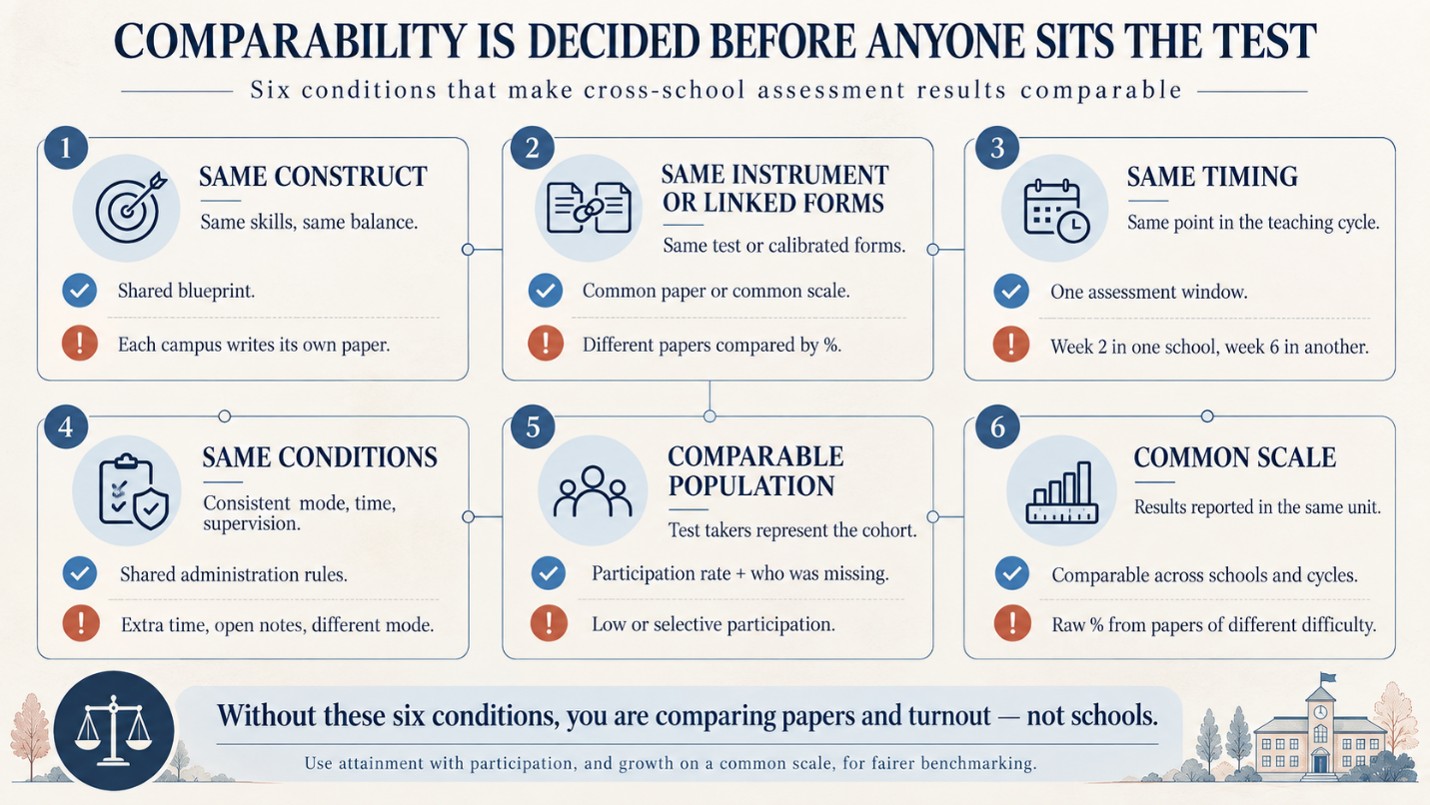
In practice, comparability rests on six conditions:
Different Papers Need Linking, Not Just Averaging
A percentage on one paper and a percentage on another paper are not the same unit. A harder paper produces lower percentages from the same students.
Kolen and Brennan’s standard text on test equating explains that scores from different test forms can be treated as interchangeable only after a formal equating or linking process. That process has to be planned in advance, for example by including common items across forms.
For a school group, the implication is simple. If every campus writes its own paper, a percentage comparison between campuses is weak evidence. Networks that want real comparison need either a common instrument or a scale on which different forms have been calibrated.
Who Sat the Test Can Change the Ranking
Participation is one of the most overlooked threats to comparability. If a school’s weaker students are more likely to be absent on test day, its average rises without any learning changing. A result built on half the cohort is a sample, not a finding.
Leaders should read participation beside performance every time. Checking for assessment participation bias should be a routine step before any cross-school discussion.
Mode, Timing and Conditions Matter More Than They Look
The Standards for Educational and Psychological Testing treat consistent administration as part of what allows scores to be interpreted in the same way across test takers. They also ask users to consider how changes in conditions might affect what a score means.
For school groups, three conditions cause most of the trouble:
- Timing. Testing in week 2 versus week 6 means students have received different amounts of teaching.
- Mode. Paper and screen can behave differently for some item types and some students. This is why paper vs online assessment comparability needs checking rather than assuming.
- Conditions. Time allowed, supervision and the support available during the test.
Comparable Is Not the Same as Fair
Even perfectly comparable attainment results mostly reflect intake. A school that admits strong students will usually rank well regardless of how much it adds.
If your top-ranked school is simply the one that admitted the strongest students, what exactly is the ranking rewarding?
Growth, measured on a common scale across cycles, gives a fairer picture of what each school is actually changing. A school that is behind but climbing fast may deserve more recognition than one that is ahead but has not moved in two cycles. This is the core of benchmarking without unhealthy competition.
What a Network Should Standardise, and What It Can Leave Local
Not everything needs to be the same across campuses. Standardising everything creates heavy workload and removes useful local judgement.
Standardise for benchmark cycles: the blueprint, the instrument, the assessment window, the cycle label, the competency framework, participation rules and the reporting scale.
Leave local: day-to-day formative assessment, classroom quizzes, teaching approaches and most unit tests.
Getting this balance right is one of the main design decisions in implementing a shared assessment system across a school group.
Comparison Is a Design Choice
Cross-school comparison can be one of the most useful tools a school group has. It shows where support is needed and where good practice can be shared. But comparability is designed before the test, not discovered after it. Without shared construct, instrument, timing, conditions, population and scale, a network is comparing papers and turnout, not schools.
FAQs
What is benchmark assessment in a school network?
It is a common assessment given across campuses at set points in the year, for example the beginning, middle and end of the year. It is designed so that results can be compared across schools and over time.
Can schools compare results if each campus writes its own test?
Only weakly. Different papers vary in difficulty and coverage, so percentages are not directly comparable unless the forms have been formally linked or placed on a common scale.
Does participation really affect school comparisons?
Yes. If lower-attaining students are more often absent, a school’s average can rise without any change in learning. Always check who sat the test.
Should school groups rank schools by assessment results?
Rankings based only on attainment mostly reflect intake. Growth comparisons on a common scale, read alongside attainment, give a fairer and more useful picture.
Can paper and online results be compared?
They can be, if the same blueprint and scoring are used. But mode effects should be checked rather than assumed away, especially for certain item types.