

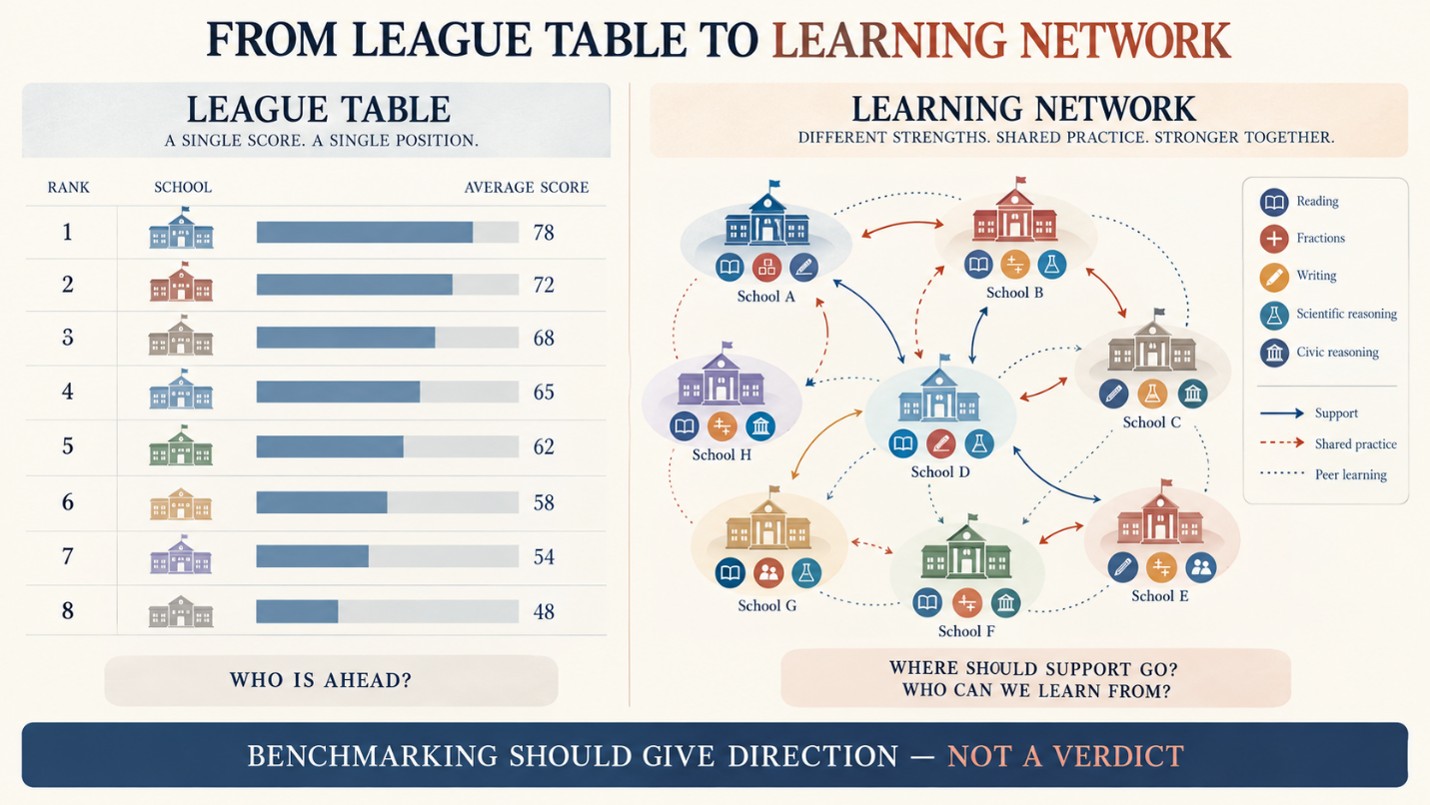
Picture a quarterly review at a school group with eight campuses. The academic director shares one slide: every school ranked by its average score in the latest benchmark assessment. The principal at the bottom spends the next week preparing explanations. The principal at the top relaxes. Teachers in the middle campuses quietly wonder which way they will move next term.
Look closely at what that slide produced. It produced plenty of feeling and very few teaching decisions.
That is the central risk in academic standards benchmarking for school groups. Comparing campuses is valuable, because a group that cannot see how its schools differ cannot direct support or spread good practice. But a comparison designed like a league table asks “who is winning?”, and that question rarely improves a single lesson. The more useful questions are where support should go next, and which school has already solved a problem the others still face.
So here is the short answer. Multi-school benchmarking stays healthy when three things are true:
- The evidence is genuinely comparable.
- Results are read alongside growth and context, not raw averages alone.
- Everyone agrees in advance that a weak result triggers help, not blame.
The Pressure Is Already in the Building
Group leaders sometimes treat benchmarking as a neutral reporting exercise. Teachers rarely experience it that way, and recent international evidence suggests why.
The OECD’s Teaching and Learning International Survey, Results from TALIS 2024, found that on average, 45% of teachers report that being held responsible for their students’ achievement is a significant source of stress. The same report found that in 17 out of 54 education systems, experienced teachers are more likely than novice teachers to report being held accountable for student achievement as a source of stress. Overall, around one in five (19%) of teachers report experiencing stress “a lot” in their work.
These figures need careful reading. The findings come from responses collected in 2024 from lower secondary teachers and principals, and TALIS relies solely on self-reports, which reflect perceptions but may be shaped by social and cultural context. The survey does not measure school-group benchmarking, and it does not show that comparing schools causes stress. oecd
For school groups, one implication is still clear. Any new comparison lands in a workforce where accountability pressure is already common. A benchmark report can add to that weight. It can also be designed to explain, direct and support. Which one it becomes depends far more on design and governance than on the data itself.
Fair Comparison Comes Before Any Comparison
A group report that compares schools assessed in different ways compares nothing. Before a ranking or chart is shared, leaders should be confident of four things about every campus:
- It sat the same instrument.
- That instrument was built on the same blueprint.
- It was taken in the same assessment window.
- Testing conditions were similar.
If one school used a teacher-made paper and another a common test, the gap between them is partly a gap between tests. It is worth understanding what makes results comparable across schools before anyone draws a conclusion.
Participation needs its own check. Suppose, hypothetically, that Campus A tested 95% of its Grade 7 students while Campus C tested 72%, and most of Campus C’s absent students were already struggling. Campus C’s average will look healthier than its classrooms really are. A leader who praises that result is rewarding a missing-data problem. This is why the first habit on any group dashboard should be checking who took the assessment.
Growth Changes Which School Looks Like the Problem
Even when the evidence is fair, raw attainment tells only half the story.
Consider two hypothetical campuses. Campus A has averaged 78% for three cycles. Campus B averages 61%, up from 52% a year earlier. A ranked list puts Campus A comfortably ahead. A growth view asks a different question: which school is actually changing what its students can do?
On that measure, Campus B may be the school the group should learn from. Campus A may need more attention than its score suggests. Reading growth alongside attainment is what turns a ranking into a fair picture.
Comparing each school with its own previous cycles, as well as with the network, also takes much of the sting out of the exercise. A principal can argue with a rank. It is harder, and less necessary, to argue with “your Grade 8 reading has moved this much since last year.”
This raises an uncomfortable question for many groups.
If the top-ranked school has not moved in three cycles, is it the group’s strongest school, or simply its most comfortable one?
Benchmark at the Level Where Teaching Changes
School averages are useful for governance but too blunt for improvement. Two campuses with the same average can have completely different problems: one in Grade 6 fractions, another in Grade 8 data handling.
When comparison moves down to grade, subject and competency, something useful happens to the culture. The question stops being “which school is best?” It becomes “which school teaches proportional reasoning well, and what are they doing differently?” A weak result in one campus is now matched by a source of practice in another.
This is the point where benchmarking starts building collaboration instead of rivalry. The comparison names a colleague to learn from, not just a school to worry about.
Agree What a Low Result Triggers Before Anyone Sees It
The most important design decision happens before the report is published.
If a red flag has historically meant a difficult meeting, principals will learn to manage the number rather than the learning. If it reliably brings a support visit, shared planning time or a specialist from a stronger campus, the same flag becomes something worth raising early.
These rules belong inside the group’s wider approach to academic quality assurance beyond compliance. Before sharing any multi-school report, a leadership team might ask:
- Was every campus measured with the same instrument, under the same conditions?
- Is the participation rate shown next to every average?
- Does the report show each school’s growth, not only its position?
- Have we agreed what support a low result will trigger?
- Who needs to see school-level rankings, and who only needs their own data?
A second question is worth putting to any group executive team.
If principals were confident that a weak result would bring support rather than scrutiny, how differently would they talk about their data?
Comparison Should Give Direction, Not a Verdict
Benchmarking across a multi-school group is worth doing. Without it, leaders guess where support is needed, and good practice stays locked inside one campus. But the purpose of a group comparison is direction: where to look, whom to help and whom to learn from.
When the comparison is fair, read through growth and connected to support, it strengthens a network. When it shrinks to a single rank, it mostly produces anxiety and defensive behavior, and classrooms see very little of the benefit.
FAQs
Q: What is academic standards benchmarking in a school group?
A: It means comparing evidence of student learning across campuses against a shared expectation, using common assessments. The aim is to see where standards differ, where support is needed and which schools have practice worth sharing, rather than simply ranking campuses.
Q: Why can ranking schools create unhealthy competition?
A: A single rank turns a complex picture into a win-or-lose result. Principals may focus on protecting their position instead of examining their data honestly. Accountability pressure is already common: on average, 45% of teachers report that being held responsible for their students’ achievement is a significant source of stress. oecd
Q: Should school groups compare attainment or growth?
A: Both, but never attainment alone. Attainment shows where students are now. Growth shows whether teaching is changing that position. A high-scoring school with flat growth may need more attention than a lower-scoring school that is improving quickly.
Q: How can a school group make results comparable across campuses?
A: Use the same assessment, built on the same blueprint, in the same window and under similar conditions. Then check participation at every campus before interpreting averages, because missing students can make a result look stronger or weaker than it really is.
Q: Who should see school-level benchmark results?
A: Group leaders need the full network view to direct support. Each principal needs their own school’s results in the context of the network. Wider sharing should follow agreed rules, so that results are used for support and shared learning rather than public comparison.