

Every August, teachers in districts across the country file into a gym or a library for an in-service day. A presenter introduces a new strategy, the sign-in sheets get collected, and the hours are logged toward license renewal. By October the strategy has mostly faded from classrooms, and nobody is very surprised.
The presenter was probably fine and the teachers were probably willing. The real trouble is that a single day was asked to do the work of a career.
A career-long growth pathway replaces that one-off event with a sequence. It gives a clear picture of what strong practice looks like at each stage of a teacher’s career. It provides support that helps a teacher reach the next stage. And it collects evidence that practice has actually changed. Hours still get logged, but they stop being the point.
Hours Are Easy to Count. Growth Is Harder to See.
In many states, license renewal depends on collecting professional development hours or credits. That is a reasonable floor. The problem starts when districts build their whole professional learning system around that floor. Reporting becomes a compliance exercise. Who attended? How many hours? Was the certificate filed?
None of those questions tells a principal whether a teacher has become more skilled.
If your district can report every teacher’s PD hours but cannot name one change in any teacher’s practice, what exactly has been measured?
A better question for leaders is:
What can this teacher do now that they could not do three years ago?
A growth pathway is designed so that this question has an answer.
The Second-Year Teacher and the Fifteen-Year Veteran Need Different Things
Most whole-staff training treats experience as if it doesn’t matter. A teacher still building classroom routines sits next to a veteran who could run the session. Both leave with the same handout.
Development needs change across a career. Early-career teachers usually need help with routines, pacing, and checking whether students understood today’s lesson. Mid-career teachers often benefit most from sharpening how they read student evidence and adjust instruction. Experienced teachers may be ready to deepen a specialty, mentor others, or lead team inquiry.
A seventh-grade math teacher in her sixth year has strong classroom management and good relationships with students. Another session on engagement strategies will not move her forward. What would help is learning to tell, from her students’ work, whether a weak result comes from a missing concept or from trouble applying a concept they already know. That is a different kind of professional learning altogether. It is also why instructional design in teacher training matters: good training starts from where the learner actually is.
What a Teacher Growth Pathway Can Look Like
A pathway does not need to be complicated. It needs to be visible, so that a teacher can find where they are and see what comes next. It should also rest on a shared view of what good teaching requires, including the future-ready teaching competencies that a school expects to develop over time.
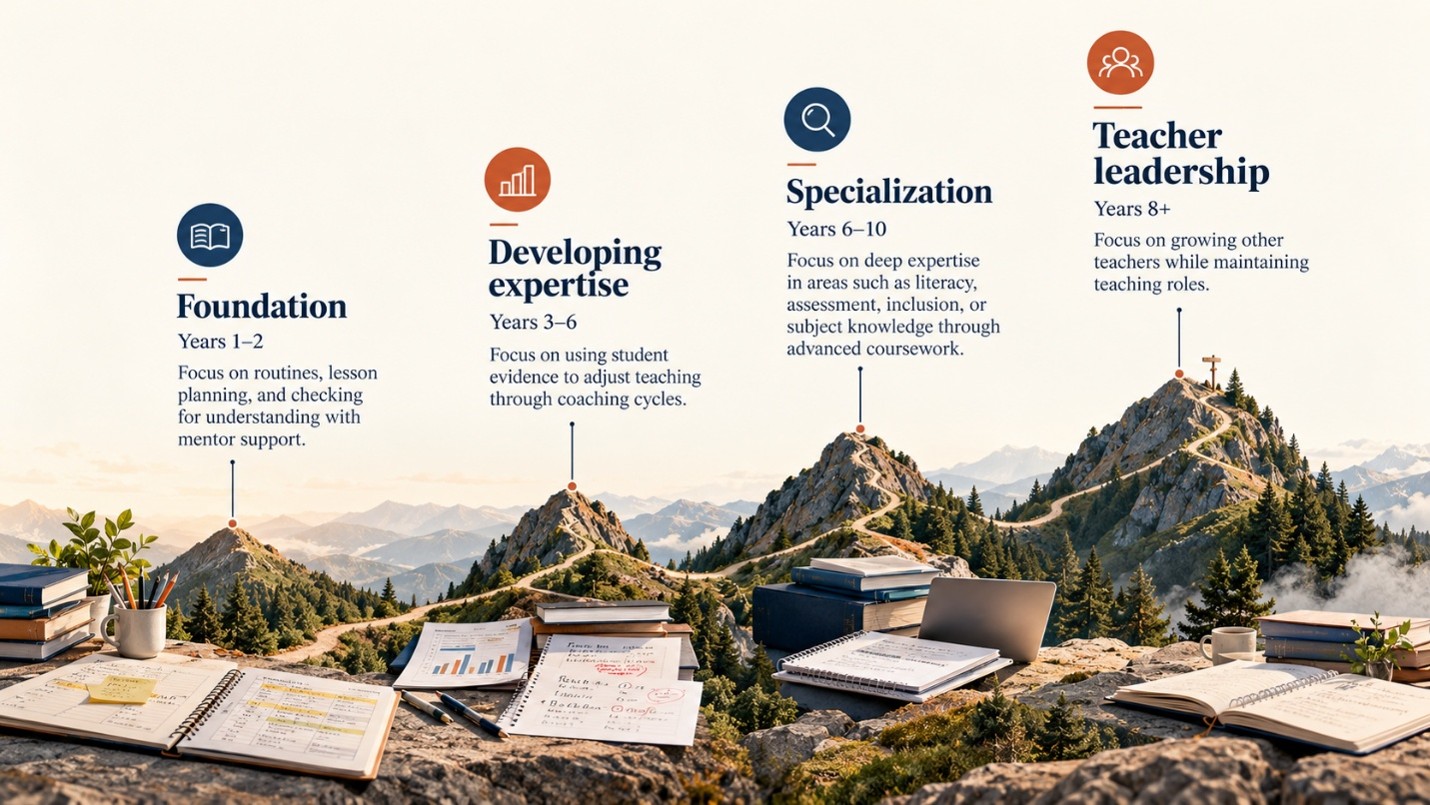
| Stage | Rough career point | Focus of growth | Typical support | Evidence that growth happened |
| Foundation | Years 1–2 | Routines, lesson planning, checking for understanding | Mentor teacher, induction program, frequent low-stakes observation | Routines hold without constant correction; the teacher can name which students missed today’s objective |
| Developing expertise | Years 3–6 | Using student evidence to adjust teaching; deciding when to reteach, practice, or move on | Coaching cycles, professional learning community inquiry | Planned changes can be traced to student work; students show growth on targeted skills |
| Specialization | Years 6–10 | Deep expertise in a subject or area such as literacy, assessment, English learner support, or inclusion | Advanced coursework, National Board Certification, specialist roles | Colleagues adopt the practice; results improve in the focus area |
| Teacher leadership | Years 8+ | Growing other teachers while still teaching | Mentor, coach, department lead, or hybrid teaching roles | Mentees’ practice changes; team-level outcomes improve |
The support column is where most districts already spend money. The difference is in how that spending is organized. A well-designed instructional coaching model can serve teachers at every stage, as long as each coaching cycle connects to the teacher’s next step rather than to the district’s initiative of the year.
Growth Should Not Mean Leaving the Classroom
In many districts, the only route to more pay and more responsibility leads out of teaching and into administration. The result is predictable. Some of the best teachers become assistant principals, and classrooms lose exactly the expertise a pathway is supposed to build.
If a teacher’s only route to more responsibility leads out of the classroom, what is the system quietly saying about classroom expertise?
Hybrid roles help with this. A teacher can lead a grade-level team, mentor new hires, or coach part-time while keeping a teaching load. Those roles also give principals a natural leadership pipeline for the teachers who do want to move into administration later. Visible growth inside the profession is also part of the business case for investing in teacher growth. Teachers are more likely to stay where they can see a future.

Count the Change in Practice, Not the Certificate
If hours are not the measure, what is? A sensible pathway uses a mix of evidence:
- Focused observation. Look at the specific practice the teacher is working on, not a general checklist.
- The teacher’s own inquiry. What did they try, what did they notice, and what did they change?
- Student learning evidence. Did students improve on the skills the teacher targeted?
That last item needs care. Student results are shaped by many factors outside a teacher’s control. One assessment is a noisy signal. Used as a scorecard, student data will make teachers defensive, and fairly so. Used as the starting point for a coaching conversation, it gives growth something concrete to aim at. The goal is to ask what changed for students when practice changed, not to grade the teacher.
Five Questions for District and School Leaders
Before redesigning anything, these questions show where a system really stands:
- Can every teacher describe their next growth step in one sentence?
- Does professional learning differ by career stage, or does everyone get the same calendar?
- What evidence besides attendance do we accept as proof of growth?
- Can an expert teacher gain responsibility and pay while still teaching?
- Who owns each teacher’s pathway: the principal, a coach, HR, or nobody?
Many districts already direct federal Title II, Part A funds and local budgets toward professional learning. The question is whether that money buys events or sequences.
From a Calendar Event to a Career Direction
Annual training days will not disappear, and they don’t need to. A well-planned in-service day can launch a year of work. It just can’t be the work. A teacher growth pathway changes the question leaders ask. Instead of “Did our teachers attend?”, the question becomes “Are our teachers becoming more expert, and can we see it?” Districts that can answer the second question are building something a sign-in sheet never could.
Frequently Asked Questions
What is a teacher growth pathway?
A teacher growth pathway is a structured sequence of development stages across a teacher’s career. Each stage defines a focus for growth, the support available to the teacher, and the evidence that shows growth has happened. It replaces one-off training events with a clear sense of direction.
How is career-long professional development different from traditional PD?
Traditional PD is often organized around events and hours, with everyone attending the same sessions. Career-long professional development is organized around stages. Support is matched to experience, and progress is judged by changes in practice rather than by attendance.
How can schools measure teacher growth without relying on PD hours?
Schools can combine focused observation of a specific practice, teachers’ own records of what they tried and changed, and student learning evidence on targeted skills. Together these give a fuller picture than hours logged.
Should student assessment results be part of a teacher’s growth pathway?
They can be, as long as they are handled carefully. Student results work best as a starting point for coaching conversations, not as a teacher scorecard, because many factors outside a teacher’s control affect outcomes.
Can teachers advance in their careers without moving into administration?
Yes, when districts create hybrid and teacher leader roles. Mentoring, coaching, team leadership, and specialist positions let expert teachers take on more responsibility while still teaching.