
Picture a principal in late May, finishing the last of forty evaluation write-ups. This is a composite scenario, but a familiar one. Every rubric box is filled and every signature is collected. Almost every teacher is rated effective or highly effective. The district report will show 100% completion.
Then a quieter question arrives. Which of those forty teachers will teach differently in September because of this process?
If the honest answer is “very few,” the framework has done its administrative job and missed its educational one. That gap is the central problem with many teacher evaluation frameworks in US schools. They are designed to serve two purposes, accountability and growth, but the compliance purpose tends to win. It wins because it is easier to count.
Two Jobs, One System
Most teacher evaluation frameworks are asked to do two different things at once.
The first is accountability: documenting performance, meeting state requirements, and supporting tenure and personnel decisions. The second is growth: helping teachers improve what they do in classrooms.
Both are legitimate. The trouble starts when one system tries to do both and only one of them is ever measured. Completion rates, deadlines, and rating distributions are easy to report to a board. Whether a teacher’s questioning improved between October and March is not.
What the US Learned From a Decade of Evaluation Reform
The United States has run something close to a national experiment on this question. Between 2009 and 2017, 44 states and Washington, DC implemented major reforms to their teacher evaluation systems. Federal incentives encouraged regular teacher evaluations based on multiple measures, including student achievement growth, with performance ratings used to inform professional development and personnel decisions.
A study by Bleiberg, Brunner, Harbatkin, Kraft and Springer examined what those reforms did for students. The researchers combined the timing of state reforms with district-level student achievement data on standardized math and English Language Arts exams from the Stanford Education Data Archive, plus American Community Survey data on high school graduation and college enrollment. repec
The study found precisely estimated null effects on average, ruling out impacts as small as 0.017 standard deviations for achievement and 1.2 percentage points for high school graduation and college enrollment. The researchers also found little evidence that effects varied with the rigor of a state’s evaluation design.
There is an important nuance. In a small group of systems that the National Council on Teacher Quality had profiled as exemplary, including Tennessee, New Mexico, Dallas, DC, Denver and Newark, the researchers found positive effects that rose over time to a high of 0.15 SD. However, those exemplar systems were selected after the fact, partly based on their outcomes, so the authors describe these results as descriptive rather than causal.
What this does not mean: it does not prove that evaluation cannot improve teaching. It shows that the version adopted at national scale, on average, did not move student outcomes.
Where the Growth Purpose Got Lost
The study’s explanations read like a description of the compliance trap.
The first is capacity. Districts overwhelmingly gave principals the job of observing, evaluating and giving feedback, rather than hiring additional expert evaluators. Many principals were not prepared to give substantive feedback to teachers across a wide range of grades and subjects, which narrowed the scope, depth and quality of feedback.
The second is where attention went. Administrators prioritized the paperwork the new systems required, because paperwork was easier for districts to monitor. That is the compliance purpose quietly taking over the growth purpose.
The third is how teachers experienced it. In the authors’ analysis of national survey data, the reforms decreased teachers’ job satisfaction and perceived job security, with no evidence that they changed teachers’ curriculum or pedagogy, which was a key mechanism the reforms relied on.
None of this was cheap. The authors’ back-of-the-envelope estimate is that public schools spend about $2 billion each year on teacher evaluation systems. ed
If nearly every teacher receives the same rating, what decision is that rating actually informing?
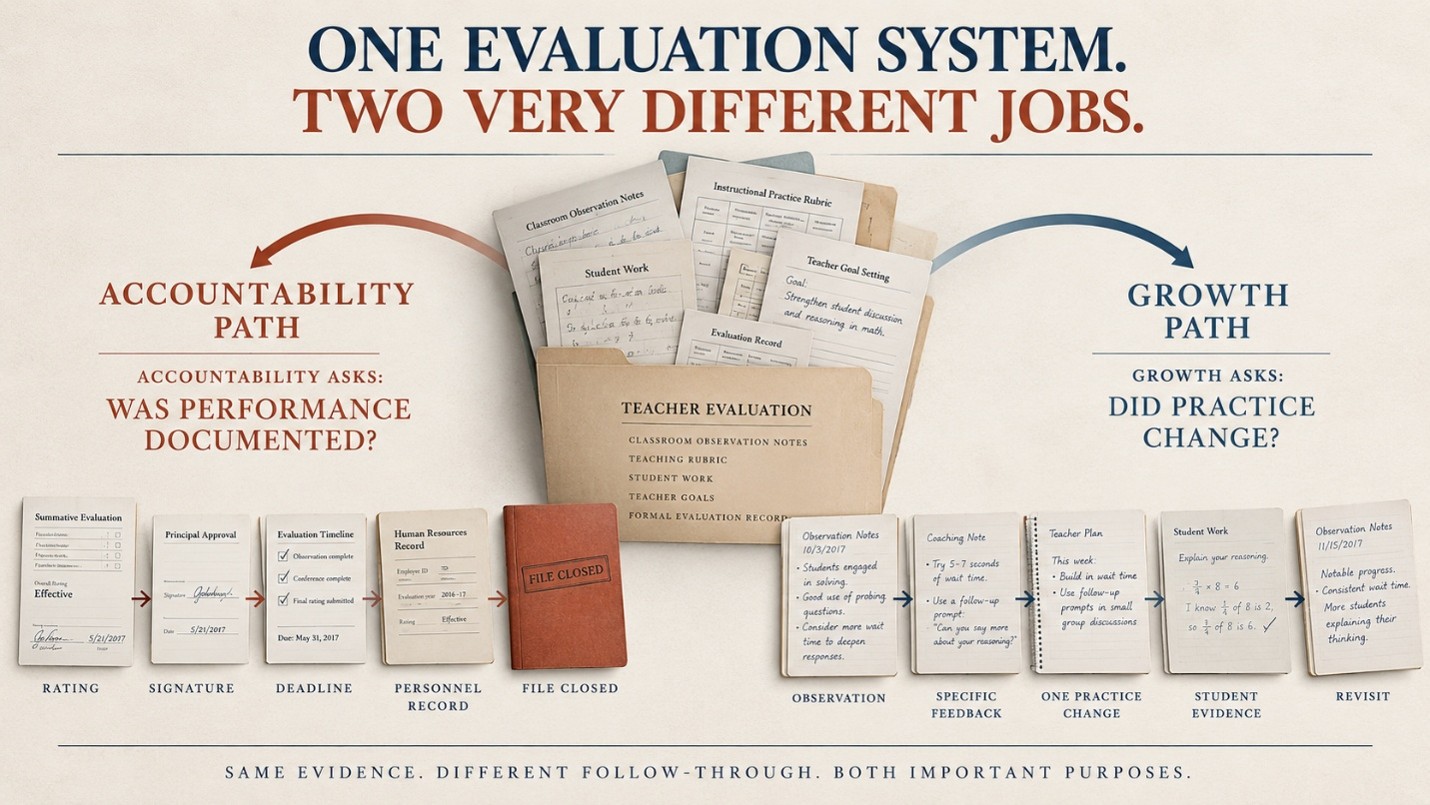
The Same Rubric Can Serve Two Very Different Frameworks
The rubric itself is rarely the problem. What matters is what happens around it. Often the clearest way to see this is to compare how a compliance-led system and a growth-led system answer the same practical questions.
| Question | Compliance-led framework | Growth-led framework |
| What is the main output? | A rating on file | A specific change in classroom practice |
| How often does feedback happen? | Once or twice a year, tied to formal observations | Short, frequent cycles across the year |
| Who gives feedback? | Whoever is assigned to evaluate | Someone with relevant grade or subject expertise |
| What student evidence is used? | A summary score or single growth number | Skill-level evidence a teacher can act on |
| What happens after the rating? | Filed, and acted on only at the extremes | Linked to coaching, goals and a development pathway |
| How is success judged? | Completion rates and deadlines met | Whether teaching and student learning changed |
| How do teachers experience it? | Something done to them | Something done with them |
A growth-led framework still needs clear standards for good teaching. Curriculum-agnostic teaching effectiveness metrics give leaders a shared definition that works across departments. Evaluation also works best when it sits inside a broader teaching and learning effectiveness framework rather than standing alone as an HR process.
Five Questions to Ask Before the Next Evaluation Cycle
For a superintendent or principal, the useful move is not to scrap evaluation. It is to audit what each part of it is for.
1. What decision does each component feed? If an observation score never influences coaching, assignments or support, ask why it is collected.
2. Is the feedback-giver equipped for this classroom? The national evidence points directly at this weak spot. Separating ongoing feedback from formal rating, through an instructional coaching model, can give teachers expert support without every conversation feeling high-stakes.
3. How often do teachers hear useful feedback? Annual events rarely change habits. A feedback-rich teaching culture treats evaluation as one moment in a longer conversation.
4. What student evidence enters the conversation? A single growth number can start a discussion, but it cannot tell a teacher what to change. Evidence about which skills students are missing, and in which classes, gives the conversation something concrete to work on.
5. Where does a rating lead? A rating should open a door, not close a file. Connecting outcomes to teacher growth pathways makes the process feel like an investment rather than an inspection.
If an evaluation cycle produced a complete paper trail but no teacher taught differently the following week, did the school evaluate teaching, or only document it?
Evaluation Should Leave a Trace in Teaching, Not Just in Files
The US experience offers a sobering lesson. Rating systems were adopted widely and quickly, and on average students did not benefit. Where results looked better, the systems appear to have invested in the harder parts: skilled observers, real feedback, and follow-through.
Compliance still matters. Districts have legal duties, and teachers deserve fair, documented processes. But compliance should be the floor of a teacher evaluation framework, not its purpose. The real test is simple to state and hard to meet. After the cycle ends, is teaching better than it was?
FAQs
What is the purpose of a teacher evaluation framework?
A teacher evaluation framework has two purposes: accountability (documenting performance and supporting personnel decisions) and professional growth (improving classroom practice). The strongest frameworks treat accountability as a baseline requirement and design most of their time, feedback and follow-up around growth.
Did teacher evaluation reform improve student achievement in the US?
On average, no. A national study of reforms in 44 states and Washington, DC found no detectable average effect on math or ELA achievement, high school graduation, or college enrollment. A small number of exemplary systems showed positive results, but that finding is descriptive, not causal.
Why do teacher evaluation systems become compliance exercises?
Paperwork and completion rates are easy to monitor, while changes in teaching are not. Research on US reforms found that administrators prioritized required paperwork, and many principals lacked the time or subject expertise to give substantive feedback across grades and subjects.
How can schools make teacher evaluation support professional growth?
Schools can increase feedback frequency, match teachers with feedback-givers who have relevant expertise, separate coaching from formal rating, bring skill-level student evidence into conversations, and link evaluation results to coaching and long-term development pathways.
Should student test scores be used in teacher evaluation?
Student evidence can inform growth conversations, but a single summary score rarely tells a teacher what to change. Skill-level and class-level evidence is more useful for improving practice. How much weight test scores carry in formal ratings is a policy decision that varies by state and district.