

Every Wednesday at 2:15, the fourth-grade team at a hypothetical elementary school sits down for its PLC. The agenda is printed. The team norms are on the wall. Someone takes notes in the shared folder. Forty-five minutes later, the team has agreed next week’s pacing, swapped two worksheets, and talked about a student who is having a hard time at home.
By most compliance measures, this is a working professional learning community. The time is protected, attendance is high, and the notes are filed.
Now ask a harder question.
Did any teacher on that team teach a lesson differently the following week because of what was discussed?
Often, the honest answer is no. That gap between meeting and working is where many PLC efforts in American schools quietly stall. The structure exists, but the impact does not.
A PLC Is Defined by What Changes, Not by When It Meets
Teacher professional learning communities were never meant to be a calendar item. Richard DuFour and colleagues’ PLC at Work model, which many U.S. districts use, organizes team work around four questions:
- What do we want students to learn?
- How will we know if each student has learned it?
- How will we respond when some students do not learn it?
- How will we extend learning for students who are already proficient?
Only the first question can be answered by planning alone. The other three need evidence of student learning, and they need the team to act on that evidence.
That is the core idea of this article: a PLC is only as useful as the student evidence on the table and the teaching decision that leaves the room. When either one is missing, teachers still talk, often thoughtfully. But they talk about impressions instead of evidence, and about plans instead of results.

Where Effective PLC Meetings Usually Break Down
Most PLCs do not fail because teachers resist collaboration. They fail in ordinary, predictable ways.
Logistics slowly fill the time. Field trips, pacing guides and testing schedules are real work, but they are not the work a PLC exists to do.
Data arrives without diagnosis. Teams look at class averages or proficiency bands and agree that “this group is low.” Without item-level or skill-level detail, the conversation can only describe the problem. It cannot explain it.
The output is a discussion, not a decision. Everyone agrees fractions need more attention, but nobody leaves with a specific plan for specific students.
And nobody checks whether it worked. The next meeting starts a new topic, so the team never learns which of its decisions actually helped.
| Objectives | A PLC that meets | A PLC that works |
| Starting point | A standing agenda | A recent common formative assessment |
| Evidence on the table | Averages, grades, anecdotes | Skill-level and item-level results, student work |
| How a weak result is read | “This group is low” | “Which skill, and why?” |
| What leaves the room | Notes and pacing changes | A specific teaching decision with owners and dates |
| Follow-up | Next week’s agenda | A planned re-check of the same skill |
| Role of leaders | Protect the time | Protect the purpose and supply usable evidence |
The Same Score Can Hide Very Different Problems
Consider a hypothetical Grade 5 math team. All three classes take a common formative assessment on adding fractions with unlike denominators. The class averages are 68%, 71% and 74%.
A meeting that stops at averages reaches an obvious conclusion: reteach fractions for a week, with extra time for the lowest class.
Now look underneath. On one question, most students in all three classes chose the same wrong answer: they added the numerators and the denominators. That is not three classes with weak fractions knowledge. It is one shared misconception, and it may need one well-planned lesson.
On another set of questions, students handled straightforward calculations well but struggled with word problems where they had to decide what to do. That is a gap between knowledge gaps versus application gaps. Reteaching the procedure will not fix it. Students need practice applying what they already know.
And the lowest class average came mostly from a small group of students who missed much of the unit. They need targeted small-group support, not a whole-class repeat.
Same averages, three different decisions. A team without that evidence could spend weeks reteaching what most students already understand.
If a team met every week for a full school year and no teacher taught a single lesson differently because of it, what exactly did the school get for that time?
A Simple Protocol That Moves From Evidence to Action
Teams do not need a complicated system. They need a meeting shape that makes a decision hard to avoid. Here is one 45-minute structure:
- Name the target (5 minutes). Which skill are we looking at, and which common assessment gives us evidence on it?
- Look below the average (10 minutes). Review results by skill and by question. Bring two or three samples of student work.
- Diagnose the cause (10 minutes). Is it a knowledge gap, an application gap, a shared misconception, or a question that was too hard or poorly written?
- Decide (15 minutes). Which students need reteaching, which need practice, and which are ready to move on? Agree on one instructional strategy everyone will try.
- Schedule the re-check (5 minutes). Which questions, on which date, will tell us whether the decision worked?
This structure works only if teachers can read the reports in front of them. Building assessment data literacy for teachers is not a side project. It is what makes step 3 possible.
What School and District Leaders Should Ask
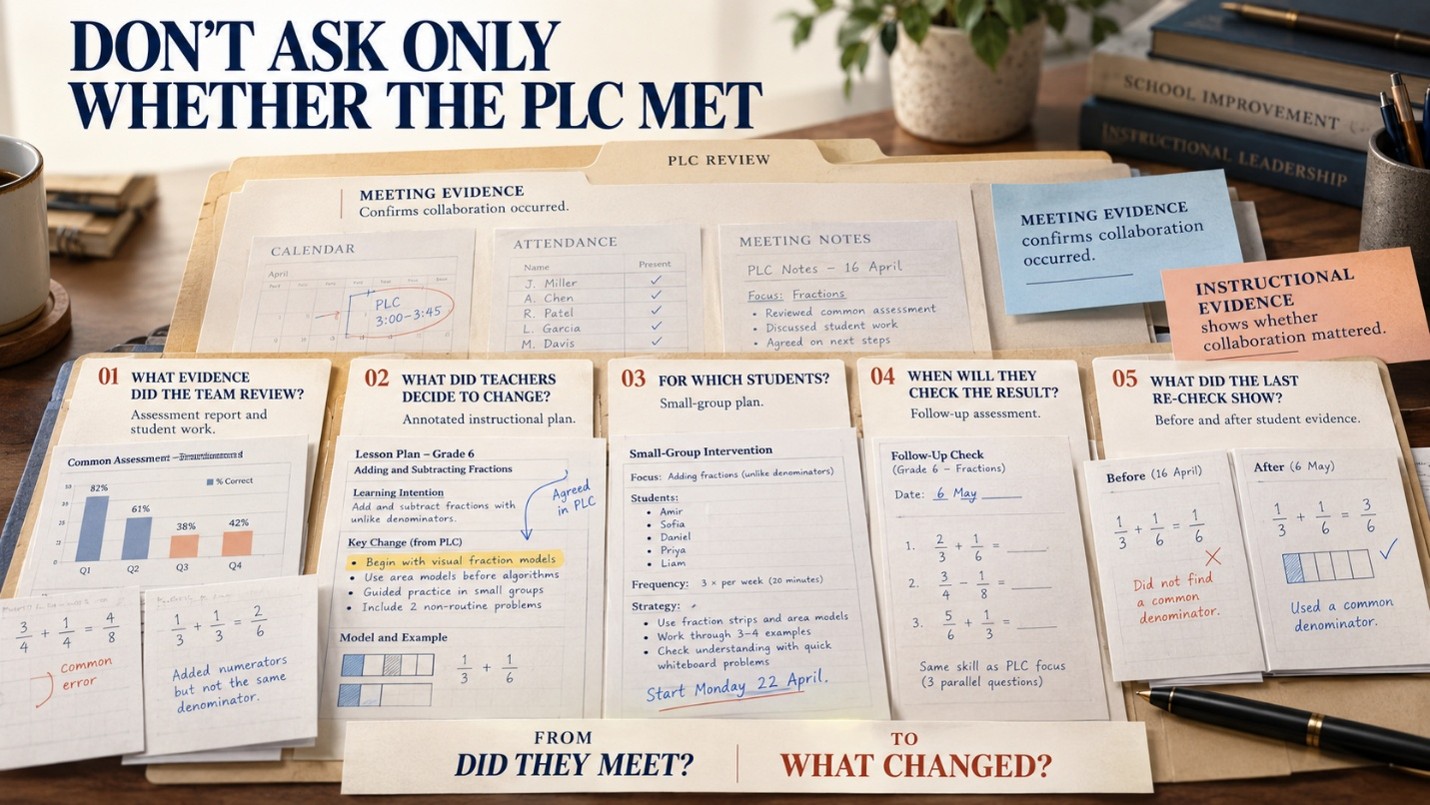
Leaders often judge PLCs by inputs: minutes scheduled, attendance taken, notes submitted. Those numbers show that the meeting happened. They do not show that it worked. More useful questions include:
- What evidence did the team look at this cycle, and was it more specific than an average?
- What did the team decide to do differently, and for which students?
- When will the team check the result, and what did the last re-check show?
- Are teams using the same common assessments on the same skills, so results can be compared fairly across classrooms and campuses?
- Do teachers share a common way of describing instruction, so “we’ll model it again” means the same thing in every room?
That last question matters more than it seems. Teams with a shared pedagogical vocabulary can agree on a strategy in minutes. Teams without one spend the meeting finding out what each person means.
At the district level, the same principle scales up. When campuses use common assessments, grade-level teams can see how their students compare with similar classes elsewhere and learn from teams getting stronger results on the same skill. Used carelessly, that comparison turns into ranking. Used well, it gives teams new ideas about evidence-based teaching practice that has already worked down the hall or across town.
Are your teams discussing students, or discussing evidence of what students can and cannot yet do?
Time Is Necessary. Purpose Is What Makes It Count.
Protected collaboration time is a real investment, and many schools have fought hard for it. But time alone does not create a professional learning community. A PLC works when every cycle starts with evidence, moves to a diagnosis, ends with a decision, and comes back to check the result.
That rhythm is also how schools build a continuous improvement culture that lasts beyond one principal or one initiative. The question for leaders is not “Are our PLCs meeting?” It is “What changed in classrooms because they met, and how do we know?”
FAQs
Q: What is a teacher professional learning community (PLC)?
A: A PLC is a team of teachers, usually by grade level or subject, who work together regularly to improve student learning. An effective PLC uses shared evidence, such as common formative assessments, to decide what to teach differently, then checks whether those changes worked.
Q: Why do many PLCs fail to improve teaching?
A: Most PLCs fail quietly rather than dramatically. Meeting time fills with logistics, data is reviewed only as averages, discussions end without a clear decision, and teams rarely check whether earlier decisions helped students. The meeting happens, but classroom practice stays the same.
Q: What should happen in an effective PLC meeting?
A: An effective PLC meeting names a target skill, reviews results below the average level, diagnoses the cause of weak performance, agrees a specific teaching response for specific students, and schedules a re-check. Every meeting should end with a decision someone can act on.
Q: What role do common formative assessments play in PLCs?
A: Common formative assessments give every teacher on the team evidence on the same skills, measured the same way. This makes it possible to compare classrooms fairly, spot shared misconceptions, and learn which teaching approaches produced stronger results.
Q: How can principals tell whether a PLC is working?
A: Instead of tracking attendance or meeting minutes, principals can ask what evidence the team reviewed, what the team decided to change, for which students, and what the last re-check showed. A working PLC can answer all three clearly.