

Picture a first-year biology teacher in a large suburban district. She is assigned a mentor in week ten of the school year. They meet twice before winter break, both times for twenty minutes after school, and mostly to complete forms for the district induction portfolio. By January, she has drawn a simple conclusion: support is just one more thing to get through.
Nobody designed her induction to fail. On paper, she had a mentor, a program and a portfolio. In practice, she had more work and very little help. That gap between having an induction program and running one well is where much of the burnout risk for new teachers sits. Coaching new early-career teachers well depends less on whether support exists and more on whether it is frequent, focused and built into the school day.
What Research Review Says Effective Induction Looks Like
One of the most useful recent summaries for US school leaders is a February 2025 brief from EdResearch for Action, Strengthening Early-Career Teachers: Effective Components of Teacher Induction Programs. It was written by Andrew Kwok and Kathy Ogden Macfarlane of Texas A&M University and produced with the Annenberg Institute at Brown University and Results for America.
The brief reviews existing studies rather than reporting a single new experiment. Its overall conclusion is that most high-quality studies find induction improves teacher retention, instructional quality and student learning. It also identifies three components with the strongest research base: individualized coaching, professional development and peer collaboration. Administrative support and workload adjustments also help new teachers, but they are less common in practice and have been studied less.
On coaching, the brief is specific. It describes regular, targeted coaching as the most effective and most researched part of induction. The strongest programs provide at least 90 minutes of coaching, weekly or every two weeks, across the whole first year. Coaching that concentrates on classroom management and subject-specific teaching strategies is the most helpful to new teachers. Among the studies the brief cites, having an induction coach was associated with a 35 to 50 percent reduction in the odds of a teacher leaving.
One honest limitation: the brief measures retention, teaching quality and student outcomes. It does not measure burnout directly. Leaving the job is not the same thing as burning out, although the two are closely related. When this article draws conclusions about burnout, those are reasonable interpretations of the evidence, not findings from it.
Poorly Run Induction Can Leave New Teachers Worse Off
The most striking part of the brief is its list of practices to avoid. The authors warn that inconsistent or poorly run programs can undermine new teachers’ confidence and raise their frustration, doing more harm than good. Their examples include coaches assigned late in the year, rare or shallow coach-teacher contact, and activities that feel irrelevant or purely procedural. They also warn against rigid, generic requirements, especially when these repeat content new teachers already learned in their preparation programs.
That list reads very much like the hypothetical biology teacher’s year. It also points to a central idea for anyone designing induction: an hour of compliance work is not an hour of support. For a new teacher who is already stretched, it costs an hour and gives nothing back.
If a district’s induction program disappeared tomorrow, would its first-year teachers have more time or less?
Six Design Choices That Make Coaching Worth a New Teacher’s Time
- Give coaching real time in the school day. About 90 minutes every week or two is very different from a monthly check-in after school. Leaders should budget that time within the schedule the same way they budget instructional time.
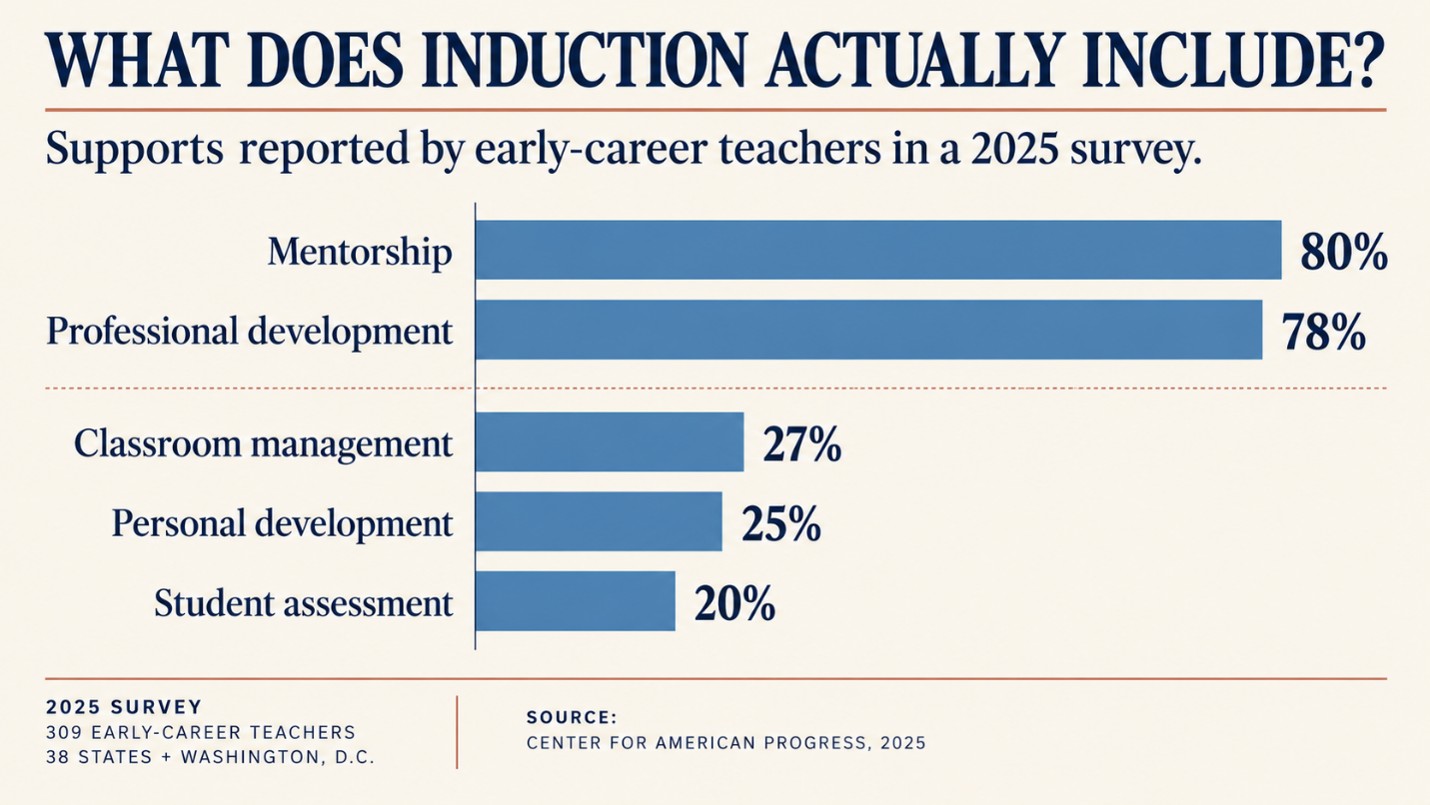
Source: Center for American Progress Early-Career Teacher Retention Survey
2. Start with classroom management and lesson planning. The brief suggests putting these core skills ahead of other professional topics. In practice, this means the district’s policy orientation can be shorter, while the first weeks of coaching focus on routines, transitions, behavior responses and planning the next lesson.
3. Match coaches carefully, then train and pay them. The brief reports that coaches from the same school or district tend to be more successful, and that matching coaches to the new teacher’s subject and grade level makes support more relevant. Trained coaches have a stronger effect than untrained ones. It also notes that stipends, reduced teaching loads or full-time coaching roles help coaches give consistent support. A mentor who has no time is a mentor in name only.
4. Coach alongside the teacher, not at them. The brief finds that expert-driven coaching, where the new teacher passively receives advice, is less effective than reflective conversations that help teachers analyze their own practice. It also warns against giving too much guidance at once. One practical implication, which is our interpretation rather than the brief’s, is that coaching should be clearly separated from formal evaluation. A well-designed instructional coaching model makes those boundaries clear, so new teachers feel safe saying a lesson went badly.
5. Put peer collaboration on the schedule. Common planning time, peer observation and regular meetings with colleagues build skills and a sense of community. Collaboration works best when it is part of a wider everyday feedback culture rather than a single monthly meeting.
6. Treat workload as part of the program. The evidence here is thinner and partly mixed. For example, studies on adding classroom aides disagree about the effect on retention. Even so, a reduced teaching load or fewer non-teaching duties gives new teachers time to observe colleagues and work on their practice. Coaching that asks for change without creating time for it may simply add to the load.
Induction should not stop in June. The brief describes induction as support during a teacher’s first one to three years, and the strongest student-achievement findings it cites come from programs that lasted two years. Districts can connect induction to longer-term teacher growth pathways so that support does not disappear just as new teachers start to find their feet.
Questions to Ask Before Next School Year
Before redesigning anything, leaders can audit what new teachers actually experience:
- Was every new teacher matched with a coach before the first day of school, or weeks later?
- How many minutes of coaching did a typical first-year teacher receive this semester, and how much of it happened during the school day?
- Are coaches matched by grade level and subject, and have they been trained?
- Which induction requirements repeat what teachers already learned in their preparation programs?
- Can each new teacher name the one thing they are working on with their coach right now?
What would change if a district judged its induction program by the minutes of focused coaching it delivered, instead of the number of activities it required?
Retention is the outcome that justifies the investment, and it is the strongest link between induction and the wider case for teacher retention. However, retention data arrive slowly. Coaching minutes, the timing of coach assignments and new teachers’ own reports of whether the support helps are earlier and more useful warning signs.
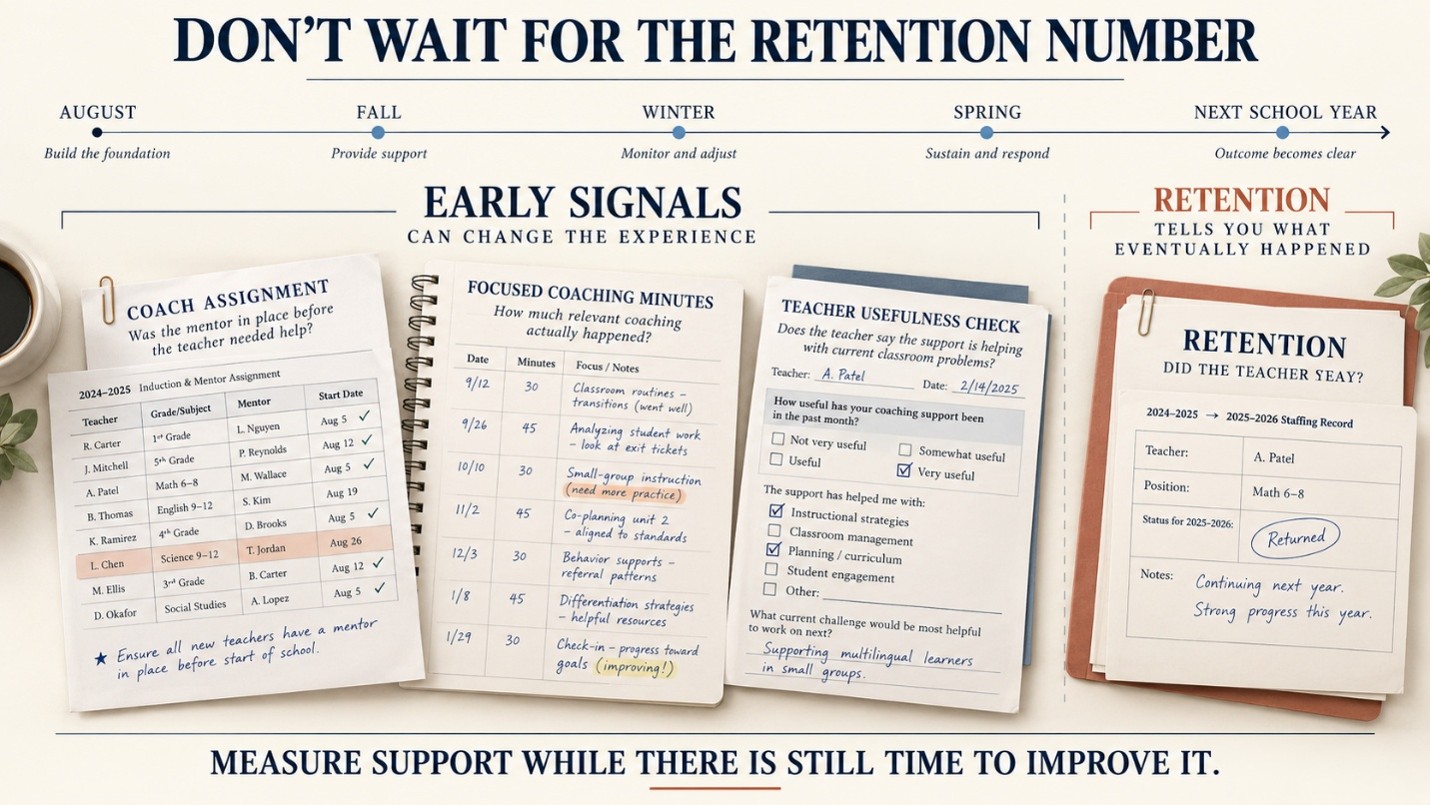
Support That Earns Its Place
The research does not suggest that new teachers need more programs. It suggests they need better ones: coaching that is frequent, matched to their classroom and focused first on behavior and planning, with time created to act on it. An induction program that cannot show the time it protects and the confidence it builds may be adding to the very burnout it was meant to prevent.
Frequently Asked Questions
What makes a new teacher induction program effective?
A 2025 EdResearch for Action review found that individualized coaching, targeted professional development and peer collaboration have the strongest research support. Effective programs offer regular coaching, ideally at least 90 minutes weekly or every two weeks, through the first year.
How often should new teachers receive coaching?
The research review reports that the most effective programs provide at least 90 minutes of coaching weekly or biweekly across the whole first year. Occasional or brief check-ins are less likely to help.
What should coaching for first-year teachers focus on first?
Classroom management and lesson planning. The research suggests prioritizing these core skills before other topics, because they are where new teachers most often struggle.
Can a poor induction program make things worse?
Yes. The review warns that inconsistent or poorly run programs, such as late coach assignments, rare or shallow meetings and generic paperwork, can lower new teachers’ confidence and increase frustration.
How long should induction last?
The review describes induction as support during the first one to three years. The strongest student-achievement findings it cites come from programs lasting two years, which suggests that one year may not be enough.