

It is the second week of August. A district has gathered every teacher in the high school auditorium for a full day of professional development. The presenter knows the material, and the slides are clear. The exit survey comes back with strong ratings. Then October arrives. Walk into twenty classrooms and you will struggle to find the strategy anywhere.
Nobody in that story did anything wrong. The teachers listened, and the presenter was competent. The failure was in the design. The day was built to deliver information, but the real challenge in teaching is putting knowledge into practice.
So why do most teacher training programs fail? Usually they stop exactly where the hard part begins. Teachers leave with ideas, but without the materials, rehearsal, feedback and follow-up they need to turn those ideas into next Tuesday’s lesson. Instructional design principles fix this by treating teacher learning the way a skilled teacher treats student learning. You start from what the learner should be able to do, plan the practice, build in feedback, and check whether anything actually changed.
A Training Event Is Not a Learning Design
Most PD is planned as an event. There is a date, a venue, a presenter and a sign-in sheet. Whether the money comes from Title II or the general fund, the planning conversation tends to be about logistics.
Instructional design starts with different questions. What should a teacher be doing differently in the classroom three weeks from now? What would that look like in an actual lesson? Where will teachers practice it before trying it with students? Who will they ask when it goes wrong on day two? How will anyone know whether it stuck?
Most districts measure attendance and satisfaction. Both are easy to collect, but neither answers those questions. They confirm the event happened. They say nothing about whether teaching changed.
Here is a fair question for any leadership team. Would a principal approve a unit plan for students that had no practice, no feedback and no check for understanding at the end? Yet that is roughly how many systems design learning for their own teachers.
What the Evidence Says About Training That Works
The recent US synthesis on this question is a research brief by Heather Hill (Harvard) and John Papay (Annenberg Institute at Brown University): Building Better PL: How to Strengthen Teacher Learning, published by the Research Partnership for Professional Learning. The authors
drew mainly on studies that identified a causal impact of PL on teaching and learning, along with recent reviews and meta-analyses.
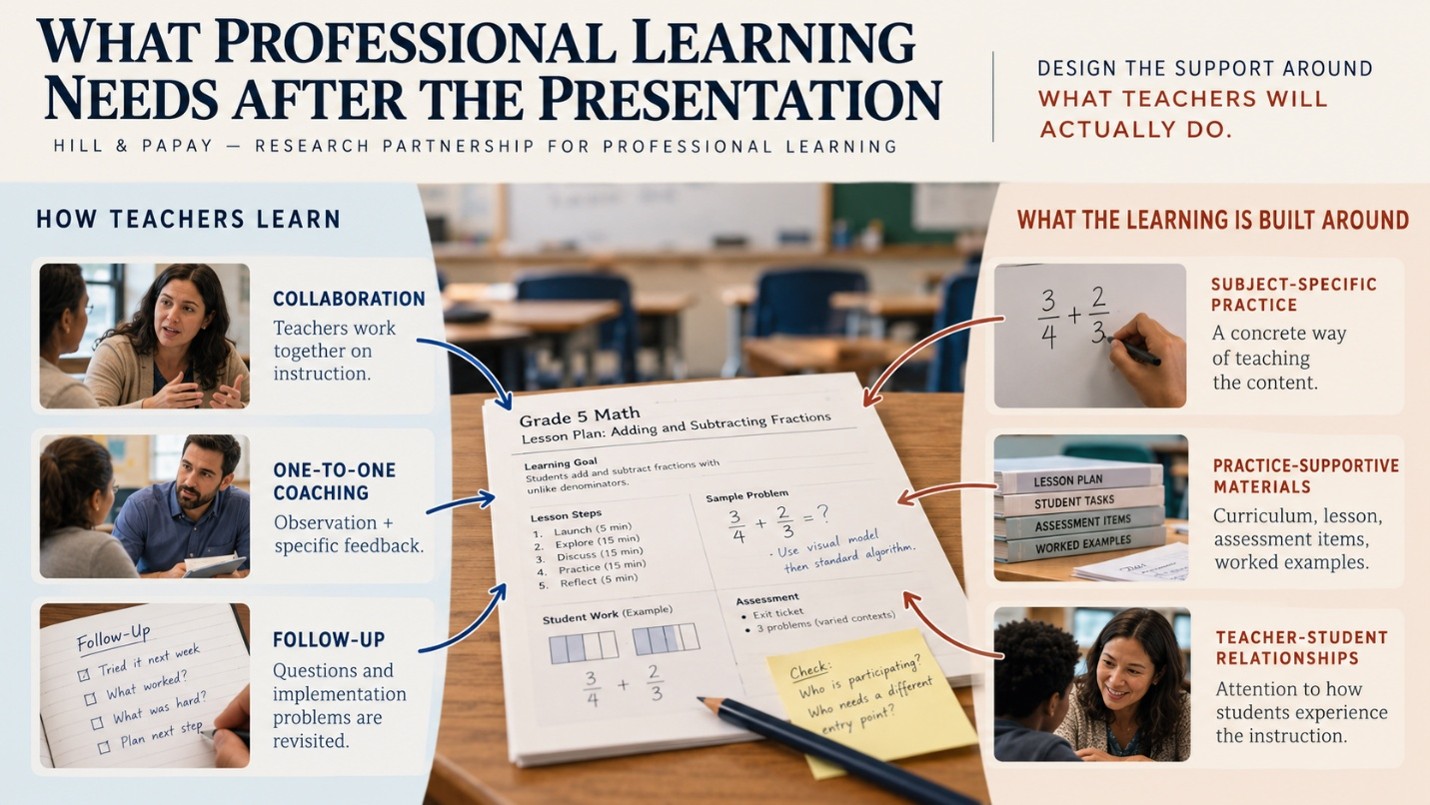
They identified six design features. Three concern how PL is delivered: built-in time for teachers to collaborate on improving instruction, one-to-one coaching where coaches observe and give feedback, and follow-up meetings that answer teachers’ questions and fine-tune implementation. The other three concern what PL covers: subject-specific instructional practices rather than content knowledge alone, concrete materials such as curricula or formative assessment items rather than general principles only, and explicit attention to teachers’ relationships with students.
Two findings stand out for anyone designing training.
The first is about practice versus knowledge. In a synthesis of 37 studies, Gonzalez and colleagues found that changes in teachers’ instructional practice brought about by a program were positively linked to changes in student outcomes, while changes in teacher knowledge were not. In one elementary science comparison the brief describes, teachers spent the same amount of time in both PD models, yet students of teachers in the lesson-analysis program outperformed those in the content-deepening program by 20 percentile points on a researcher-developed assessment.
The second is about data. The brief notes that teachers studying student data does not usually improve student outcomes, but PL appears more successful when that data is connected to materials that give specific next steps in the classroom.
The authors are careful about limits, and school leaders should be too. They describe the evidence base as relatively tentative and largely correlational, and point out that most rigorously evaluated programs are “boutique” efforts with volunteer teachers and generous resources. Much of the research also comes from STEM and ELA, so it is not yet known whether the findings generalize to all teacher learning. This does not mean every coaching program will work. It means the direction of the evidence is clear enough to design toward.
Five Instructional Design Principles That Change the Outcome

1. Start from the classroom move, not the topic. “Formative assessment” is a topic. “Asking one hinge question before independent practice and regrouping students based on their answers” is a classroom move. A teacher can rehearse a move, a coach can observe it, and a peer can give feedback on it. You cannot do any of that with a topic. Good instructional design names the observable behavior first and builds everything else backward from it.
2. Send teachers home with materials, not just principles. The brief found that practice-supportive materials beat general principles. It notes that at least two successful formative assessment programs gave teachers item banks to use regularly, while one program built on general principles alone actually lowered student achievement compared with a control group. Every principle should arrive with something teachers can use: a lesson, a set of questions, or a planning template. This is also what separates schools that talk about research from schools that are adopting evidence-based teaching practices.
3. Design rehearsal and feedback into the program. Adults learn a teaching move the same way students learn a skill: through modeling, practice and correction. That is the case for instructional coaching. The brief explains that because coaching is cyclical, accountability is built in: teachers know the coach will come back, so they may pay closer attention to putting the work into practice. One caution for US districts: coaches employed by schools are more likely to have their time taken over by administrative duties. A coaching budget does not guarantee coaching.
4. Schedule the follow-up before the launch. Successful programs often hold short follow-up sessions, usually within a month or two of the first implementation, where teachers share what happened and get feedback from peers and program staff. These sessions are cheap and often skipped. Professional learning communities that actually work are a natural home for this follow-up. When a teacher has said they will try something and has to report back next week, the follow-up creates social accountability. rpplpartnership
5. Evaluate practice and student evidence, not satisfaction. Decide before the training what evidence will show success. Classroom observation is one source. Student work and short assessments are another. This is where assessment data literacy for teachers matters. Data only helps when it points to a specific next step, not when it is reviewed and filed.
Questions to Ask Before Approving the Next PD Day
For a superintendent, principal or professional learning director, the practical test is simple. Before the next session is approved, ask:
- What will teachers do differently in the first two weeks, and in which lessons?
- What materials will teachers take back to their classrooms?
- Where is the rehearsal, and who gives feedback?
- When is the first follow-up, and who owns it?
- What evidence will show, eight weeks from now, whether practice changed?
If the answers are vague, the session is probably an event, not a design.
Constraints are real. Contract hours, sub coverage and coach caseloads all limit what is possible. But one PD day redesigned to include materials, a short practice cycle and one scheduled follow-up is often worth more than three extra days of presentation.
And one more question worth sitting with:
If a PD session earns glowing ratings and changes nothing in a single lesson, what exactly did the district pay for?
Teacher Learning Is a Pathway, Not a Calendar Date
Teacher training does not fail because teachers can’t learn. It fails because the design ends at the auditorium door. Instructional design moves the finish line into the classroom. It starts from a concrete teaching move, supports it with real materials, rehearses it, follows up, and checks whether students experienced anything different.
That shift also changes how leaders plan the year. PD stops being a set of separate days and becomes part of career-long professional development pathways, where each cycle builds on evidence from the one before.
Frequently Asked Questions
Q: Why does most teacher professional development fail?
A: Most PD fails because it is designed as a one-time event that delivers information. Teachers leave without the materials, practice, feedback and follow-up needed to change classroom routines. Without those supports, new ideas rarely make it into everyday lessons, even when teachers rate the session highly.
Q: What are instructional design principles in teacher training?
A: Instructional design principles mean planning teacher learning around a clear goal: what teachers should do differently in class. The program then includes concrete materials, rehearsal, feedback, scheduled follow-up and evidence of whether practice and student learning changed. It treats teachers as learners, the same way teachers treat students.
Q: What does research say makes teacher PD effective?
A: A 2022 US research brief by Hill and Papay identified six features linked to stronger results: teacher collaboration, one-to-one coaching, follow-up meetings, a focus on subject-specific practices, practice-supportive materials and attention to teacher-student relationships. The authors note the evidence is still tentative and mostly from STEM and ELA.
Q: Is content knowledge training useless for teachers?
A: Not useless, but often not enough on its own. The research reviewed by Hill and Papay found that changes in teaching practice were more closely linked to student gains than changes in teacher knowledge alone. Knowledge tied to the specific curriculum teachers use may matter more than abstract subject training.
Q: How should districts measure whether teacher training worked?
A: Measure changes in classroom practice and student evidence, not just attendance and satisfaction surveys. Agree in advance on what success looks like, such as observed use of a strategy or improvement on a specific skill in the next assessment, and review it at a set follow-up point.