
Take two hypothetical Grade 5 students. Both score 11 out of 20 on a fractions diagnostic. The first adds the denominators whenever she adds fractions (1/3 + 1/4 = 2/7). The second understands fractions well but loses marks on multi-step word problems because he misreads what is being asked.
Same score. Opposite next lessons. If the diagnostic assessment reports only “11/20, below expected”, it has measured something, but it has diagnosed nothing.
That is the central test for diagnostic assessment in schools. A diagnostic earns its name when it tells the teacher why a student is struggling and where to begin. Without that, it is simply an early summative test.
A Weak Result Is Where Diagnosis Starts
Schools often use the word “diagnostic” for any assessment given at the start of a year or unit. Timing does not make an assessment diagnostic. Design does. A beginning-of-year test that only returns percentages tells leaders who is behind. It does not tell teachers what the students are missing or which gap to close first.
This distinction also shapes the wider assessment system. A diagnostic answers a different question from the end-of-term test or the network benchmark. formative vs summative assessment explains where each type sits.
What a Diagnostic Assessment Should Reveal
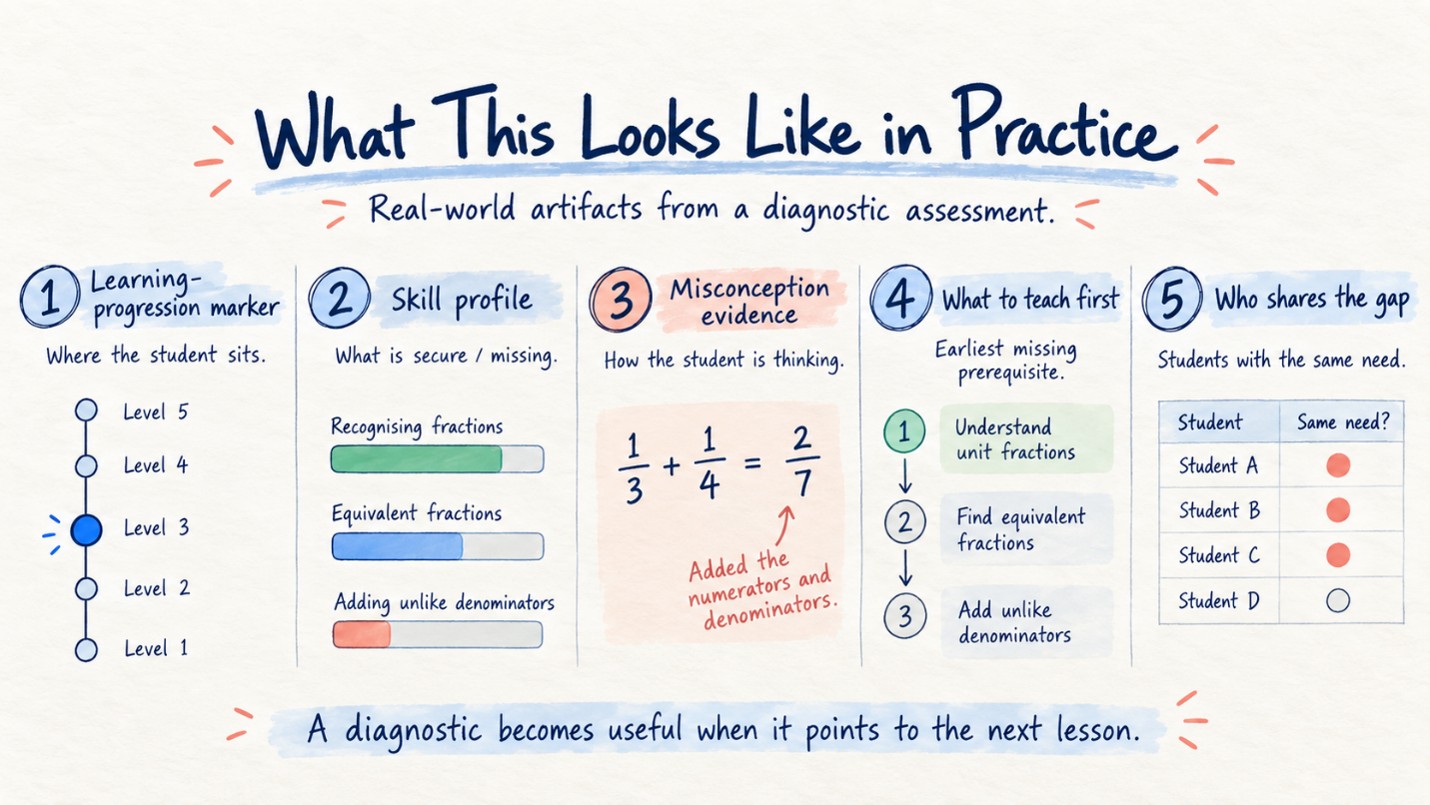
| What the teacher needs to know | What it looks like in the report | What the assessment design needs |
| Starting point: where the student sits on the learning progression | A position on a scale or a progression level, not just “below grade” | Items that reach below and above grade level |
| Secure and missing skills | Results by sub-skill | Several items tagged to each sub-skill |
| Error pattern or misconception | The type of wrong answer, not only that it was wrong | Answer options built from known errors |
| What to teach first | The earliest missing prerequisite | A model of how skills build on each other |
| Who shares the gap | Groups of students with the same need | Consistent tagging across all items |
The third row is often missing. A multiple-choice question where every wrong option reflects a real misconception can tell a teacher far more than a question with random wrong options. The student who picks 2/7 has revealed their thinking. For more on separating these kinds of gaps, see when reteaching content is the wrong response.
Diagnosis Needs a Map of How Learning Develops
You cannot say what to teach first unless you know which skills come before which. That is why diagnosis depends on a model of progression.
A 2022 systematic review in the Review of Educational Research examined 59 studies of assessments built on learning progressions and found evidence that they can support teacher judgements, inform teaching decisions and help teachers develop their own practice. (Harris, Adie & Wyatt-Smith)
The same review is careful about limits. Of the 23 studies that measured student achievement, all reported positive overall effects, but only six used experimental designs strong enough for causal claims.
Formative uses were well supported, while evidence for summative and accountability uses was limited. The authors also found trade-offs between these assessments and standardization at scale, and noted that teachers need room to negotiate their judgements within existing curriculum and policy. ERIC
For school leaders, the implication is practical. A diagnostic built on a clear progression can point to a starting point. A diagnostic built only on a list of grade-level standards can tell you what is missing, but not what order to fix it in. The review does not prove that progression-based diagnostics raise attainment on their own; the causal evidence is still thin.
Four Ways Diagnostic Assessments Fail
- Too few items per skill. One question per sub-skill cannot separate a gap from a careless slip.
- Pitched only at grade level. If a student is three years behind, a grade-level test only shows that they failed. It does not show where they are secure.
- Reported as a percentage. Percentages hide the pattern that makes diagnosis possible.
- No plan for what happens next. A diagnosis that does not feed a teaching plan within days loses most of its value.
Adaptive testing can help with the second problem, because it adjusts difficulty to find a student’s level more precisely. That is a gain in measurement. It is not the same as proof that teaching will improve. The teacher still has to act on the result, as covered in what happens between a test result and better teaching.
A question worth asking:
If a diagnostic assessment returns a score and a colour but no reason, has anything actually been diagnosed?
Questions Leaders Should Ask Before Adopting a Diagnostic
- Can the assessment show a starting point below grade level?
- How many items sit behind each sub-skill judgement?
- Are wrong-answer options designed to reveal specific misconceptions?
- Does the report group students by shared need?
- How quickly do results reach teachers, and what planning time follows?
Leaders who want to see how this looks at the skill level can continue with tracing a weak score to a specific skill. The reporting side is covered in competency reports that lead to a teaching decision.
The Point of Diagnosis Is the First Lesson After It
A good diagnostic assessment should change the first lesson a teacher teaches after it. If it cannot say why a student struggled and where to begin, it is a measurement exercise with a hopeful name. The schools that get value from diagnostics are the ones that design for the explanation, not just the score.
Frequently Asked Questions
What is a diagnostic assessment in schools?
It is an assessment designed to identify what a student knows, what they are missing, and why, so the teacher can plan where to start.
How is diagnostic assessment different from formative assessment?
Diagnostic assessment usually comes before a unit or intervention and aims to find the starting point. Formative assessment happens during learning to adjust teaching as it goes.
Is a beginning-of-year test automatically diagnostic?
No. It becomes diagnostic only if it reports skill-level gaps and error patterns, not just an overall score.
Can adaptive testing replace teacher judgement in diagnosis?
No. It can locate a student’s level more precisely, but the teacher still has to interpret the pattern and decide the response.