

A Grade 7 science teacher writes a strong question on a Sunday evening. It is clear, it fits the unit, and her students answer it well. Because it asks students to “explain”, she tags it as DOK 3 and adds it to the shared bank. Three months later, the same question appears in a benchmark paper sat across five campuses. The report says Grade 7 students are strong at strategic thinking in science. Nobody questions it, because the chart looks clean.
But the question only asked students to restate a definition in their own words. It was a recall item carrying a strategic-thinking label.
Nobody in that story did anything wrong, and that is exactly the problem. The school had a way to write questions. It did not have a way to publish them.
Here is the short answer to the title. Almost anyone with subject knowledge should be able to write and suggest a question. Far fewer people should be able to publish one. And no one should publish their own question without a second person checking it against criteria the school has agreed in advance. That is the core of good assessment item bank governance.
Publishing a Question Is a Decision About Evidence
Writing a question is a teaching act. Publishing it into a shared bank is something different. Once an item is live, it stops belonging to one classroom. It shapes competency reports, feeds difficulty estimates, appears in benchmark papers and may influence which students are grouped for intervention.
A shared bank multiplies whatever goes into it. A well-written, correctly tagged item improves every assessment it appears in. A weak or mislabeled item damages them all, and does it quietly, because reports rarely show where a question came from.
So the real question for leaders is not “who is allowed to contribute?” It is “whose judgement do our reports carry when they use this question?”
Why “Let the Subject Expert Decide” Is Not Enough
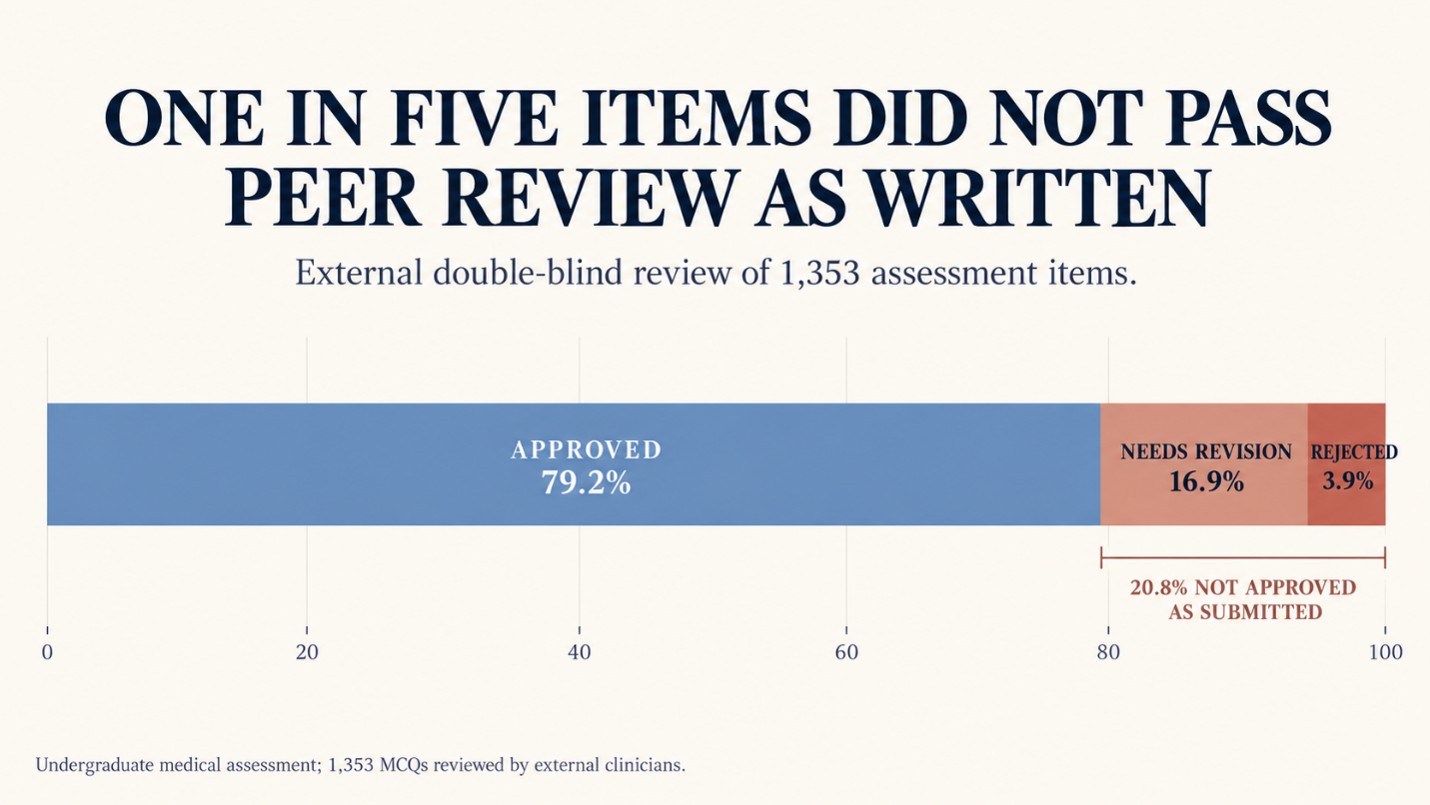
Source: Smeby et al.
Most schools default to trust. If the Head of Mathematics wrote a question, it goes in. Expertise matters, and subject knowledge must sit at the center of any review. But expertise does not remove blind spots, especially in your own work.
Authors are the people least likely to notice that a question has two defensible answers, that the reading load is harder than the maths, or that the DOK tag describes the verb rather than the thinking. These are not signs of weak teachers. They are normal limits of reviewing something you created.
Seniority is also a poor filter on its own. A senior leader with no time to review carefully is a weaker gatekeeper than a trained peer who works through a clear checklist. The principle that holds up best is simple: the person who approves an item should not be the person who wrote it.
Separate the Right to Write From the Right to Publish
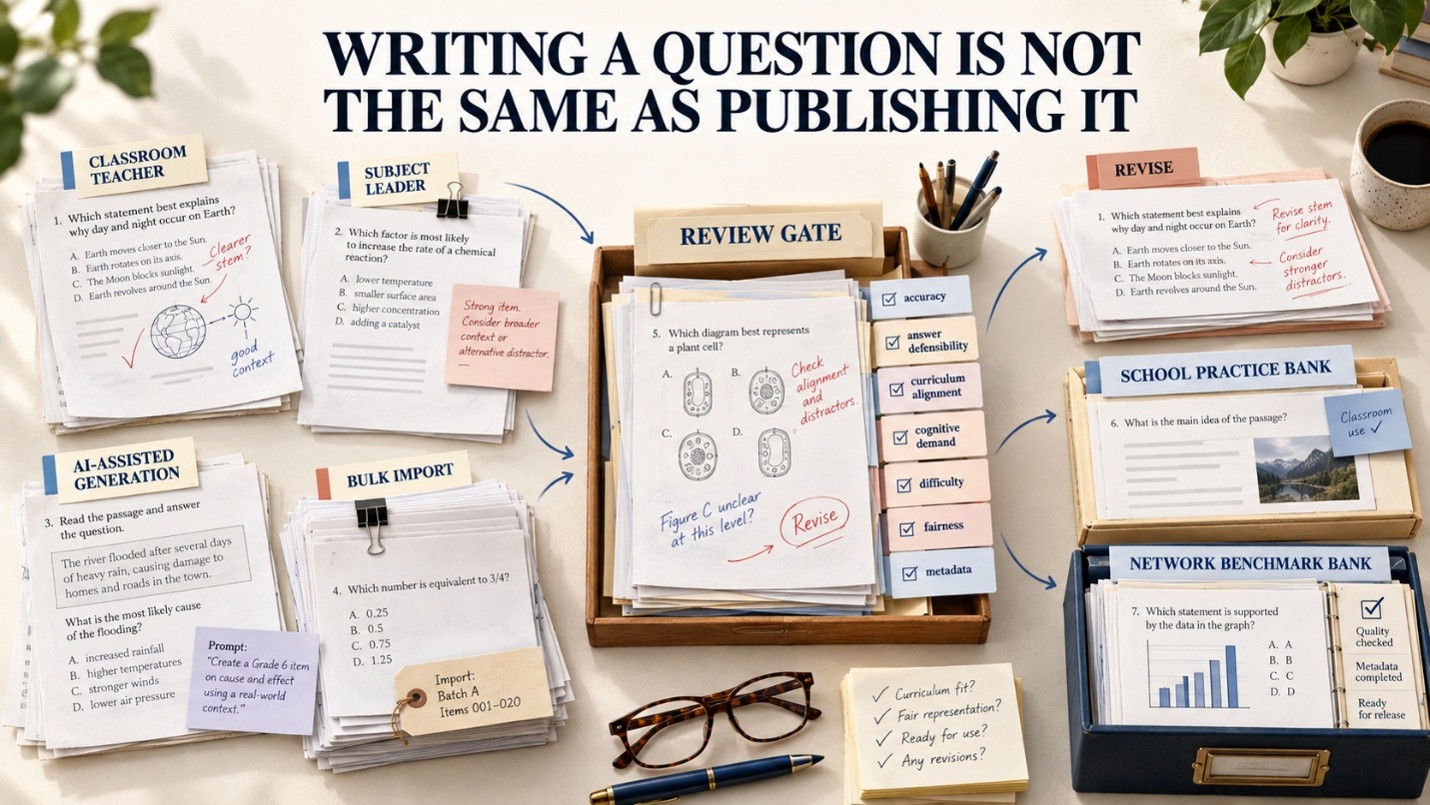
A workable question bank review process gives different people different rights. The table below shows one practical way to divide them.
| Role | Should be able to | Should not do alone |
| Classroom teacher | Draft items, suggest edits, flag problems with live items | Publish their own items into the shared bank |
| AI generation tool | Produce draft items from a clear specification | Place any item into live use |
| Subject reviewer (trained peer or Head of Department) | Check accuracy, wording, answer key and tags; approve or reject | Approve items they wrote themselves |
| Head of Assessment / Assessment Coordinator | Set review criteria, audit samples, manage blueprint coverage, decide on retirement | Personally review every item, which creates a bottleneck |
| School-group assessment team | Approve items for shared benchmark use across campuses | Override local practice banks without a clear reason |
For school groups, one extra layer helps. Consider two tiers of bank. A school-level practice bank can accept items with a lighter review, because they support classroom checks. A network benchmark bank needs a higher bar, because its results are compared across campuses. Mixing the two is how a quick Friday quiz item ends up in a board report.
What a Reviewer Should Actually Check
A review is only as good as the checklist behind it. At minimum, a reviewer should ask:
- Is the content accurate, and is there exactly one defensible correct answer?
- Does the item really assess the standard and competency it is tagged to?
- Does the thinking it demands match its DOK level, not just its command verb? This is where Bloom taxonomy vs depth of knowledge becomes practical.
- Is the difficulty estimate realistic for the grade?
- Could language, reading load or cultural assumptions block a student who knows the content?
- Does the feedback text help a student understand the error?
- Does the item fill a real gap in the bank, or add a fortieth version of something already well covered? A clear assessment blueprint design answers this quickly.
The last point is often forgotten. A bank with 3,000 recall items and 40 reasoning items will always produce assessments that lean towards recall, however carefully each paper is assembled.
AI Raises the Volume, Not the Standard
AI-assisted generation changes the pressure on review. A tool can produce fifty draft items in a few minutes. A careful reviewer cannot check fifty items in a few minutes. Review capacity, not authoring time, becomes the real constraint.
The risk here is not that AI writes bad questions. Some will be good. The risk is that reviewers start approving in bulk because the queue is long. AI-generated items should pass through exactly the same gate as human-written ones, with the same criteria. It also helps to generate against a specific blueprint gap rather than generating for volume. The wider principle is explored in human oversight of AI-assisted assessment.
Governance Also Means Knowing When a Question Should Leave
Most item bank policies focus on the way in. Fewer think about the way out.
Questions should be reviewed again when the curriculum changes, when an item has been used so often that students may remember it, or when response data looks odd. An item that almost every student gets right, or that strong students miss more often than weaker ones, is telling you something.
Retiring an item should not delete it. Past reports used that question, and their history needs to stay readable.
If a question has been live for three years and nobody has looked at how students answered it, is it still evidence, or just habit?
A Practical Starting Point for School Leaders
Item bank quality control does not need a large team to begin. Leaders can start with five steps:
- Write down the lifecycle states every item passes through.
- Name your reviewers and train them on one shared checklist.
- Make self-approval impossible, not just discouraged.
- Audit a small sample of live items each term.
- Set a higher bar for any item used in cross-school benchmarks.
Treat this as part of your wider quality assurance for academic standards, not as a separate admin task.
The Bank Carries Someone’s Judgement Either Way
Every report built on an item bank carries someone’s professional judgement. The only question is whether that judgement was checked.
When your benchmark report says a cohort is weak at reasoning, how confident are you that the questions behind it were ever reviewed for reasoning at all?
Schools that answer that question well do not restrict who can contribute. They restrict who can publish, and they are clear about why.
Frequently Asked Questions
Who should approve questions for a school item bank?
A trained subject reviewer who did not write the item should approve it. Heads of Assessment should set the review criteria and audit samples, rather than personally checking every question.
Should teachers be allowed to add their own questions to the item bank?
Yes, as drafts. Teachers are often the best source of good items. Their questions should still pass a second review before they become available for live assessments.
Do AI-generated questions need a different review process?
They need the same review, applied with the same care. The main difference is volume. Schools should plan reviewer time before generating large batches of items.
What should a question bank review checklist include?
Content accuracy, a single correct answer, standard and competency alignment, a DOK level that matches the thinking required, a realistic difficulty estimate, language fairness and useful feedback.
How often should items in a question bank be reviewed again?
At least whenever the curriculum changes, and whenever response data looks unusual. A small sample audit each term helps catch problems before they reach benchmark reports.
Should school groups use one shared item bank or separate banks?
Many groups benefit from two tiers: a school-level practice bank with lighter review, and a network benchmark bank with a higher approval bar for comparable results.