

A group of six schools moves onto one assessment system. After the first term, the group report shows one campus clearly at the bottom. The board asks questions, and the principal is called in.
Then the details come out. That campus ran the test two weeks earlier than the others, before a key unit had been taught. Another school used paper and typed marks in by hand. A third left out a class with poor attendance. All six schools used the same system, but in practice they sat six different tests.
This is the most common failure in school assessment system implementation, and the cause is not the software. Implementing a shared assessment system across a school group means first agreeing on four things:
- a common structure of grades, subjects and competencies
- a common calendar of assessment cycles
- common delivery conditions
- a common route from result to action
The software comes after those agreements. Without them, a group gets shared screens but not shared evidence.
A Shared Login Is Not a Shared Assessment System
Many groups treat implementation as a technology rollout: accounts created, training done, first test launched. It is better understood as three layers that have to be built in order.
The first layer is shared vocabulary. Every school must report against the same grades, subjects and competency framework. If one campus groups “fractions” under number and another under measurement, the group cannot compare them, however good the dashboard looks.
The second layer is a shared instrument and cycle. The same assessment, given in the same window, labelled as the same cycle, so that a mid-year result in one school means the same as a mid-year result in another.
The third layer is a shared response. Results have to lead somewhere that every school understands: diagnosis, a plan and reassessment. Without this layer, the group has a reporting system, not an assessment system.
Comparability Is Designed Before the First Test
School groups usually want comparison above everything else. Comparison is something a group has to design, though; it does not come with the system. Timing, delivery mode, curriculum pacing and participation all shape a result before any student answers a question. Leaders who want to understand this in depth should look at what makes assessment results comparable across schools making assessment results comparable across schools.
Participation deserves special attention. If one school quietly leaves out its weakest students, its average rises while its learning stays the same. Before reading any group report, check who actually took the assessment checking who took the assessment.
If seven schools sit the same test in seven different weeks, under seven different conditions, is the group comparing schools or comparing circumstances?
Comparability does not mean every school must do everything the same way. The real decision is which parts are standardised and which stay local.
| Area | Standardize across the group | Leave to each school |
| Grades, subjects, competency framework | Yes. This is the shared vocabulary. | Local labels can sit on top. |
| Benchmark assessments (start, middle, end of year) | Same instrument, same window, same cycle label | Room set-up and timetabling |
| Participation rules | Who must sit, and how absences are recorded | Catch-up sessions for absent students |
| Classroom formative assessment | Not required | Teacher judgement and local practice |
| Response to results | A common route: diagnose, plan, reassess | The actual teaching strategy chosen |
| Paper or digital delivery | Results must land in the same record | Mode can depend on grade or bandwidth |
A group that standardizes everything creates resistance and extra workload. A group that standardizes nothing ends up with numbers that cannot be compared. The table above is a starting point for that conversation, not a fixed rule.
The Rollout Sequence That Protects the Data
Groups often launch across every school at once because it feels fair. A phased rollout usually protects the data better, because problems surface while they are still small.
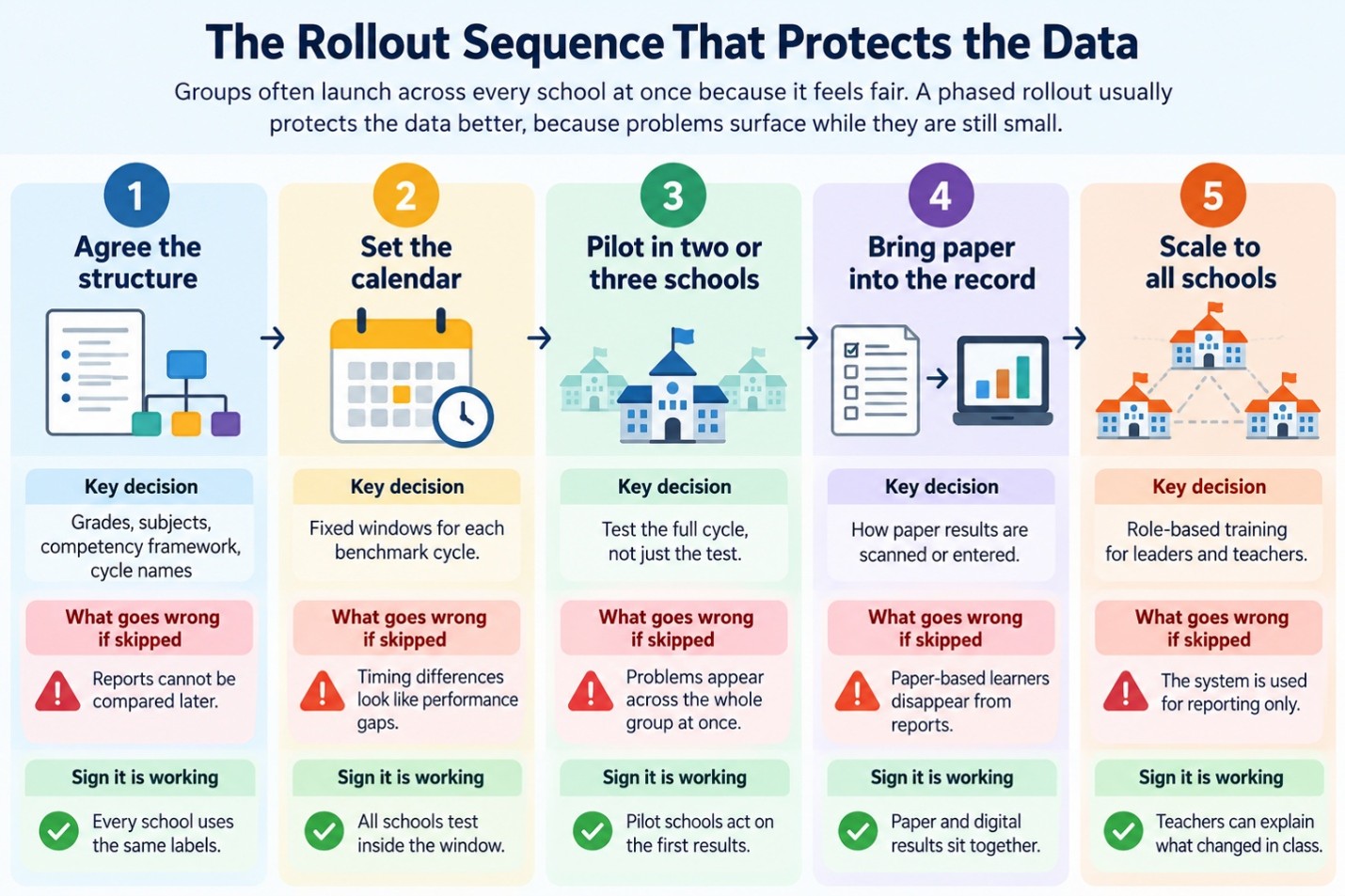
When choosing the system itself, groups should judge it on the whole journey from item design to classroom action, not only on its dashboards assessment platform evaluation criteria. Groups with primary grades or low-bandwidth campuses should plan early for how paper assessments can contribute to a shared evidence system paper and digital assessment integration.
Teachers Decide Whether the System Is Actually Used
A shared system is usually bought at group level but lived at classroom level. If teachers see it only as a way for head office to watch them, they will complete the tests and ignore the reports.
Two things help. First, teachers need to see their own classes, skills and students, not just a school average. Second, they need the confidence to read a report and turn it into a teaching decision they can test. That skill does not appear by itself; it has to be built, through work such as helping teachers turn assessment reports into testable teaching decisions building teachers’ assessment data literacy.
Group leaders also set the tone. If the first group meeting ranks schools by average score and nothing else, every principal learns that the system exists to judge them. Putting growth beside attainment, and asking what each school plans to do next, sends a very different message.
What Leaders Should Check After the First Cycle
The first cycle is the real test of implementation. Before presenting results to a board, leaders should ask:
- Did every school test inside the agreed window?
- Is participation similar across schools, and are absences recorded the same way?
- Did paper-based results reach the same record as digital ones?
- Can each principal name one grade or competency they will act on?
- Has a single teaching plan actually changed because of these results?
- Is reassessment already scheduled, so the group will know whether the action worked?
If the group report changes nothing in a single classroom, who was the shared system really built for?
Shared Evidence Is Built on Shared Agreement
A shared assessment system is a set of agreements first and software second. Groups that agree on structure, timing, participation and follow-up get evidence they can compare and act on. Groups that skip those agreements get a faster way to produce numbers that mean different things in different schools. The best measure of implementation is not how many tests were run, but how many teaching decisions improved because of them.
Frequently Asked Questions
What is a shared assessment system for a school group?
It is one common approach to assessment across all schools in a group. Every school uses the same grades, subjects, competency framework, assessment cycles and process for acting on results, so that evidence can be compared and used at every level.
How long does it take to implement a shared assessment system across a school group?
It depends on the size of the group and on how different the schools’ current practices are. A sensible approach is to agree the structure first, pilot one full assessment cycle in a few schools, and only then scale up. Treat the first full cycle as part of implementation, not as the end of it.
Should every school in the group use the same assessments?
For benchmark assessments, yes: the same instrument, in the same window, under similar conditions. Day-to-day classroom assessment can stay local, so teachers keep their professional judgement.
Can paper and digital assessments work in one shared system?
Yes, as long as paper results are entered or scanned into the same record as digital results. Otherwise, students who sit paper tests, often younger students or those on low-bandwidth campuses, disappear from group reports.
How do you stop a shared assessment system from becoming a league table?
Report growth alongside attainment, check participation before comparing schools, and make every group review end with what each school will do next, not just where it ranks.