
Picture two lesson observations filed on the same afternoon.
In a Grade 7 maths class, the teacher asks, “Is everyone clear?” A few students nod, and the observer ticks checks for understanding.
Next door, in Grade 7 history, every student writes a one-line claim on a mini-whiteboard, backs it with one piece of evidence, and holds it up. The teacher sees that a third of the class has confused a cause with a consequence, and changes the next activity on the spot. The observer ticks the same box.
The indicator, the tick and the rating were all the same, but the teaching was very different. This is a hypothetical example, but most academic leaders will recognise it.
So, are there teaching quality indicators that genuinely work across every subject and curriculum? Yes, a small number do. The evidence suggests they work best as shared questions that each subject answers in its own way, rather than as a universal checklist. And the most important indicator is something the teacher does not do: it is what students can show they now understand.
What “Curriculum-Agnostic” Should Actually Mean
The demand for curriculum-agnostic teaching effectiveness metrics is real. A school group may run IB, British, American and national curricula side by side. Leaders need one language to discuss teaching across all of them, without writing a new framework for every programme.
The risk is that “works everywhere” quietly turns into “easy to see everywhere”. Learning objectives on the board, group work, and a plenary at the end all show up in any subject. They can also be present in a lesson where very little learning happens.
A useful curriculum-agnostic indicator describes the quality of thinking and interaction in a classroom. It does not just record whether a visible routine took place.
The Research Agrees on the Broad Shape of Good Teaching
The OECD’s 2025 report Unlocking High-Quality Teaching is one of the most useful recent attempts to describe teaching in a way that works across systems. It focuses on 20 practices that support five key goals of high-quality teaching, and it built on qualitative insights from more than 150 schools in 40 countries.
The five goals are ensuring cognitive engagement, crafting quality subject content, providing social-emotional support and fostering classroom interaction, along with using formative assessment and feedback, where practices include learning goals, diagnosing student learning, and feedback. The report also notes that empirical studies have generally agreed that three broad dimensions (classroom management, social-emotional support, and strategies for engaging and supporting learners) are useful perspectives for assessing classroom teaching quality.
Two details deserve attention.
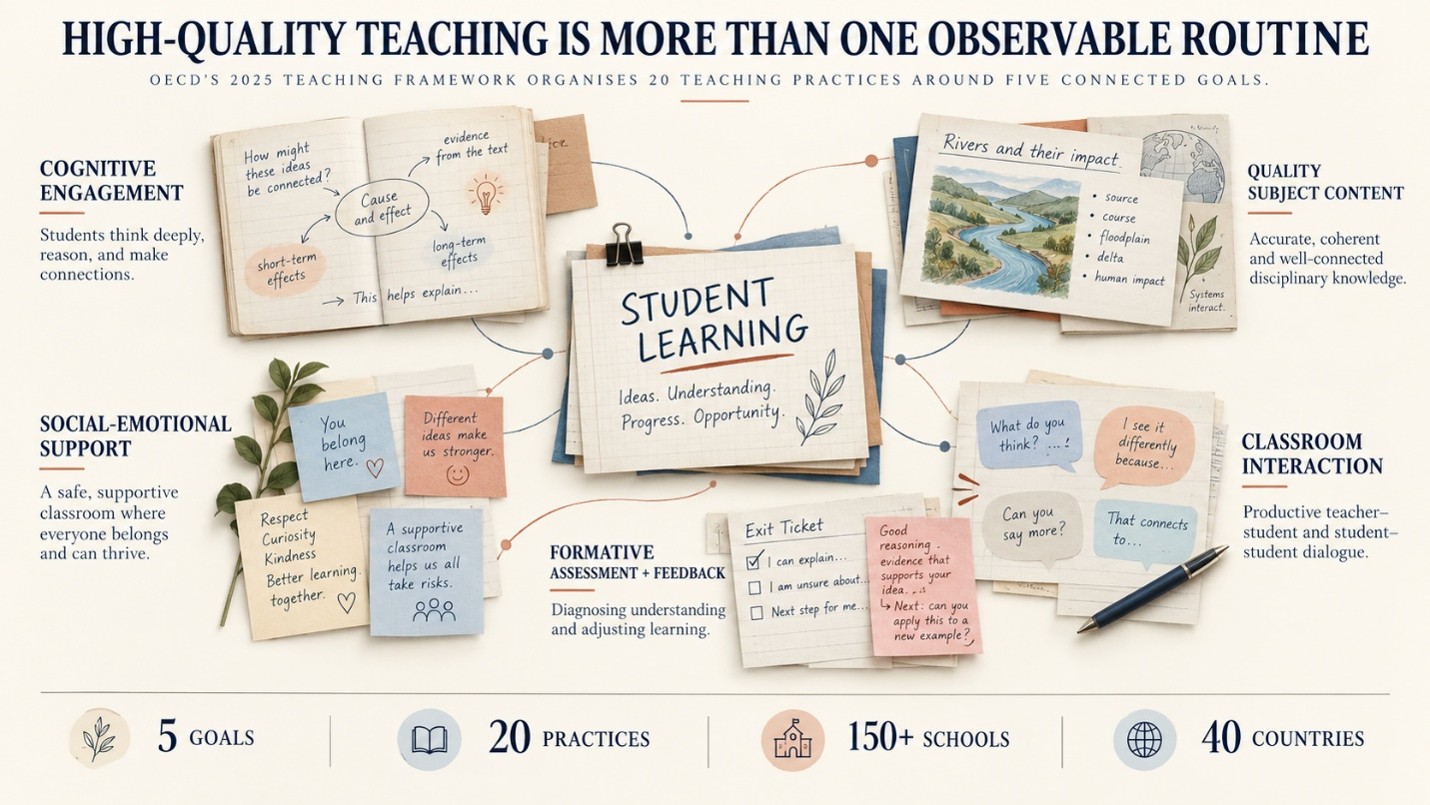
First, even this cross-system framework keeps the subject in view. Its practices for quality subject content include crafting explanations, clarity, accuracy and coherence, making connections, and the nature of the subject. A framework that tries to remove subject knowledge entirely has moved away from where the research points. oecd
Second, the report treats teaching as judgement rather than compliance. It states that high-quality teaching requires flexible, context-sensitive decision-making that combines evidence with professional judgement. oecd
Some Indicators Travel Well. Others Need a Subject Lens.
A 2024 study in School Effectiveness and School Improvement, tested how “generic” these dimensions really are. It drew on TIMSS student questionnaires, which asked about cognitive activation, supportive climate and classroom management in mathematics and science classes. doi
The result was uneven. For cognitive activation and supportive climate, the correlation across subjects was small and not statistically meaningful, whereas the correlation for classroom management across subjects was high and statistically meaningful.
This finding needs care. The study used primary students’ perceptions, not student achievement, and it compared two subjects. It does not show that any dimension matters more for learning.
For school leaders, one reasonable implication is this: routines and the use of learning time may look similar from one classroom to the next, but intellectual challenge and support are closely tied to the content being taught. Cognitive challenge in maths might mean explaining why a method works. In English literature, it might mean defending an interpretation against a counter-reading. The question is the same in both subjects, but the evidence that answers it looks different.
Six Questions That Hold in Every Classroom
Drawing on the OECD goals, here are six questions any observer can ask in any subject:
- Is learning time protected? Are routines clear, transitions short, and disruptions handled? This is the foundation, and the one that appears to travel best across subjects.
- Are students thinking hard about the right thing? Are tasks pitched so students have to reason, not just copy or recall?
- Is the content accurate, clear and connected? This usually needs a subject specialist to judge well.
- Do students feel safe enough to be wrong? Do mistakes get used, or hidden?
- Who is doing the talking, and about what? Do students explain, question and build on each other’s ideas?
- Does the teacher know what students understood before moving on? This is the heart of formative assessment within a whole-school strategy.
Notice that every question is about students. None of them can be answered by looking only at the teacher.
An Indicator Is a Question, Not a Score
Go back to the two lessons at the start. The same tick hid a real difference because the indicator recorded a teacher behaviour, not a student response.
If an observer can tick every box on the form without knowing whether a single student learned anything, what exactly is the form measuring?
This is why observation should not stand alone. If observation records rate “checks for understanding” highly across a department, but assessment results show the same misconception surviving in every class, the two pieces of evidence disagree. That disagreement is useful. It points to a conversation worth having.
It also matters how the evidence is used. The OECD stresses that high-quality teaching is not solely about teachers, and factors such as class size, curriculum design, and school culture also play important roles. Indicators used to rank individual teachers tend to produce performance for the observer. Indicators used for development, as discussed in teacher evaluation frameworks that support growth, tend to produce honest evidence. cnaes
What This Means for School Groups
For a multi-school or multi-curriculum group, a workable approach looks like this:
- Keep the common indicators few. Five or six shared questions are easier to apply well than forty look-fors applied badly.
- Write subject look-fors with heads of department. The shared question stays fixed, and each department describes what strong evidence looks like in its subject. This is where a whole-school pedagogy framework earns its value.
- Calibrate observers across subjects. Joint observations, where a maths lead and an English lead watch the same lesson, quickly show where ratings drift.
- Triangulate. Put observation notes beside student work and assessment evidence before drawing conclusions.
- Connect findings to support. An indicator that flags a weakness should lead into an instructional coaching model, not just a lower rating.
Would your strongest physics teacher and your strongest Grade 2 teacher score highly on your framework for the same reasons?
If the honest answer is no, the framework may be measuring familiarity with its own vocabulary rather than teaching quality.
Common Language First, Subject Lens Second
Curriculum-agnostic indicators are worth building. A school group without a shared language for teaching cannot compare, support or improve consistently. But the strongest frameworks treat each indicator as a shared question, answered with subject-specific evidence and checked against what students actually learned.
That is the difference between a framework that describes teaching and one that helps improve it. The next step is fitting these indicators into a usable teaching and learning effectiveness framework.
Frequently Asked Questions
Q: What are curriculum-agnostic teaching quality indicators?
A: They are indicators of teaching quality that apply in any subject or curriculum. Examples include how well learning time is used, whether students are cognitively challenged, and whether teachers check understanding before moving on. They describe the quality of thinking and interaction in a lesson, not specific content.
Q: Which teaching quality indicators apply to every subject?
A: Research commonly groups them into classroom management, student support and cognitive engagement. The OECD’s 2025 report adds quality subject content, classroom interaction, and formative assessment and feedback. Recent evidence suggests classroom management looks the most consistent across subjects, while challenge and support depend more on the content.
Q: Can one observation framework work across IB, British and national curricula?
A: Yes, if the framework fixes the shared questions and lets each subject or programme define what strong evidence looks like. A single checklist with no subject detail tends to reward visible routines over real learning.
Q: Are generic indicators enough to judge teaching quality?
A: No. They are a starting point. Subject expertise is needed to judge content accuracy and intellectual challenge, and student evidence is needed to check whether the teaching worked.
Q: How should school groups use teaching quality indicators fairly?
A: Keep the indicators few, calibrate observers across subjects, combine observation with student work and assessment data, and use the findings for coaching and development rather than ranking.
Q: How do teaching quality indicators connect to student assessment data?
A: Observation shows what happened in the lesson. Assessment shows what students can now do. When the two disagree, for example strong observation ratings next to a persistent misconception, that gap is a useful signal for leaders to investigate.