

Picture a teacher in late May. She receives her annual observation report. It runs to three pages, is carefully written, and lists two strengths and three “areas for development.” Some of it is useful. But the lesson it describes happened six weeks ago, the class has moved on, and the next formal observation is a year away. By September, the report sits in a folder nobody opens.
Now picture one of her students getting back an end-of-unit test with a thoughtful comment at the bottom. The unit is finished and the next topic starts tomorrow. The comment is read once, perhaps, and then the paper goes into a bag.
Both of these are feedback, and both took real effort. Both also arrived after the moment when they could have changed anything.
That is the difference between a feedback event and a feedback-rich teaching culture. An event is scheduled, formal and occasional. A culture is a set of small, ordinary habits that let people adjust while the work is still happening. Most schools have plenty of feedback events. Far fewer have built the habit.
An Event Tells People Where They Were. A Habit Shapes Where They Go Next.
Annual appraisals, termly reports and formal observations have a place. They create a record, support accountability and give leaders a view across the year. The trouble starts when schools treat them as the main way feedback happens.
Feedback is useful in proportion to how soon it can be used. A comment on Tuesday’s misconception helps on Wednesday. The same comment in June is a historical note. Teachers work the same way: advice on questioning is most useful when the teacher can try it in the next lesson and get a second look a week later.
So the most useful question for leaders is about distance. How short is the gap between a piece of feedback and the next attempt?
More Feedback Is Not the Same as a Feedback Culture
When schools decide feedback matters, the first response is often to ask for more of it: more written comments, more marking, more observation forms. The result can be a heavier workload with little change in learning.
Volume tends to create three problems. Teachers spend hours writing comments that students skim. Students learn that feedback is something you receive rather than something you use. Leaders end up checking compliance (whether the comment exists in the exercise book) instead of whether anything improved.
A school can have a strict marking policy and a weak feedback culture at the same time.
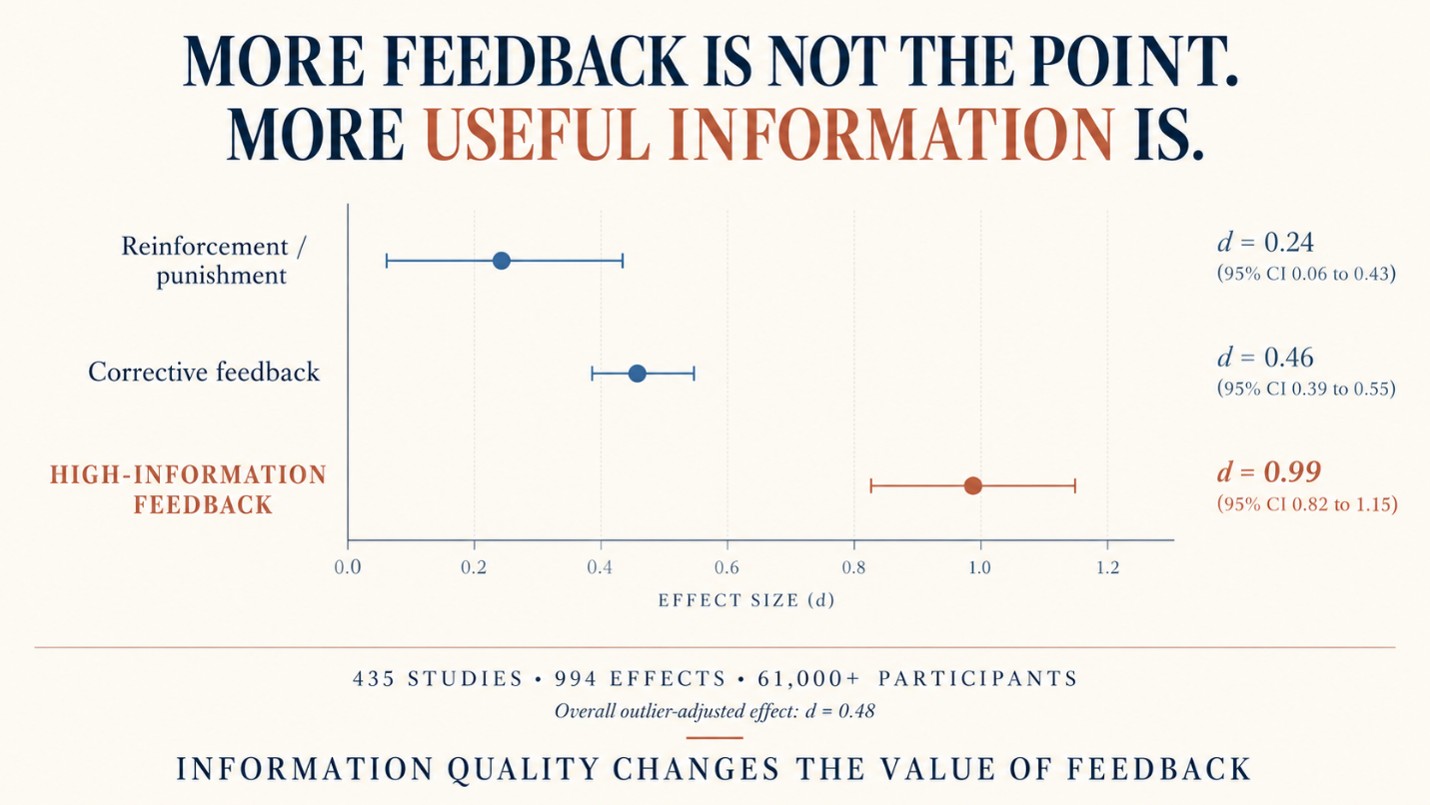
Source: Wisniewski, Zierer & Hattie, The Power of Feedback Revisited
That leads to an uncomfortable question for any leadership team.
If students receive more written comments than ever but rarely act on them, is the school giving feedback, or just recording it?
What the Daily Habit Looks Like in Classrooms
A classroom with strong formative feedback usually looks less dramatic than people expect. There is no single technique, only small routines repeated often.
A teacher pauses mid-lesson, asks one quick question the whole class answers, and adjusts the next ten minutes based on what she sees. The next lesson opens with a short task that responds to yesterday’s errors. Written comments are shorter and come with time in the lesson to act on them. When most of the class makes the same mistake, it gets one whole-class explanation instead of thirty identical comments.
This is the everyday side of formative assessment within a whole-school strategy. Summative tests still matter. The aim is for the low-stakes checks to be frequent enough that the summative result is rarely a surprise.
What the Daily Habit Looks Like for Teachers
The same principle applies to the adults in the building. A once-a-year observation cannot carry the weight of professional growth on its own. Shorter, more frequent and lower-stakes conversations usually do more.
In practice, that might be a ten-minute drop-in focused on one agreed area, followed by a five-minute conversation the same day, and then a second visit two weeks later to see whether the change held. Many schools build this through instructional coaching that teachers welcome. Others build it through peer conversations in professional learning communities, where teachers look at student work together.
One condition matters a great deal. Developmental feedback needs to feel separate from judgement. If every conversation might end up in an appraisal file, teachers will reasonably start managing impressions instead of trying something new. That tension is at the heart of rethinking teacher evaluation.
The Step Most Schools Skip: Checking Whether Feedback Was Used
Giving feedback is only half the loop. The other half is checking what happened next. Did the student fix the error in the next task? Does the teacher’s new routine still look the same three weeks later? Did a class-wide gap close after reteaching, or did the class simply move on?
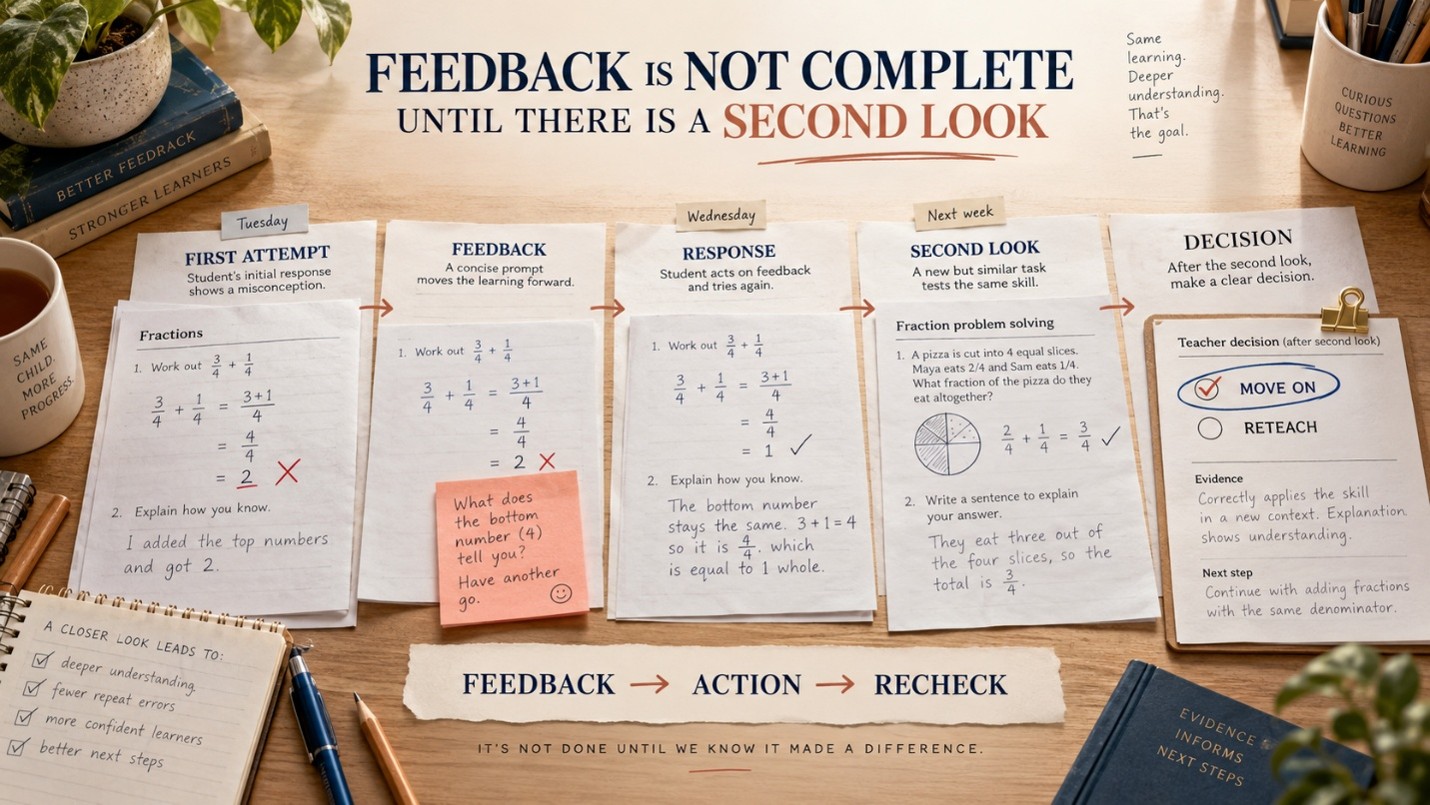
Without that second look, feedback quietly turns back into an event. It was given and logged, and nobody knows whether it worked. This is where daily habits and formal assessment can support each other. A short reassessment on a weak skill is itself feedback, both for the student and for the teacher who retaught it.
If a teacher receives feedback once a year and nobody checks again until the next year, how would anyone know whether that feedback changed anything at all?
What Leaders Can Look For
Culture is hard to audit directly, but some signs are visible. Leaders who want to know whether feedback has become a habit can look for:
- How much time passes between an assessment and the moment students act on the result.
- Whether students can explain, in their own words, what they are working to improve.
- Whether written feedback is short and followed by time to respond, or long and left unanswered.
- How often teachers get low-stakes feedback outside the formal appraisal cycle.
- Whether anyone checks, a few weeks later, that an agreed change actually happened.
- Whether senior leaders ask for feedback on their own work and act on it.
The last point is easy to miss. Staff notice whether leaders treat feedback as something meant for other people, and a culture rarely moves faster than the behavior of the people at the top.
Culture Is What Happens Between the Events
Schools do not need to abolish the annual review or the end-of-term report. Those do a different job. The aim is to make sure they are not doing the job alone.
A school has a feedback culture when feedback is small enough to give often, timely enough to use, and followed up often enough that people believe it matters. The formal events then become summaries of a year of conversations, rather than the only conversations that happened.
FAQs
What is a feedback-rich teaching culture?
It is a school culture where feedback to students and teachers is frequent, specific and acted on as part of normal work. Feedback does not wait for formal reports or annual reviews.
What is the difference between a feedback event and a feedback culture?
A feedback event is scheduled and occasional, such as an annual appraisal or an end-of-term report. A feedback culture is made of small daily habits that let people adjust while learning or teaching is still in progress.
Does more marking mean better feedback?
Not necessarily. More written comments can raise teacher workload without improving learning if students do not use them. Shorter feedback with time to respond is often more useful than long comments that are only read.
How often should teachers receive feedback?
There is no single right number. A practical test is whether feedback comes often enough that a teacher can try a change and get a second look within a few weeks, not a year later.
How does formative assessment support a feedback culture?
Formative assessment gives teachers quick, low-stakes evidence during a unit. When that evidence leads to an immediate adjustment and a later check, it becomes a daily feedback habit rather than a record.
How can school leaders tell if feedback culture is improving?
They can watch how quickly students act on results, whether students can describe their next step, how often teachers get low-stakes feedback, and whether anyone checks that agreed changes actually happened.