
Two heads of department watch the same Grade 8 lesson. One writes: “Strong engagement. Good pace.” The other writes: “Students busy but not thinking. Pace too fast to check understanding.” Both used the school’s observation form, and both picked words from the school’s teaching framework.
The teacher now has two pieces of feedback that point in opposite directions.
This is why a whole-school pedagogy framework is only as useful as the agreement behind its words. Many schools have a framework. Far fewer have a shared pedagogical language, meaning a small set of terms that every teacher and leader understands in the same way and can recognize when they see it in a classroom.
What a Shared Pedagogical Language Is, and What It Isn’t
A shared pedagogical language is a short list of agreed terms for teaching practice. Each term is defined by what you would actually see teachers and students doing. The terms are then used the same way in lesson planning, observation, coaching, professional learning and assessment design.
It is not a poster of educational buzzwords. It is not a script that tells every teacher to teach the same way. It is also not the same as a list of approved strategies.
The test is simple. Ask two experienced colleagues to describe the same lesson using the school’s terms. If they describe it very differently, the school has shared vocabulary but not a shared language.
For a deeper look at why this foundation matters before any improvement plan, see shared language of pedagogy.
When Every Part of the School Speaks a Different Dialect
Teachers receive messages about teaching from many directions: curriculum materials, professional development, observation rubrics, department meetings and assessment results. When those messages agree, teachers can act with confidence. When they clash, teachers spend their energy translating instead of improving.
A 2024 RAND research brief looked at exactly this problem, which the researchers call instructional system coherence. It drew on surveys of US K–12 English and mathematics teachers from 2021–2022, including a nationally weighted spring 2022 sample of 1,810 teachers, plus interviews with 45 teachers
The study found the following:
- Across 21 possible pairings of seven parts of the instructional system, teachers on average saw about 13 as sending similar messages and about five as sending conflicting ones.
- Teacher evaluation and summative assessment were the parts teachers felt were least aligned with everything else.
- In interviews, teachers said coherence boosted their confidence. Conflicting messages left them frustrated and anxious.
- Some teachers coped by working out the conflicts with colleagues. Some leaned on more experienced peers. Others disengaged from the system altogether.
There is an important limit here. The researchers found only a minimal link between perceived coherence and teachers’ instructional practice as reported in surveys. So this evidence does not show that a common language improves teaching on its own. What it does suggest, for school leaders, is that mixed messages carry a real cost in confidence and in teachers’ willingness to engage. rand
The OECD’s TALIS 2024 survey adds an international angle. The survey gathered responses from 280,000 teachers and principals across 55 education systems. On average across the OECD, 55% of teachers said their professional learning over the past year had a positive impact on their teaching. That means a large share of teachers did not feel their professional learning made a difference. In 32 of 54 systems, teachers who took part in collaborative professional learning tended to report greater success in meeting their lesson aims TALIS
These findings are self-reported and correlational. Still, they point to something practical. Collaboration seems to matter, and collaboration depends on colleagues meaning the same thing when they talk.
If two skilled observers can watch the same lesson and disagree about whether it was rigorous, what exactly is the teacher supposed to improve?
The Words That Cause the Most Confusion
Most confusion comes from a handful of familiar terms. Everyone uses them, so nobody stops to check what they mean. The definitions below are examples only. Each school should write its own.
| Term | How it often gets used | Example shared definition | What you would see |
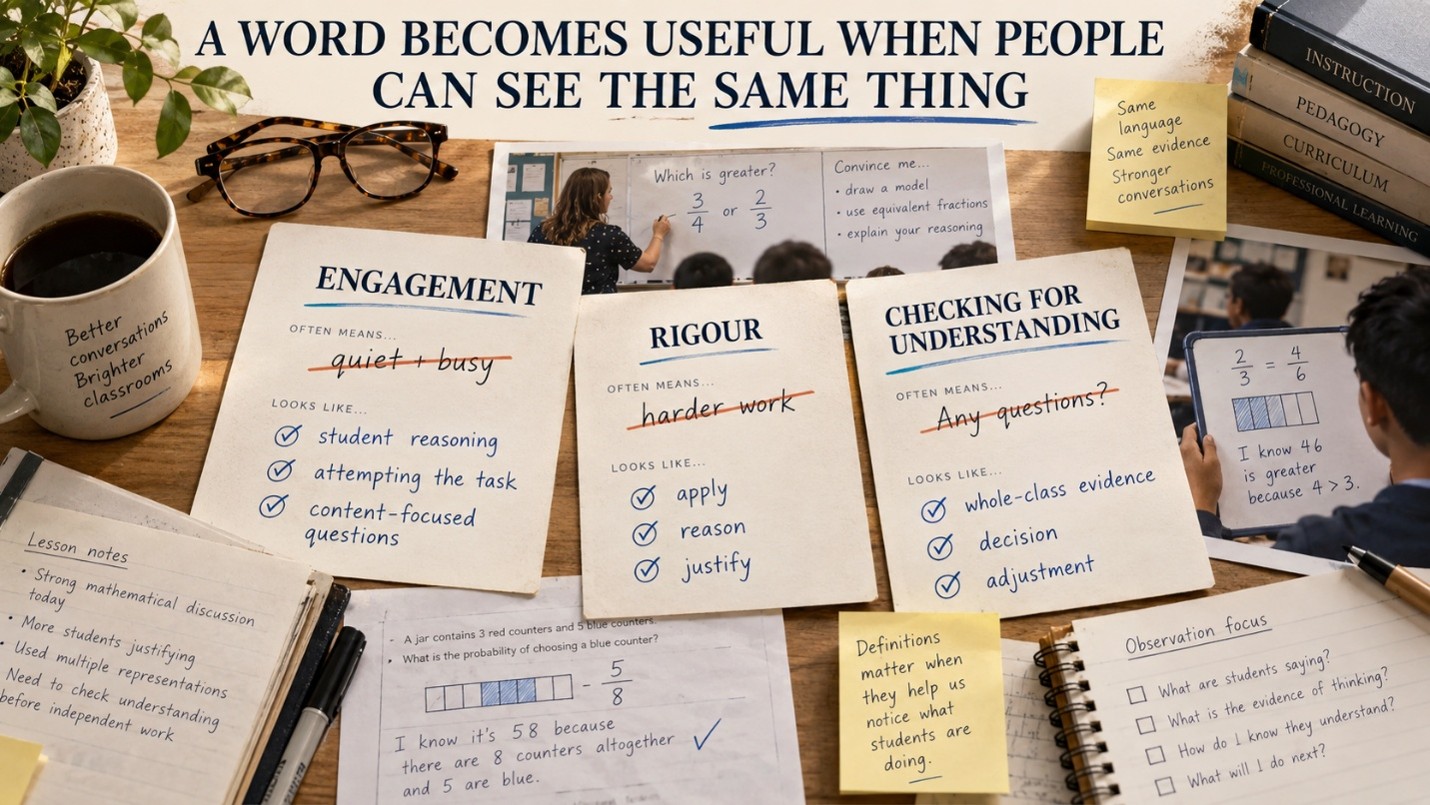
| Engagement | Students are quiet and look busy | Students are thinking hard about the intended content | Students explain reasoning, attempt problems and ask questions about the content |
| Rigour | Harder worksheets or more content | Tasks ask students to apply, reason or justify, not only recall | Higher-demand questions; students defend their answers |
| Checking for understanding | “Any questions?” or a thumbs-up | The teacher collects evidence from most students before moving on | Mini-whiteboards, hinge questions, cold calling; the teacher adjusts the lesson |
| Differentiation | Three worksheets at three levels | The same goal for everyone, with different support to reach it | Scaffolds are reduced over time; all students attempt the core task |
| Feedback | Marks and comments in books | Information the student uses to improve the next attempt | Students act on feedback during lesson time |
| Pace | The lesson moves quickly | Lesson speed matches how fast students are learning | The teacher slows down or speeds up based on evidence |
“Rigour” causes particular trouble because it overlaps with assessment design. A shared way of describing cognitive demand, such as Depth of Knowledge levels, can stop “rigorous” from meaning “difficult.” See a shared way of describing cognitive demand.
How to Build One: Six Practical Steps
1. Start from your current problems, not a glossary. Choose a small number of terms, perhaps five to eight, that connect to the priorities you are working on now. A long list gets ignored.
2. Define each term by what you can observe. “Students are engaged” cannot be checked. “Most students attempt the problem before the teacher models it” can.
3. Calibrate together. Have small groups watch the same lesson clip, rate it on their own, and then compare. The disagreements show you where definitions are still loose. This is the step most schools skip.
4. Build the language into everyday routines. Use it in planning templates, observation forms, coaching conversations and department meeting agendas. If the words appear only in a policy document, they will not change practice. Coaching is often where a shared language becomes real, so it is worth designing coaching around the same terms.
5. Connect the language to student evidence. Each term should point to something visible in student work or assessment results. Otherwise the conversation stays about the teacher’s performance and never reaches student learning.
6. Review it once a year. Retire terms nobody uses, and sharpen definitions that still cause disagreement.
The way the language is introduced also matters. A single training day rarely changes how people talk, which is why it helps to apply instructional design principles to teacher training.
What Leaders Should Watch For
The language turns into a compliance checklist. If observers start ticking terms off a form, teachers will perform the words instead of using them.
An imported framework is never defined locally. A published framework gives you a starting point. Its terms still need local examples before they mean anything in your classrooms.
Only leaders speak the language. If teachers do not use the terms in their own planning conversations, the language belongs to the leadership team, not the school.
School groups over-standardise. Across multiple campuses, a shared core of terms supports fair comparison and makes it easier for teachers to move between schools. Local examples should still come from each campus’s own classrooms.
Would your teachers describe a strong lesson in the same words your observation form uses, or have they learned to translate between the two?
The Real Test of a Shared Language
A whole-school pedagogy framework succeeds when people stop noticing it as a framework. It becomes simply how colleagues talk about teaching: in a corridor, after an observation, or while planning next week’s unit together. Getting there takes a small number of words, clear definitions, repeated calibration and patience.
Once that language exists, it becomes the foundation for a fuller teaching and learning effectiveness framework.
FAQs
What is a shared pedagogical language?
It is a small set of agreed terms for teaching practice, each defined by what teachers and students visibly do. Staff use these terms consistently in planning, observation, coaching and professional learning.
How is a whole-school pedagogy framework different from a teacher evaluation rubric?
A pedagogy framework describes what good teaching looks like so that teachers can plan and improve. An evaluation rubric judges performance. The two should use the same language, but they serve different purposes, and mixing them up often turns the framework into a compliance exercise.
How many terms should a shared pedagogical language include?
There is no research-fixed number. In practice, a small set of around five to eight terms tied to current priorities is easier to define, calibrate and use than a long list.
How do you know if a shared pedagogical language is working?
Look for agreement. Colleagues who observe the same lesson should describe it in similar terms, teachers should use the language in their own planning, and feedback conversations should refer to student evidence rather than general impressions.
Can a school group use one pedagogical language across all its campuses?
Yes. A common core of terms supports consistent feedback and fairer comparison across schools. Each campus should still add its own classroom examples so the terms stay meaningful locally.
Does a shared pedagogical language limit teacher autonomy?
It should not. It defines what to look for, not how to teach every lesson. Teachers keep professional choice over methods. What they share is the way they describe and discuss practice.