
Two heads of department watch the same Year 8 lesson. Afterwards, both write “strong questioning” in their notes.
One of them means the teacher asked plenty of questions and kept the pace up. The other means three students were pushed to explain why their answer worked. Both notes go into the same review file. At the end of term, the school reports its questioning priority as “mostly secure.”
This is a hypothetical example, but most school leaders will recognize it. Nothing in that report is false. The problem is that it is not shared, and a school cannot improve something its staff describe in different ways.
That is the case for a shared language of pedagogy. It rarely appears as the headline of a school improvement plan. It sits underneath the plan and quietly decides whether observation notes, coaching conversations, department meetings and assessment reports mean the same thing to everyone reading them.
A Vocabulary List Is Not Yet a Shared Language
Most schools already share teaching words: retrieval practice, checking for understanding, scaffolding, challenge, feedback. These words appear in policies, appraisal forms and training slides.
A word on a form is only a label, though. A shared pedagogical vocabulary goes further. For each term, staff agree on four things:
- what it looks like in a real lesson
- what does not count, even when it looks similar
- what evidence is enough to say it happened
- why it matters for student learning
Without the last three, the words circulate around the school while their meanings stay private. Teachers nod at the same terms in a meeting and leave with different pictures in their heads.
Even Trained Observers Disagree on the Big Words
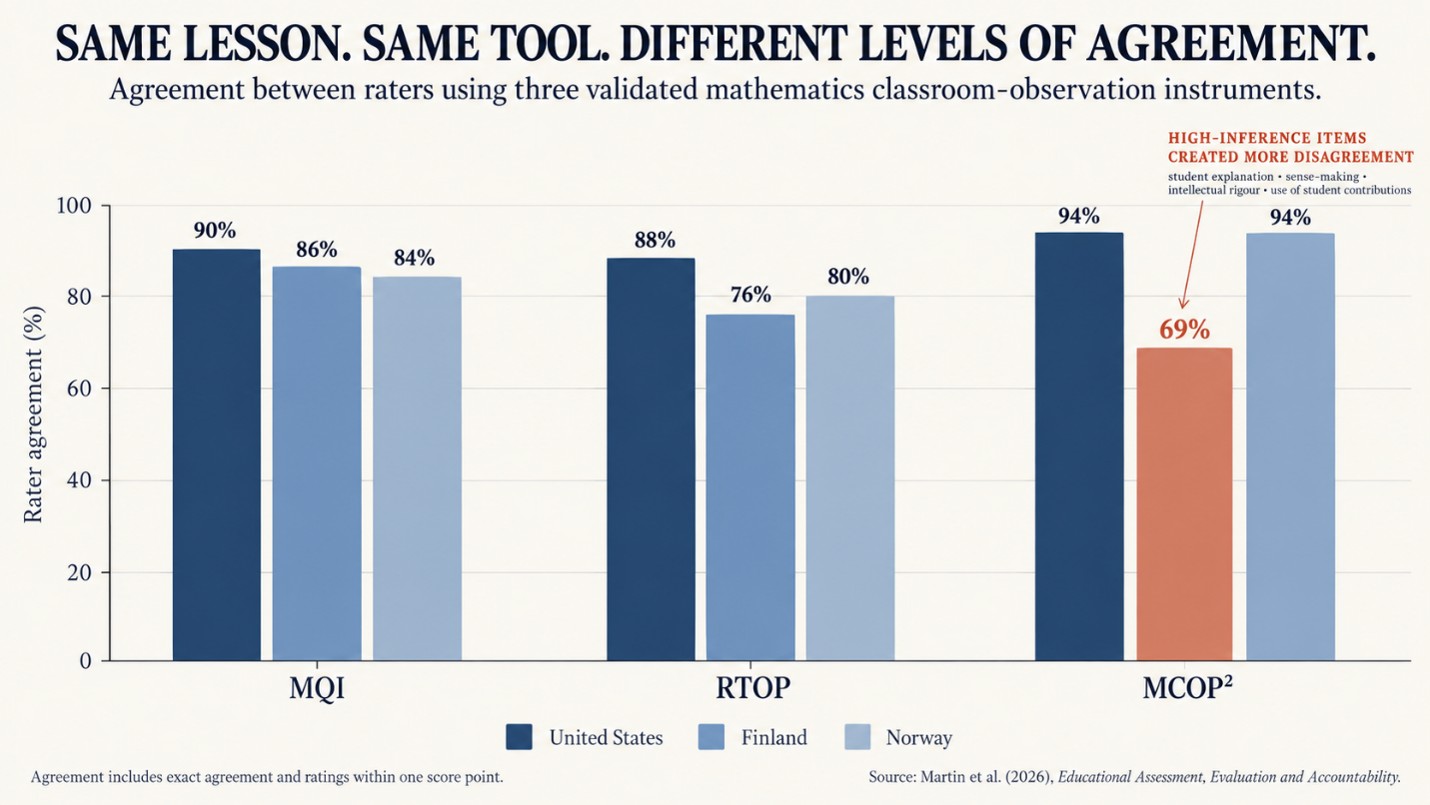
Recent research makes this point clearly. In a study published on 15 August 2026 in Educational Assessment, Evaluation and Accountability (read the study), three researchers used three validated observation instruments to score mathematics lessons from the United States, Norway and Finland, and recorded their scoring discussions. springer
The pattern was telling. Raters agreed most on low-inference items, such as whether students were doing mathematics, how much time was spent on it, whether the classroom was respectful, and whether there were obvious content errors. Disagreement clustered around terms such as student explanation, sense-making, intellectual rigor and teachers using student contributions.
Often the raters saw the same moment and still disagreed about what it meant. In one lesson, a teacher distinguished between x² and 2x; one rater read this as mathematical sense-making, while another saw it as simply defining terms. The authors concluded that a common language does not remove the interpretive work involved in observation, and that high-inference items need clear scoring guidance, rater preparation and collaborative calibration. Exploring the use of mathematics
The study is deliberately small: three raters, three lessons, one subject, and researchers rather than school staff. It does not tell us how often teachers in a typical school disagree.
For school leaders, one implication still stands out. The words schools care about most (challenge, depth, reasoning, quality feedback) are exactly the high-inference ones. If trained observers working from the same manual need discussion to align, staff working from a one-line definition on a slide are very likely holding several meanings at once.
Observation Is Everywhere. Shared Looking Is Rare.
The OECD’s TALIS 2024 survey gathered responses from 280,000 educators across 55 education systems. It shows a gap that bears directly on this problem.
According to principals, 96% of teachers work in schools that use classroom observation as a formal appraisal method. Yet only 9% of teachers, on average across OECD systems, observe colleagues’ classes and give feedback monthly or more, and 14% take part in joint activities across classes and age groups that often.
TALIS also found that teachers who report collaborating more tend to be more likely to fulfil their lesson aims, and that in 32 of 54 education systems, teachers in collaborative professional learning reported higher fulfilment of their lesson aims. These are self-reported, correlational findings. They do not show that collaboration causes better teaching, and TALIS does not measure vocabulary directly.
The pattern is still worth noticing. In many schools, observation is mainly an appraisal event, carried out by a few people on many. That is where meaning drifts most easily, because the people using the words rarely look at the same lesson together.
How One Term Drifts Across a Staffroom
| Term | What one teacher may mean | What another may mean | What a shared definition pins down |
| Questioning | Many questions, brisk pace | A few questions that demand reasoning | Who answers, what thinking the question requires, how the teacher follows up |
| Challenge | A harder worksheet for the top group | Every student working at a level of struggle they can resolve | Who is challenged, and what evidence shows productive struggle |
| Feedback | Written comments in books | A change in what the student does next | Evidence that the feedback was acted on |
| Checking for understanding | “Any questions?” or a thumbs-up | Every student responds, and the teacher adjusts | A response from all students plus a decision rule |
| Secure / mastered | Scored above 80% once | Can apply it unaided weeks later | Threshold, retention and context of use |
The last row matters more than it seems. The same drift happens in assessment language. If “secure” means 70% in one department and “can explain it unprompted” in another, a whole-school report is adding up things that are not alike. This is why agreeing what a mastery threshold means belongs in the same conversation as observation language.
Building Shared Meaning Without Writing Another Framework
Most schools do not need a longer document. They need fewer words that are understood more deeply.
- Start with five to eight terms. Choose words that already appear in your improvement plan or appraisal form.
- Write each term as a look-for card. Include what it looks like, one short non-example, and what evidence is enough. Keep each card to one side of A4.
- Calibrate with real practice. Two or three colleagues watch the same lesson, video clip or set of student work, judge it independently, then compare their reasoning. The disagreement is the useful part.
- Spend calibration time on high-inference words. Terms like “on task” align quickly. Terms like “rigour” do not.
- Use the words where decisions happen. Put them on coaching notes, department agendas and observation forms. Professional learning communities are a natural home for this; see PLCs that actually work.
- Revisit the cards every year. Staff turnover quietly resets meaning.
For a fuller, step-by-step method, see building a shared pedagogical language. Schools that want terms which travel across subjects can start from curriculum-agnostic teaching quality indicators.
Two cautions apply. First, a shared language describes practice; it should not prescribe one lesson style. The 2026 study itself noted that some practices visible in the Finnish classroom, such as individual feedback given across the lesson, did not map neatly onto the instruments’ categories. Leave room for good teaching that does not fit the template.
Second, in a multi-school group, every campus develops its own dialect. Unless group-wide terms are anchored in shared examples, cross-campus reviews end up comparing labels rather than teaching.
Shared meaning also makes it easier to move from opinion to evidence, which is the next step described in evidence-based teaching practice.
Two questions are worth asking your leadership team:
If your three most experienced observers watched the same lesson tomorrow, would they agree on what “challenge” looked like? If not, which version is your improvement plan actually measuring?
Is your school improving its teaching, or only improving how confidently everyone uses the same words?
Words Are Where Improvement Starts
School improvement is usually discussed in terms of priorities, plans and data. All three are built from words. When those words mean the same thing to everyone using them, observation becomes evidence, feedback becomes usable, and a report becomes something a team can act on. When they do not, a school can look aligned on paper while every classroom works to its own private definition.
Frequently Asked Questions
What is a shared language of pedagogy?
It is a set of teaching terms that staff understand in the same way. Everyone agrees on what each term looks like in a lesson, what does not count, and what evidence is enough to say it happened.
How is a shared pedagogical vocabulary different from a teaching framework?
A framework states what a school values. The vocabulary makes those values observable and discussable. A framework without shared meaning is usually read differently by each person who uses it.
How many terms should a school start with?
Start small, with five to eight terms that already appear in your plans or appraisal forms. It is better to calibrate a few words deeply than to publish a long glossary nobody uses.
How can leaders check whether staff really share the same meaning?
Run a calibration exercise. Colleagues judge the same lesson clip or piece of student work on their own, then compare their reasoning. Disagreement on high-inference terms such as “challenge” or “sense-making” is normal and shows where to focus.
Does a shared vocabulary mean every teacher must teach the same way?
No. A shared vocabulary helps people describe and discuss teaching precisely. It should leave room for different methods that achieve the same purpose.
Why does this matter for a multi-school group?
Group quality reviews and benchmarking depend on terms meaning the same thing on every campus. If they do not, comparisons measure differences in vocabulary rather than differences in teaching.