

Here is a hypothetical school group at the end of a platform selection process. The demo went well. The dashboards looked clean, the item bank was large, and the AI features got approving nods around the table. Twelve months later, heads of department still export results into spreadsheets to work out what to reteach. Nobody can say whether last term’s intervention made any difference.
Nothing shown in the demo was false. The trouble is that the evaluation judged features one at a time. The real work of assessment happens in the joins between them.
This is the idea worth carrying into any procurement conversation. The most useful assessment platform evaluation criteria do not ask “does it have this feature?” They ask a harder question. Can one question travel from the item bank, through a student’s response, into a report, and out into a specific teaching decision, without losing its meaning along the way?
Follow One Question, Not the Feature List
Feature checklists reward breadth. A vendor can tick every box and still give you a system where the boxes do not connect.
So try a different test during evaluation. Choose one real item, ideally from a subject and grade you know well. Then ask the vendor to show you its full journey. Where did the question come from? Who approved it? What standard, competency and level of thinking is it tagged to? Which students got it wrong? Which report shows that? What would a teacher do differently next week as a result?
If the trail breaks at any point, you have learned something a checklist would never reveal.
Reports Can Only Say What the Items Were Built to Say
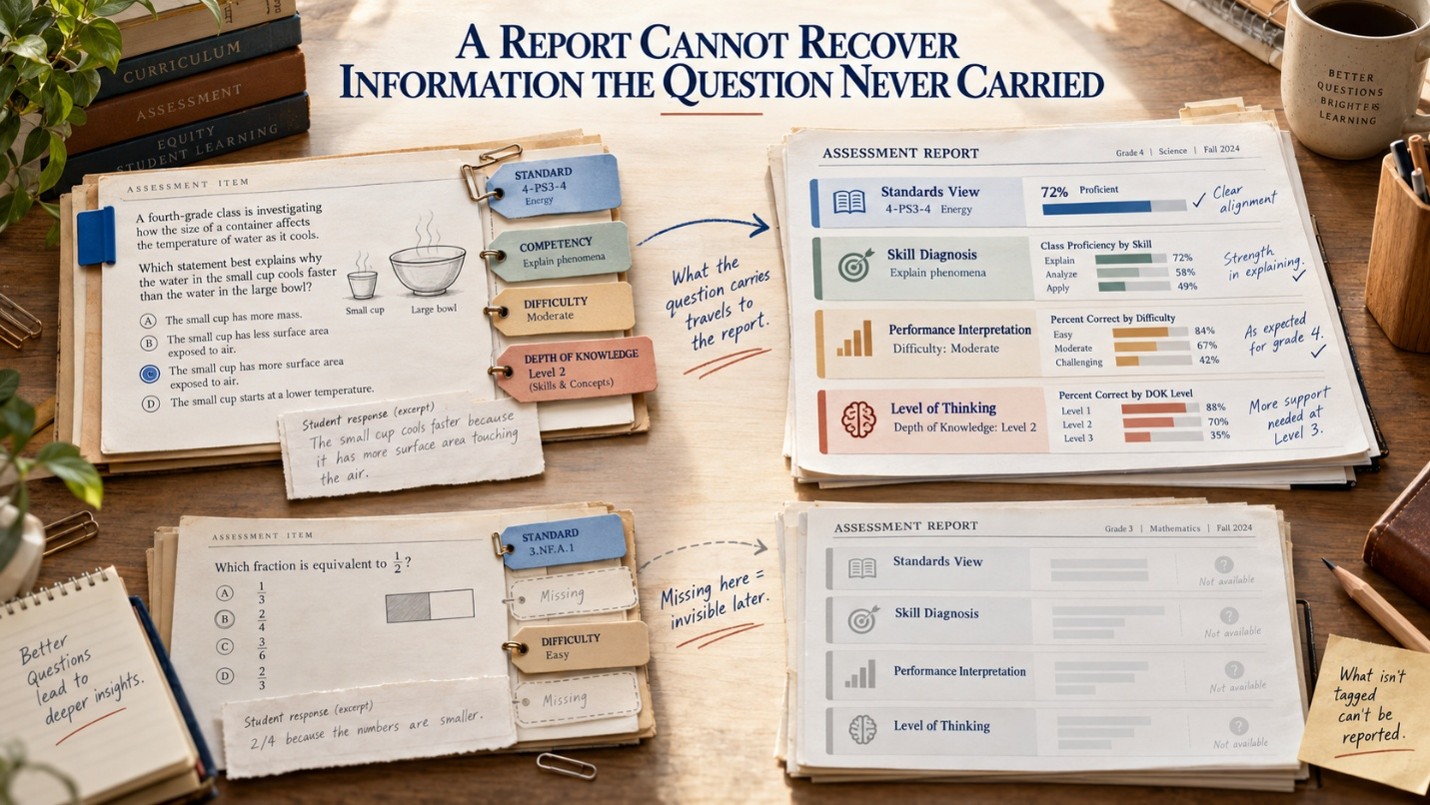
Every report a school will ever read is limited by the information attached to each question. If an item carries no competency tag, no report can link a wrong answer to that competency. If depth of knowledge is not recorded, the report cannot tell you whether students struggled with recall or with reasoning.
This makes assessment item metadata one of the least visible but most important evaluation areas. Leaders should ask which metadata fields are mandatory and which are optional. Optional fields tend to stay empty. They should also ask how difficulty is set, how items map to their own curriculum standards, and what happens to an item between being written and reaching a student. That last question is really about assessment item bank governance . It matters more as AI-generated items become common.
Size deserves a second look too. A bank of many thousands of items can still be thin in the exact competencies your Grade 7 teachers need. Coverage of your curriculum is the useful measure, not the headline number.
The Assessment Mode Should Follow the Decision
Different decisions need different evidence. A common paper gives every student the same questions, so it suits comparison across classes and campuses. An adaptive assessment adjusts difficulty for each learner, so it can locate individual students more precisely. Neither is better in general. Each answers a different question, as explored in adaptive and standard assessment modes.
The evaluation question is whether a platform lets schools choose the mode based on purpose, ideally from one governed item bank, with results that can still be read alongside each other.
Paper deserves its own question. Many schools still assess on paper for younger grades, invigilated exams or campuses with limited connectivity. Ask whether paper results enter the same student record as digital ones, or sit in a separate spreadsheet. If paper-tested learners drop out of the analytics, network averages quietly describe only part of the student population.
Where AI Is Involved, Ask What the Teacher Can See
AI can genuinely reduce workload in item writing and in marking open responses. The evaluation should not stop at whether AI is present. It should ask whether a person stays in front of each decision the AI would otherwise make alone.
For generated items, that means a review step before anything reaches a learner. For AI-assisted marking, it means the reasoning behind a score is shown and a teacher can disagree with it. AI-assisted grading with human oversight goes further into what that visibility should look like.
Would your school accept a score that no teacher could explain to a parent?
A Report Is Not Finished Until It Points to a Teaching Step
Most evaluations look at reports. Far fewer ask what a teacher actually does after reading one.
Two students can earn the same total score for completely different reasons. One may have a gap in a foundational skill. The other may know the content but struggle to apply it. A report that stops at the total cannot tell them apart. Leaders should check whether results can be followed down from score to competency to skill, and whether that level of detail reaches the class teacher rather than staying on a leadership dashboard. The test, as discussed in competency reports teachers can act on, is whether the report suggests a next teaching step.
Participation belongs here too. A strong class average means little if a third of the class never finished the assessment. Good reporting shows who took part beside how they performed.
If a report cannot change what happens in a classroom next week, what exactly has the school paid for?
Can the System Show Whether the Action Worked?
This is where many evaluations end too early. Finding a gap is the start of the cycle, not the end. The final checkpoint is whether the platform supports what comes next. That includes a plan someone can actually deliver, a reassessment that measures the same skills on a comparable scale, and a view that places one assessment cycle beside the last. Without that, schools can describe learning gaps in great detail and never find out whether they closed.
Questions Worth Putting to Any Vendor
A short set of questions will reveal more than a long feature comparison:
- Can you trace one item from authoring to a classroom decision, live, using our curriculum?
- Which item metadata is mandatory, and who approves items before students see them?
- Can we choose between common and adaptive assessments based on purpose, and still read results together?
- Do paper results join the same student record as digital ones?
- Where AI is used, what does the teacher see, and can they override it?
- Does reporting reach skill level for the classroom teacher, with participation shown beside performance?
- How do we compare one assessment cycle with the next to check whether an intervention worked?
Selection is only half the work. How a system is introduced across campuses decides whether these capabilities are ever used. School assessment system implementation covers that next stage.
The Real Test Is the Whole Journey
A platform is not valuable because it holds many questions, produces attractive charts or uses AI. It is valuable when evidence keeps its meaning from the moment a question is written to the moment a teacher changes what they do. When choosing an assessment platform for schools, leaders who follow one question through that whole journey will make a better decision than those who compare feature lists side by side.
FAQs
What criteria should schools use to evaluate an assessment platform?
Look beyond feature lists. Check item quality and metadata, assessment modes, how paper and digital results combine, how AI is supervised, whether reports reach skill level, and whether the system supports reassessment after an intervention.
Why does item metadata matter when choosing an assessment platform?
Reports can only describe what items were tagged to measure. Without competency, standard and depth-of-knowledge tags, a platform cannot explain why students got questions wrong.
Is a bigger item bank always better?
No. What matters is coverage of your own curriculum and grades. A large bank with thin coverage in the competencies you teach is less useful than a smaller, well-aligned one.
Should schools choose adaptive or standard assessment?
It depends on the decision. Common papers suit comparison across classes and schools. Adaptive assessments locate individual learners more precisely. Ideally, a platform supports both from one item bank.
How can leaders test a platform during a demo?
Ask the vendor to trace one real item live, from authoring to a report and then to a specific teaching decision, using your own curriculum. Any break in that trail shows a weakness.