
A Grade 9 student’s online science test comes back with three integrity flags. “Second person detected” carries a confidence of 0.94. “Speech detected” appears twice in four minutes. On a summary screen, it looks like an open-and-shut case.
Then an assessment coordinator opens the recording. The second person is a younger brother walking through the room on his way to the kitchen. The speech is the student reading a question aloud under her breath, which her teacher has seen her do in class for two years.
The system was not wrong. It did see a second face and it did hear speech. What it could not know was what those things meant. That gap, between what was detected and what it means, is where assessment integrity human review earns its place.
What a Proctoring Flag Actually Tells You
An integrity flag is an automated signal. It says that something during a sitting differed from the expected test conditions: a face left the frame, a voice was heard, the student looked away.
The confidence score attached to a flag is often misread. It describes how sure the system is about what it detected. It does not measure how likely it is that a student cheated. A 0.94 confidence that a second face appeared is a strong claim about a face. It says nothing about intent.
That is the core argument of this article. A flag is evidence that something happened. It is not yet evidence of misconduct. Turning one into the other needs context, and context needs a person.
The Same Flag Can Mean Very Different Things
Most proctoring flags have both a concerning reading and an innocent one. The reviewer’s job is to work out which reading the evidence supports.
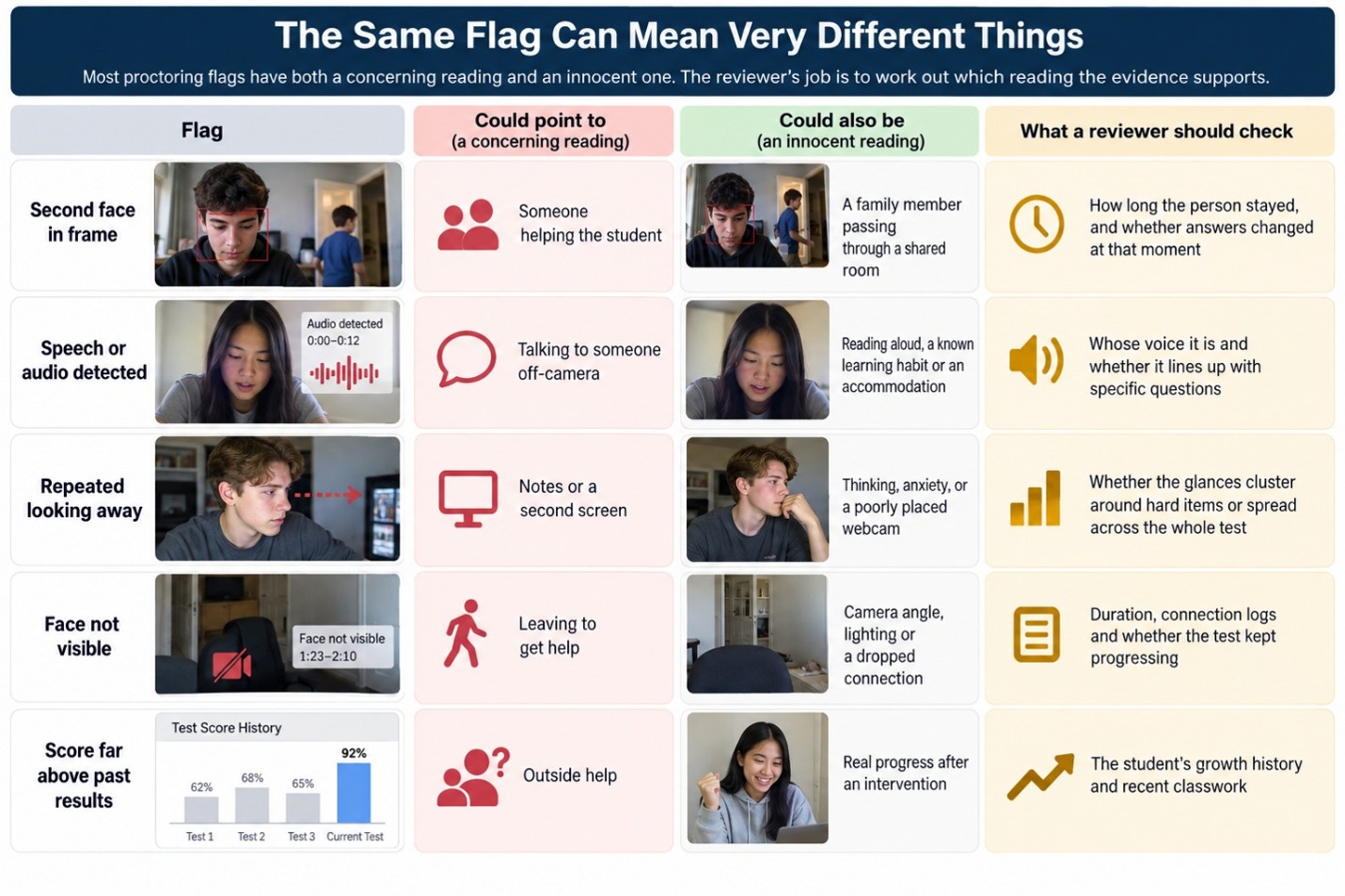
The last row matters more than it seems. A sudden jump in score is sometimes treated as suspicious when it is exactly what a good intervention is supposed to produce. A school that treats every big improvement as a possible integrity concern is, in effect, punishing growth.
Some anomalies have nothing to do with the student at all. Results can shift simply because of how a test was delivered, so leaders should understand mode effects between paper and online tests before they treat an unusual score as a red flag.
One Moment or a Pattern? Read the Timeline
A single flag in a 45-minute test is rarely enough to act on. Patterns are a different matter.
Here are two hypothetical students with the same number of flags:
- Student A looks away four times, spread across the test, mostly during long reading passages.
- Student B looks away four times, each time on one of the four hardest questions, and answers all four correctly after missing similar items on the last two assessments.
The flag count is identical. The story is not. Only a timeline that links each flag to the question on screen, and to the student’s earlier performance, shows the difference.
Human Judgement Is Where Fairness Lives
An integrity decision is not a small administrative step. An accusation of cheating can follow a student, damage the trust between that family and the school, and change how teachers see the learner. That is a heavy outcome to hand to a detection model.
Automated systems also produce false positives. Even a small error rate, applied across every sitting in a large school group, means real students placed under suspicion for something they did not do. Human review is how a school catches those cases before they become decisions.
The same principle applies to automated marking. Teachers need to see the reasoning before they accept a machine’s output, as discussed in trusting an AI-assisted score. Integrity review is the same idea with higher stakes.
A question worth sitting with:
If a system can flag a student in seconds, but nobody can explain why the flag was upheld, has the school protected integrity, or has it simply automated suspicion?
Proportionate Responses, Not One Verdict
“Cheated” or “did not cheat” is too blunt a choice. A sound integrity process offers a range of responses that match the strength of the evidence.
| Response | When it fits | What to record |
| Dismiss | The evidence has a clear innocent explanation | The reason for dismissal, so the decision can be audited later |
| Warn | Conditions were not followed, but there is no sign the result was affected | What was discussed with the student, and with parents where relevant |
| Invalidate the attempt | The evidence shows the result cannot be trusted | The specific evidence relied on |
| Approve a retake | The attempt was disrupted or invalidated, and the student deserves a fair chance | The reason, and what the retake needs to show |
A retake should also serve a purpose. It should show what a retake should demonstrate about learning, not just give the student a second roll of the dice.
What School Leaders Should Put in Place
A fair integrity process does not happen by accident. Before online assessment scales across a school or a group, leaders should be able to answer these questions:
- Who reviews? Name the roles that can make integrity decisions, and say whether a second reviewer is needed before an attempt is invalidated.
- What evidence must be seen? No decision should be made from a summary screen alone.
- Does the student get to explain? A short conversation often settles what an hour of footage cannot.
- Are accommodations visible to reviewers? A student allowed to read aloud should not be flagged and punished for it.
- Is the reasoning recorded? Decisions without written reasons cannot be checked for fairness later.
- Are parents told in advance? Families should know before the first sitting what is monitored and how flags are reviewed.
Across several campuses, consistency becomes the real test. Integrity review belongs inside a wider academic quality assurance framework, where dismissal and invalidation rates can be compared across schools. A campus that invalidates far more attempts than its peers may have more misconduct. It may also simply have a stricter reviewer.
A second question for leadership teams: Would two reviewers on two different campuses reach the same decision from the same evidence? If you cannot answer that, your integrity process may be measuring the reviewer as much as the student.
Integrity Is a Judgement, Supported by Evidence
Automated flags are useful. They point reviewers to the few sittings that need a closer look, out of the many that do not. But a flag is the start of a review, not the end of one.
The schools that handle integrity well treat detection as evidence gathering and treat decisions as professional judgement. They read flags in context, look for patterns rather than counts, respond in proportion, and write down why. That is what makes a result something a school can defend, both to the student and to everyone else who relies on it.
Frequently Asked Questions
What is an assessment integrity flag?
An integrity flag is an automated signal raised during an online test when something differs from expected conditions. Common examples are a second face in the frame, detected speech, or the student’s face leaving the camera view. A flag marks a sitting for review. It is not proof of misconduct.
Does a high confidence score mean a student cheated?
No. The confidence score shows how sure the system is about what it detected, such as a second face. It does not show how likely misconduct is. A highly confident detection can still have an innocent explanation, which is why a person needs to review the context.
Why is human review needed if proctoring technology is accurate?
Detection can be accurate and still be misleading. A system can correctly detect speech without knowing the student has a reading-aloud accommodation. People bring context, such as knowledge of the student, the home setting and past performance, that a model cannot see.
What should a school do after an integrity flag is raised?
Review the recorded evidence in context, check whether the flags form a pattern, consider the student’s history and accommodations, and talk to the student where needed. Then choose a proportionate response: dismiss, warn, invalidate the attempt or approve a retake. Record the reasoning.
How can school groups keep integrity decisions consistent across campuses?
Use shared review guidelines, define who can make each type of decision, and record the reasons for every ruling. Compare dismissal and invalidation rates across campuses regularly. Large differences may reflect differences in reviewers rather than in student behaviour.
Should students and parents be told about proctoring before a test?
Yes. Families should know in advance what is monitored, how flags are reviewed, and how students can explain or challenge a decision. Being open about this builds trust and makes the process fairer.