

A Year 7 class finishes a fractions assessment with an average of 61%. In the department meeting that follows, three teachers look at the same number and propose three different things. One wants to reteach the unit. One wants two weeks of practice. The third wants to move on, because the scheme of work says ratio starts on Monday.
Any one of them could be right. The trouble is that the average cannot tell them which.
Here is the short answer. Reteach when the evidence shows the understanding was never built. Practice, or consolidate, when the understanding exists but is not yet secure. Move on when the skill is secure, and plan when you will come back to it. The harder part is reading the evidence well enough to know which of these situations you are in. Most of the time lost to intervention is lost at that step.
Three Responses That Answer Three Different Problems
It is tempting to treat these three options as a dial. On that view, reteaching is the strong response, practice is the mild one, and moving on means doing nothing. That framing causes most of the waste.
The three options respond to three different diagnoses:
- Reteaching is for a knowledge gap. Students did not learn the content, so asking them to practice it only rehearses confusion.
- Consolidation is for learning that is fragile. Students can do it when prompted, straight after the lesson, on familiar questions. They cannot yet do it reliably, later, or in a new context.
- Moving on is for secure learning. Here, more time on the skill buys very little, and that time is badly needed somewhere else.
A teacher who reteaches a consolidation problem spends a week explaining something students already understand. A teacher who sets practice for a knowledge gap gives students forty more chances to get it wrong. Each mistake has a cost, and both come from the same source: a decision made on a score rather than a diagnosis.
A Low Score Does Not Always Mean “Teach It Again”
Go back to the 61%. Behind that single number there could be at least four very different situations.
The class may have a genuine knowledge gap, where students struggle even with simple recall questions. They may have an application gap, where they handle recall well but fall apart when a question asks them to use the idea in an unfamiliar way. That difference between knowledge gaps vs application gaps changes the response completely. Reteaching the content to a class that already knows it is one of the most common ways a term disappears.
There are two further possibilities. Most of the class may have chosen the same wrong answer on two or three questions. That is not a spread of weak ability. It is one shared misconception, which may need one well-planned lesson rather than a programme of intervention. Or performance may only have dropped on the hardest items, in which case the problem may lie with the paper rather than the class.
Each of these leads to a different Monday morning. None of them is visible in an average.
If most of a revision fortnight goes on content students already knew, was it revision, or reassurance for the adults?
What the Evidence Says About Holding a High Bar
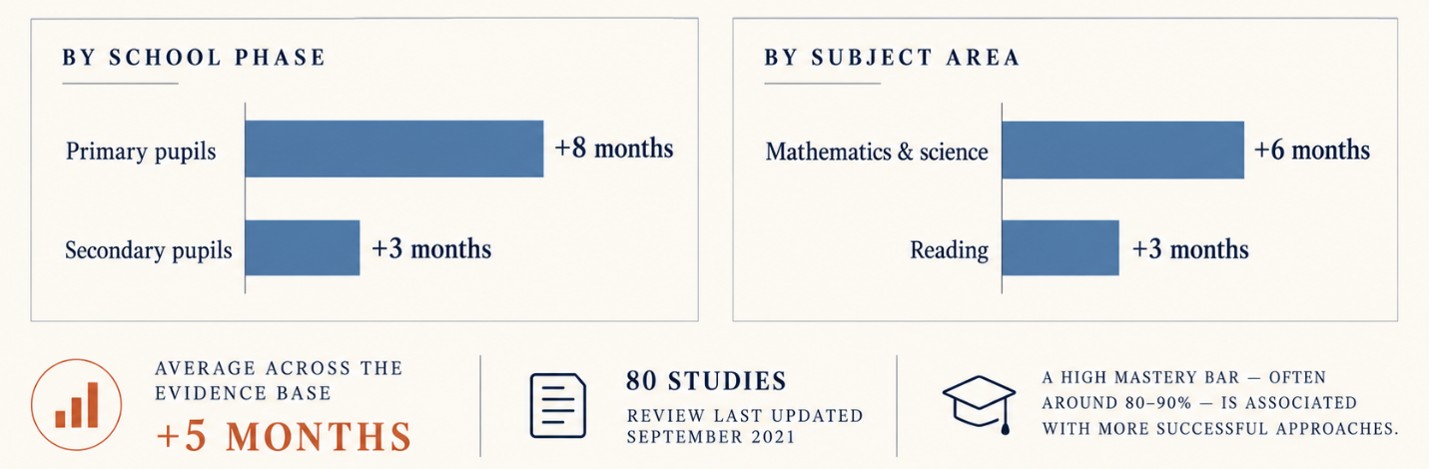
The idea of not moving on until learning is secure has a long research history under the name mastery learning. The Education Endowment Foundation’s Teaching and Learning Toolkit summarizes this evidence. Its mastery learning review was last updated in September 2021.
The EEF estimates that mastery learning approaches add about five months of progress on average over a school year. Approaches that set a high mastery bar of around 80% are associated with stronger results. The average also hides large differences. Studies with primary pupils showed bigger effects (+8 months) than studies with secondary pupils (+3 months), and effects were larger in mathematics and science (+6 months) than in reading (+3 months).
The limitations matter just as much. The EEF rates the security of this evidence as low. The review drew on 80 studies, but few were recent and many were not randomized controlled trials. The approach also appears to work much less well when pupils simply move at their own pace.
For school leaders, one reasonable reading is this. A clear threshold, together with extra support for students who have not reached it, is more defensible than moving on when the calendar says so. It does not mean every topic needs a mastery cycle. Setting student mastery thresholds is a design decision in its own right. The EEF also points to a practical tension that every teacher knows: secure students can become bored or frustrated while they wait for the rest of the class.
Consolidation Means Spacing Practice Over Time
If reteaching rebuilds understanding, consolidation makes it last. Recent classroom evidence suggests that how practice is timed matters as much as how much practice students do.
A 2025 meta-analysis by Mawson and Kang at the University of Melbourne looked only at classroom studies that used real curriculum material and realistic timescales. It covered 22 reports, 31 effect sizes and more than 3,000 learners. It found a moderate effect in favor of spreading practice out over time rather than concentrating it in one block (d = 0.54). Effects tended to be larger when the gap before the final test was longer. The authors note that the number of studies was too small for a full analysis of what drives the differences.
The study compares spaced and massed practice for remembering material. It does not tell a teacher which students need practice in the first place. That still depends on diagnosis.
Even so, the practical implication is useful. Consolidation does not mean scheduling the same lesson again tomorrow. It looks more like short, focused practice that students return to across the following weeks, built into starters, homework and low-stakes quizzes. Moving on to new content and consolidating old content can happen in the same week.
Moving On Is a Decision, Not a Default
In many schools, moving on is the one decision nobody makes deliberately. It simply happens when the scheme of work turns the page.
A deliberate move-on decision looks different. It asks whether the evidence shows the skill is secure for most students. It identifies the few students who are not yet secure and decides what will happen for them. It also plans a return point, because the spacing evidence suggests that secure learning still benefits from being revisited.
Making this decision openly has another benefit. Every skill a department can honestly mark as secure frees up time for the skills that are not.
If no skill in your department is ever formally marked “secure, move on”, how would anyone know where its teaching time is going?
What Leaders Should Ask Before the Next Intervention Cycle
At department and school level, the quality of these decisions depends less on individual teachers and more on what the system around them makes visible. Before approving a block of intervention, leaders can reasonably ask:
- Is the evidence broken down to individual skills, or only to unit averages?
- Can the assessment tell recall apart from application?
- Has anyone checked the item-level responses for a shared misconception?
- Does the department agree on what “secure” means, or does each teacher decide alone?
- Who will teach each reteaching group, when, and for how long?
- Does the next assessment include items on the reteached skills, so the result can be checked?
The last question is the one most often skipped. Without it, a reteaching decision can never be shown to be right or wrong. Turning the answers into a learning-gap plan teachers can deliver is where most of the practical work sits. It is also the point where assessment stops being a report and starts turning assessment results into instructional changes.
The Decision Is Only as Good as the Diagnosis
Reteach, practice and move on are all good teaching decisions. Each one becomes a poor decision when it is applied to the wrong problem. The research supports holding a high bar before moving on and spreading practice over time. It cannot tell a teacher which of their students sits in which group. Only good assessment evidence, read at skill level, can do that.
The 61% was never the answer. It was the start of a better question.
Frequently Asked Questions
What is the difference between reteaching and consolidation?
Reteaching is for content students have not learned. It rebuilds the understanding from the start. Consolidation is for content students partly understand but cannot yet use reliably. It strengthens that understanding through practice. Choosing the wrong one wastes time: reteaching repeats what students know, and practice alone cannot fix a missing concept.
How do teachers know when to move on from a topic?
Teachers can move on when assessment evidence shows that most students are secure on the skill, the remaining students have a support plan, and a return point is scheduled. Moving on should be a decision based on evidence, not simply the next page of the scheme of work.
Is 80% the right mastery threshold before moving on?
The EEF reports that mastery approaches with a high bar of around 80% are associated with more successful results. Schools should still think about how foundational a skill is. A skill that later topics depend on may justify a higher bar than one that stands alone.
What should consolidation practice look like in the classroom?
Classroom research points towards short practice spread over several weeks rather than one long block. In practice, that means retrieval starters, mixed homework questions and low-stakes quizzes that revisit the skill after new teaching has moved on.
How can school leaders support better reteach, practice or move-on decisions?
Leaders can make sure assessment evidence is reported at skill level, that recall and application can be told apart, that departments share a definition of “secure”, and that reassessment is planned into the intervention so its impact can be checked.