
Picture a district leadership team at the end of a school year. This is a hypothetical case, but a familiar one. The improvement plan named one priority: reading comprehension in grades 3 to 5. Every monthly report looked healthy. Professional development sessions were delivered on schedule. Principals completed their walkthroughs. Teachers logged their small-group minutes. The dashboard stayed green from September to May.
Then the state results arrive in the fall, and reading in grades 3 to 5 has barely moved.
Nobody misreported anything. The KPIs measured whether the plan was being carried out. They did not measure whether it was changing what students could do. By the time the one measure that spoke to learning finally arrived, those students had moved up a grade and the year was closed.
This is the quiet problem with most school improvement KPIs. They are either activity counts that arrive on time or learning outcomes that arrive too late. The KPIs that actually tell you whether improvement is working sit between those two. They show change in student learning early enough for leaders to do something about it.
Most Improvement Dashboards Track Effort, Not Learning
Effort indicators have a place. A strategy that never gets implemented cannot work, so leaders do need to know it happened. The trouble starts when these numbers quietly become the evidence of success.
“Nearly every teacher attended the training” tells you something about scheduling. It tells you almost nothing about whether students are reading with more understanding.
A simple test helps here. For any KPI, ask what would need to be true in classrooms for this number to go up. If the honest answer is “teachers would need to show up to sessions,” you are measuring compliance. If the answer is “more students would need to explain an author’s argument using evidence from the text,” you are getting closer to measuring improvement.
A KPI Is Only Useful If It Arrives While You Can Still Act
Education leaders often talk about leading and lagging indicators, and the distinction matters more than it first appears.
Lagging indicators include state assessment results, end-of-year proficiency rates and graduation rates. They matter for accountability and long-term direction. But they describe a year that is already over.
Leading indicators arrive earlier and give an early signal of where the outcome is heading. In school improvement, the most useful ones usually come from the school’s own assessment calendar: a beginning-of-year (BOY) baseline, a middle-of-year (MOY) check and an end-of-year (EOY) measure. These need to be given with the same instrument or on a common scale, so the results can genuinely be compared across the year.
The MOY point is the one most plans underuse. It is the last moment in the year when leaders can still change course. They can shift intervention time, regroup students, refocus coaching or stop something that is not working. Making that mid-year decision deliberate is exactly what the review stage of the improvement cycle is meant to do. It is also the stage many schools skip.
Four Kinds of Evidence a Credible KPI Set Needs
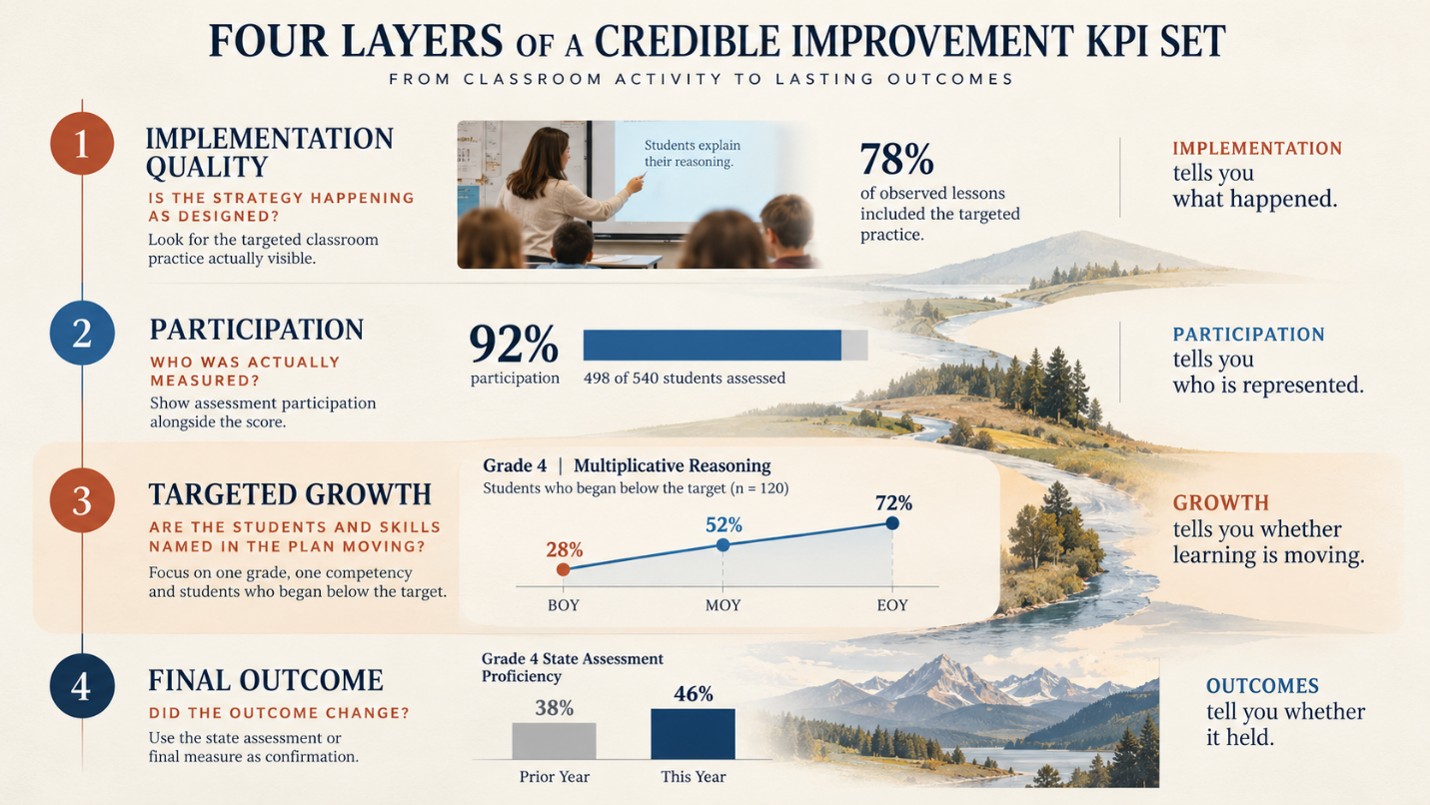
Most schools do better with a small set of KPIs across four layers than with a long dashboard. Each layer answers a different question, and each can mislead when read on its own.
Is the strategy happening as designed?
Implementation KPIs should describe quality, not attendance. Instead of counting PD hours, track whether the targeted practice is actually visible in classrooms. For example, how often do observers see students doing the specific thing the strategy calls for? Two or three measures are enough for this layer.
Who was actually measured?
Before reading any learning result, check participation. If many of the students who struggle most missed the MOY assessment, the average will look better than reality. Participation belongs next to every score, never hidden behind it. This is why leaders should understand assessment participation bias before celebrating a rise in results.
Are the targeted students growing on the targeted skill?
This is the layer most improvement plans are missing. If the priority is inference in grade 4, the KPI should be growth on inference for grade 4 students, especially those who started below grade level. It should not be the school’s overall reading average. The narrower the KPI, the clearer the link between what the school did and what changed.
Growth matters because attainment alone can hide movement. A school can post a strong average while its lower-achieving students stand still. Another school with modest scores may be making real progress. That is why a high-scoring school may still need attention.
Did the outcome change?
Lagging outcomes still belong in the set. State assessment results, proficiency rates and, where relevant, chronic absenteeism confirm whether the gains held. They are the final check, not the steering wheel. They work best inside a learning outcomes measurement framework that connects them to the earlier layers, so they do not stand alone.
When the KPIs Disagree, Pay Attention
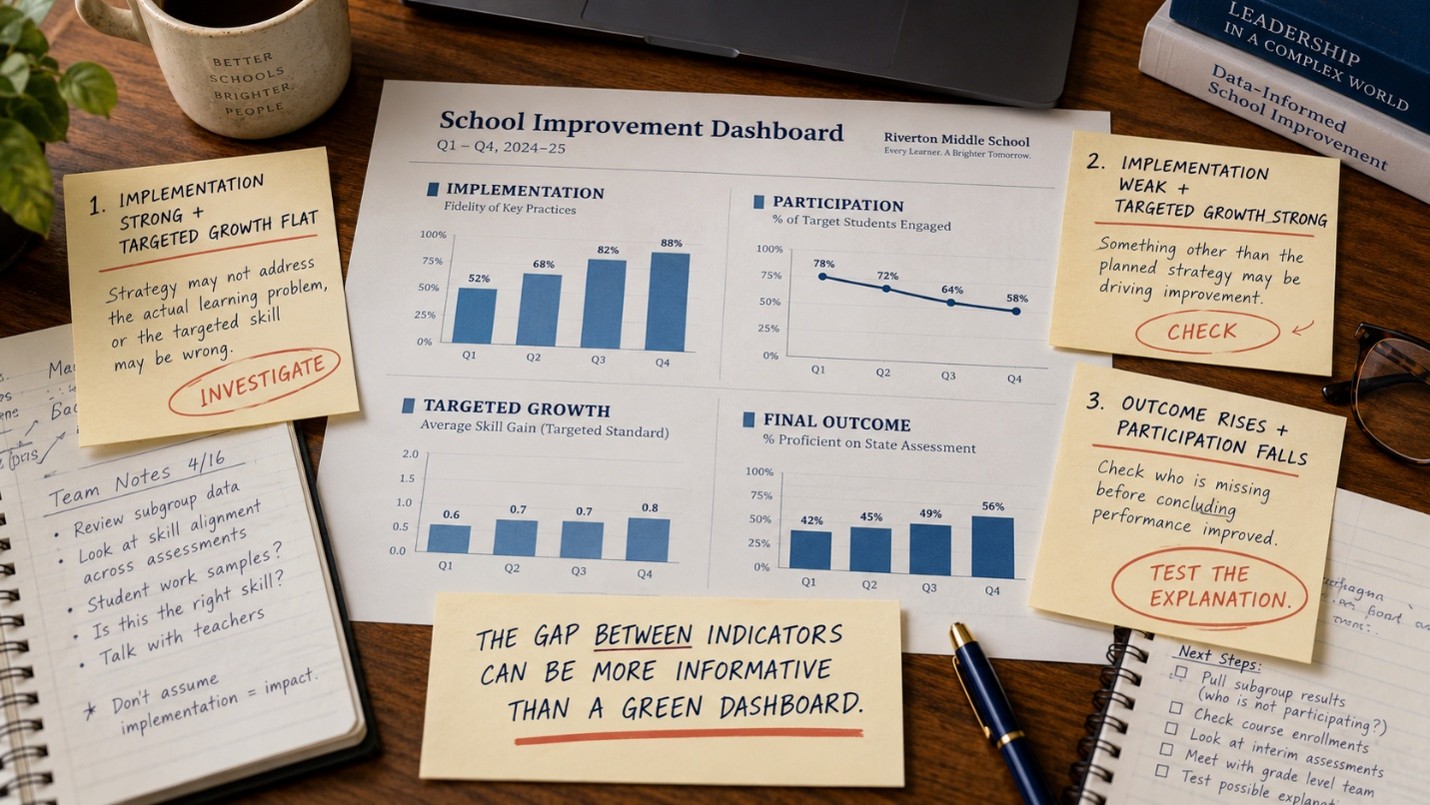
The real value of a layered KPI set shows up when the layers do not agree with each other.
If implementation looks strong but growth is flat, the strategy may be the wrong one, or it may be aimed at the wrong skill. If growth is strong but implementation is weak, something else is driving the gains, and that is worth finding out. If outcomes rise while participation drops, the improvement may not be real at all.
A single headline number cannot tell you any of this. The gaps between layers are often where leadership teams learn the most.
If every KPI on your improvement dashboard turned green this year, could you name which students learned more because of what the school changed?
Fewer KPIs, Each Tied to a Decision
KPI lists tend to grow every year. A new initiative brings a new metric, and almost nothing gets removed. The result is a dashboard that reports a great deal and steers very little.
One practical discipline helps. For each KPI, write down four things: who looks at it, when they look, what level triggers a conversation, and what decision it could change. If no decision depends on a KPI, it is reporting, not monitoring. It may still belong in a board report, but it should not take up space on the leadership team’s working dashboard.
For districts and multi-campus groups, add one more check. Are all campuses measured with the same instrument, in the same window? If not, cross-campus comparisons will reflect differences in testing rather than differences in learning. Choosing the few learning analytics for school leaders that should actually drive decisions is a leadership task, not a data task.
If a KPI cannot change a single decision before June, is it measuring improvement or simply recording it?
Measure the Change You Planned For
School improvement KPIs should answer one question: is the change we planned for actually happening for the students we planned it for? Activity counts cannot answer that. End-of-year results answer it too late.
The schools that get this right keep their KPI set small. They check participation before reading results, track growth on the specific skills named in the plan and treat the mid-year review as a real decision point. That way, when the outcome data finally arrives, it confirms what they already knew. It does not surprise them.
Frequently Asked Questions
Q: What are school improvement KPIs?
A: School improvement KPIs are the measures a school or district uses to judge whether its improvement plan is working. The most useful sets combine implementation measures, participation checks, growth on targeted skills and final outcomes such as state assessment results.
Q: What is the difference between leading and lagging indicators in education?
A: Lagging indicators, such as state test results and graduation rates, report on a year that has already ended. Leading indicators, such as BOY and MOY assessment growth, arrive earlier and give leaders time to adjust their plans.
Q: How many KPIs should a school improvement plan track?
A: Fewer than most schools use. A small set spread across implementation, participation, targeted growth and outcomes is usually enough. Each KPI should be linked to a decision the leadership team could actually make.
Q: Why are state test results not enough to measure school improvement?
A: They arrive after the school year has ended and usually report attainment, not growth. They confirm outcomes but cannot guide changes during the year, and they may not isolate the specific skills an improvement plan targeted.
Q: How often should school leaders review improvement KPIs?
A: Implementation measures can be checked monthly. Learning KPIs are best reviewed at each assessment window (BOY, MOY and EOY), with the MOY review treated as a formal point to decide whether to continue, adjust or stop a strategy.
Q: Should districts use the same KPIs across all campuses?
A: For comparison, yes. Campuses need the same instrument, the same testing window and visible participation rates. Otherwise, differences between schools may reflect differences in testing rather than differences in student learning.