

Picture a Grade 6 maths department after its mid-year assessment. The report flags fourteen skills below the expected level across three classes. Leadership asks for an intervention plan. Each teacher builds one: extra worksheets, two after-school groups, a lunchtime clinic and a reteach week. By week four, the lunchtime clinic has stopped and the after-school groups have lost half their students. The reteach week ate into new content. When the next assessment arrives, most of the fourteen gaps are still there, and the teachers are more tired than before.
Nobody in that story was careless. The gap analysis was probably accurate. What failed was the step between the report and the classroom. The plan asked for more teaching hours than the department actually had.
That is the central argument of this article. Closing learning gaps is mostly a capacity problem, not a data problem. Most schools can already find more gaps than they can close. The real skill is choosing which gaps to act on, matching each one to the cheapest response that will work, and protecting the time that response needs.
A Gap Report Is a List of Possibilities, Not a Plan
A learning-gap report tells you where students did not show a skill on a particular assessment. It does not tell you why, and it does not tell you what to do first. Good learning gaps analysis moves from the score to the specific skill. But even a precise list of skills can become a burden if every item on it is treated as equally urgent.
Two things go wrong when a school turns the whole list into action at once.
First, the response does not fit the cause. A gap caused by one shared misconception may need a single well-planned explanation. A true knowledge gap needs reteaching. An application gap needs practice, not more content. Treating all three the same way wastes time. This is why the difference between knowledge gaps and application gaps matters so much before any plan is written.
Second, the support gets spread thin. More groups mean less time for each one. Teachers start to cancel sessions, rotate who leads them, and drift away from the original target. On paper, the plan still exists, but in practice the dosage has quietly disappeared.
If every gap is a priority, which one will actually get taught on Thursday afternoon?
What the Research Says About Workload and Support at Scale
Two recent bodies of evidence help explain why this happens.
The first concerns teacher workload. In the OECD’s Teaching and Learning International Survey (TALIS) 2024, educators from 55 education systems reported on their working conditions. Across OECD systems, roughly half of teachers named excessive administrative work as a source of work-related stress, with the share higher among teachers who had more than ten years of experience. The OECD averages for full-time lower secondary teachers were about 41 working hours a week, including 22.7 hours of teaching, 7.4 hours of lesson preparation, 4.6 hours of marking and 3 hours of administrative work, and on average 19% of teachers said they experience stress “a lot” in their work. The OECD also notes that the link between stress and administrative workload may depend on more than the volume of work alone. The demands of teaching
These are self-reported survey figures, mainly from lower secondary teachers. They do not measure intervention work directly. However, they show that any new intervention plan has to fit into a week that is already full.
The second body of evidence concerns what happens to support programmes as they grow. In a 2026 meta-analysis published in the Review of Educational Research, Kraft, Schueler and Falken reviewed 263 randomized controlled trials of tutoring and found a pooled effect of .40 standard deviations across the full sample, but effects of .22 SD for programmes serving 400 to 999 students and .16 SD for programmes serving 1,000 or more, when measured on independent standardized tests. That is a drop of 45% to 60%. The authors point to likely causes: higher student-to-tutor ratios and lower planned dosage as programmes grow, weaker targeting of the students who would benefit most, and declining implementation quality, such as students receiving less of the intended time. They also found that a combination of recommended design features partly protected programmes against this decline.
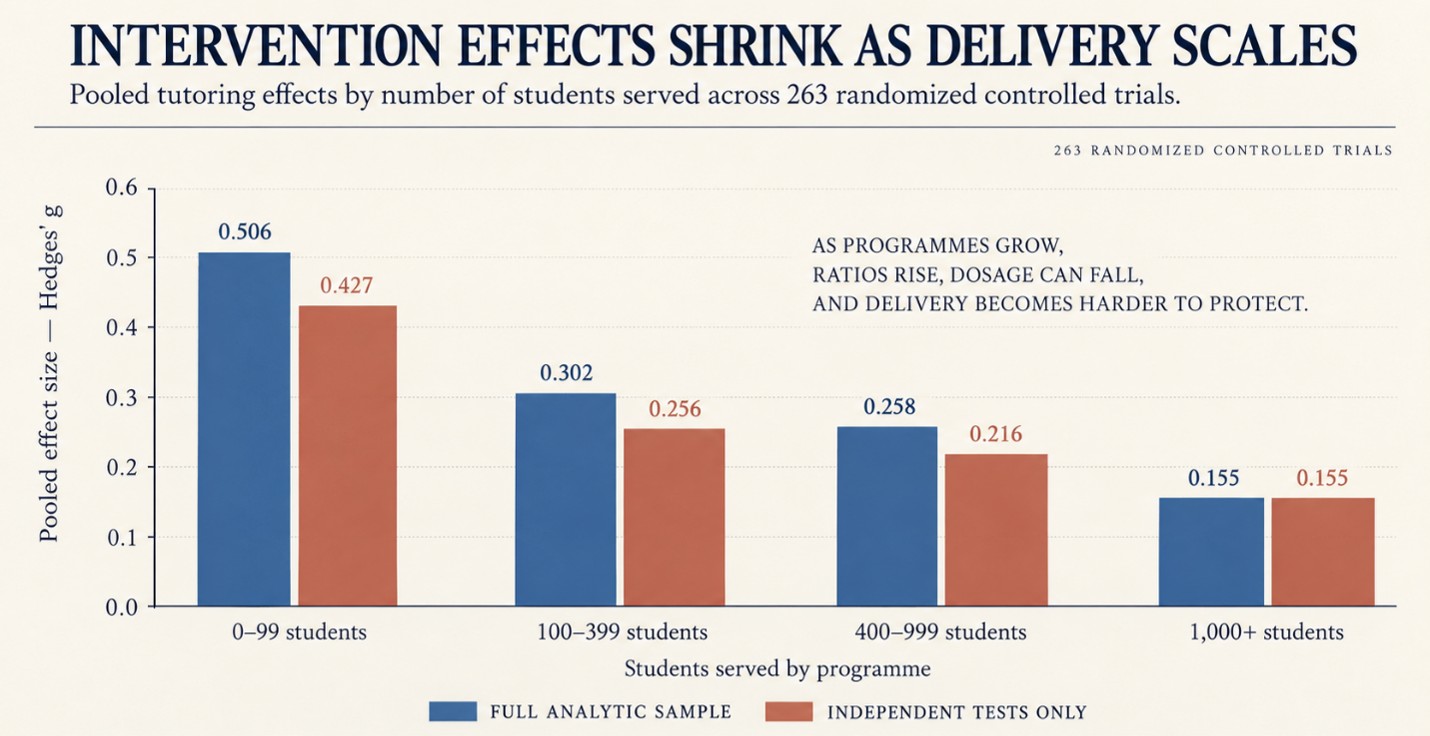
It is important to be clear about what this study covers. It is about tutoring, mostly in the United States, and most of the studies looked at early elementary literacy programmes serving fewer than 100 students. It does not measure teacher workload, and it does not prove that the same pattern happens inside a single school. sagepub
For school leaders, one reasonable implication is this: the reasons tutoring weakens at scale (thinner ratios, less time, looser targeting, slipping delivery) are the same pressures that appear when a school’s gap plan grows wider than its staffing. A plan that tries to reach everything often ends up delivering very little to anyone.
A Practical Framework: Six Decisions Before Any Intervention Starts
The framework below is built around decisions, not documents. Each step removes work rather than adding it.
1. Check the evidence before planning. If performance falls only on the hardest questions, the problem may be the paper, not the class. If participation was low, the gap may belong to a different group of students than the report suggests. A ten-minute check here can prevent a term of unnecessary intervention.
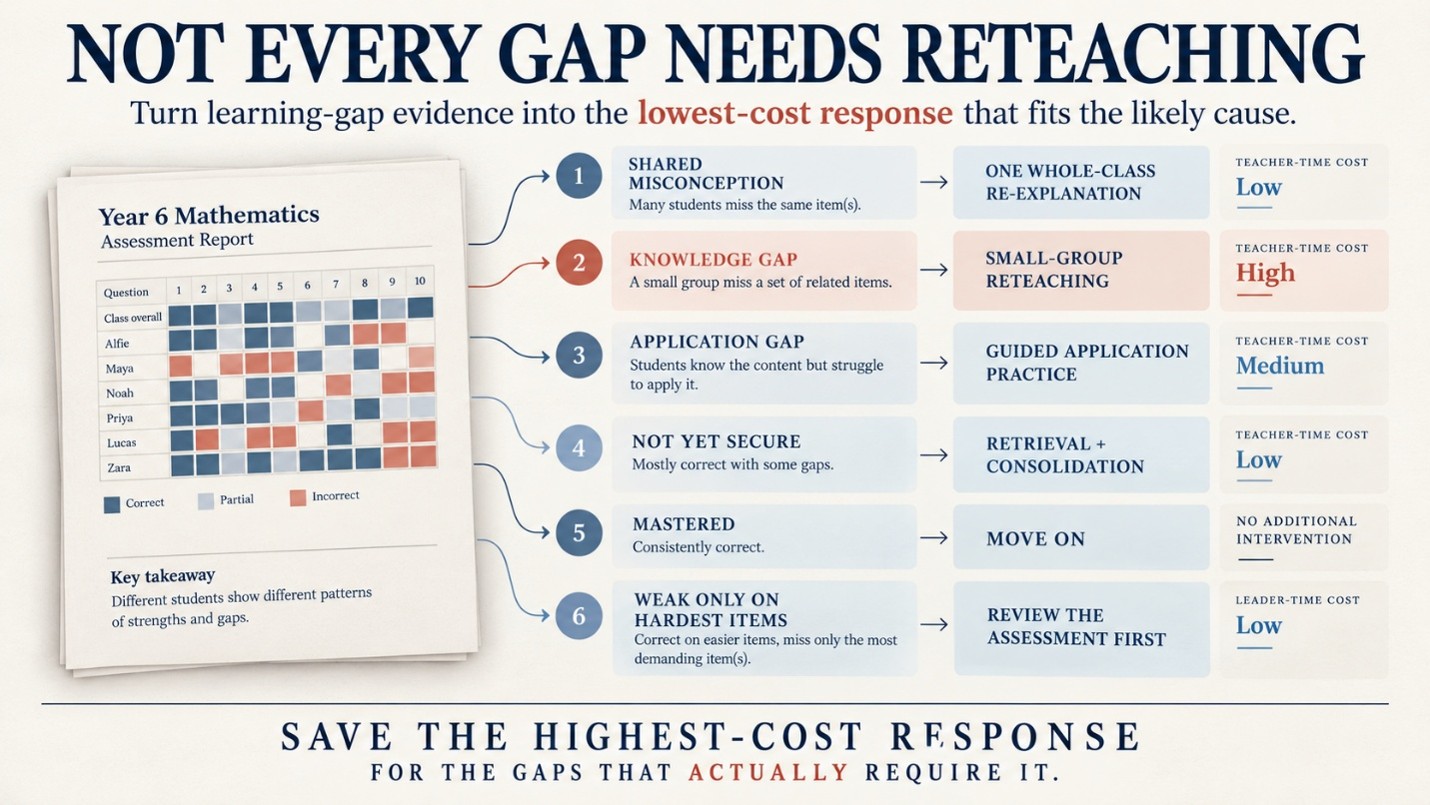
2. Sort each gap by its likely cause. Use the table below. The aim is to match every gap to the lowest-cost response that fits it.
3. Cap the number of priorities. Choose a small number of priority skills per class for each cycle, for example two or three. Everything else is consolidated within normal lessons or monitored.
4. Group students by shared need, not one by one. Six students missing the same skill should be one session, not six separate conversations. A good plan teachers can actually deliver is organized around skills and groups, not around individual case files.
5. Protect dosage inside the timetable. Fewer sessions that actually happen are better than many that get cancelled. Put the sessions in the timetable, keep the same adult leading each group, and keep the groups small.
6. Reassess only what was targeted. At the next assessment, include items on the priority skills so the team can see whether the gap moved. Then decide whether to continue, adjust or stop.
| What the evidence shows | Likely reading | Response | Teacher time cost | Where it happens |
| Most students chose the same wrong option | One shared misconception | One clear whole-class re-explanation | Low | Next lesson |
| Weak even on simple recall questions | Knowledge gap | Reteach the skill to a small group | High | Timetabled group sessions |
| Strong on recall, weak when applying | Application gap | Guided practice applying the skill | Medium | Inside regular lessons |
| Close to secure but inconsistent | Not yet secure | Short retrieval and consolidation tasks | Low | Lesson starters, homework |
| Secure across question types | Mastered | Move on | None | — |
| Weak only on the hardest questions | The paper may be the issue | Review the assessment before planning | Low (leader task) | Assessment team |
The table makes one point visible: only one row is expensive. The schools that close gaps without exhausting their teachers usually save their high-cost response for true knowledge gaps and handle everything else more lightly. Deciding whether to reteach, practise or move on is the single most important workload decision in the whole cycle.
What Leaders Should Take Off the Plate
A framework that only adds steps will fail in the same way the original plan did. Leaders also need to decide what stops.
Common candidates include separate intervention logs that repeat data already held in the assessment system, individual plans written for every student below a threshold, and extra marking created by intervention worksheets. Reviewing which assessment tasks can be streamlined is part of intervention planning, not a separate project.
At the leadership level, the useful questions are simple:
- How many teacher hours does this plan need each week, and where in the timetable do they come from?
- Which gaps were deliberately not prioritised, and why?
- Did the planned sessions actually happen?
- Did the targeted skills move at reassessment?
If a gap plan needs more teacher hours than the timetable contains, is it a plan or a wish list?
Fewer Priorities, Properly Delivered
The schools that make real progress on learning gaps are rarely the ones with the longest intervention lists. They are the ones that read the evidence carefully, match each gap to the right response, protect the time for the few gaps that truly need it, and check whether it worked.
That approach asks less of teachers, not more. It also respects what the evidence suggests: support works best when it is focused, well-timed and actually delivered, and it loses strength when it is spread too thin.
FAQs
Q1. What is the best way to close learning gaps without increasing teacher workload?
Prioritise a small number of gaps for each class, match each gap to the lowest-cost response that fits its cause, group students by shared need, and schedule sessions inside the timetable. Most gaps can be handled through consolidation in normal lessons. Only true knowledge gaps usually need separate reteaching.
Q2. Why do intervention plans often fail in schools?
They often try to address every gap at once. This spreads teacher time thin, causes sessions to be cancelled, and weakens targeting. Research on tutoring shows that effects drop as programmes grow, partly because of higher ratios, lower dosage and weaker implementation.
Q3. How many learning gaps should a teacher focus on at one time?
There is no research-fixed number. A practical starting point is two or three priority skills per class for each assessment cycle, with other gaps consolidated within regular lessons or monitored until the next assessment.
Q4. What is the difference between reteaching and consolidation?
Reteaching is for skills students have not learned, usually shown by weak performance even on simple recall questions. Consolidation is for skills that are developing but not yet secure. These students need practice and retrieval, not the full lesson again.
Q5. What should targeted support programmes include?
They should include a clear diagnosis of the gap, small groups formed around a shared need, protected time in the timetable, a consistent adult leading each group, and a planned reassessment of the targeted skills.
Q6. How do school leaders know if an intervention worked?
Include questions on the targeted skills in the next assessment and compare results with the previous cycle. Also check whether the planned sessions actually took place, because a plan that was not delivered cannot be judged on its outcome.