

Every August, in districts across the country, school improvement plans get finished. They are reviewed, signed, uploaded to the state portal and sometimes presented to the school board. Then the school year starts.
By January, try asking a 4th grade team to name the plan’s top three goals. You will probably get a long pause.
That pause is the real problem. Most plans don’t fail because the goals are wrong. They fail because the plan never made it from the document into the weekly life of the building.
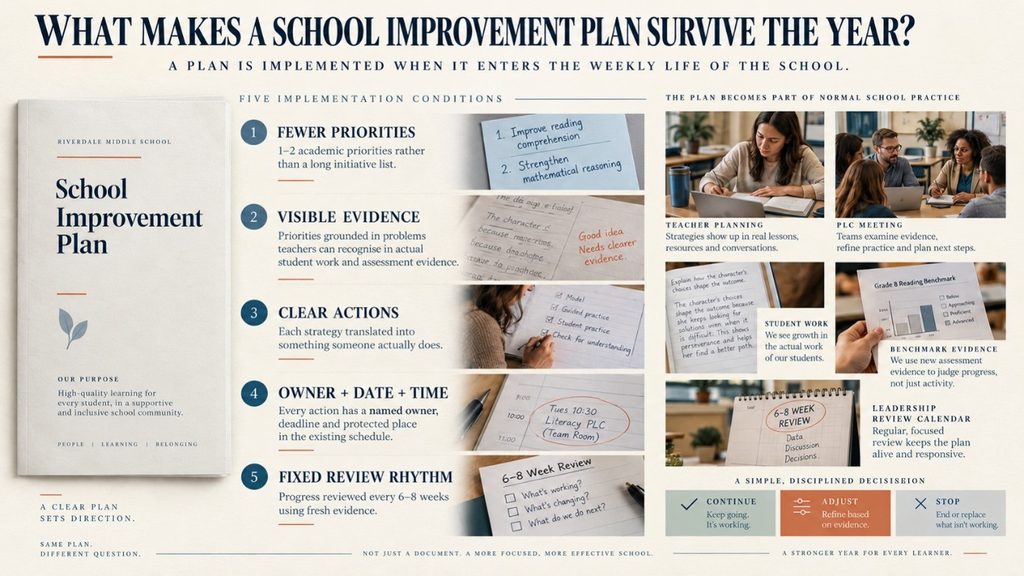
So here is the short answer. A school improvement plan gets implemented when you:
- choose fewer priorities,
- root those priorities in evidence teachers can see,
- break each one into actions with named owners and dates,
- decide in advance how you will know it is working, and
- put the reviews on the calendar before the year begins.
The rest of this article explains each step and where plans usually break down.
Most Plans Are Written for the Wrong Reader
Think about who a typical school improvement plan is written for. Often the honest answer is the district office, the state template or a compliance reviewer. Schools identified for Comprehensive or Targeted Support and Improvement under ESSA have real federal requirements to meet, and those are not optional.
But a document written to pass review is rarely the document a grade-level team opens on a Wednesday afternoon. It tends to be long and written in system language. It is organized around required sections rather than around the work.
A practical fix is to keep two layers:
- The full plan, which satisfies the template.
- A one-page working version, which the leadership team, coaches and teachers actually use. It names the priority, the few actions that matter this semester, who owns each action and when progress gets checked.
If the two versions disagree, the one-page version is usually closer to what will really happen.
Start With a Problem Teachers Can Recognize
The school improvement planning process often starts with a goal written backward from a target, such as “Increase math proficiency by 8 points.” That tells everyone where to land. It says nothing about why students aren’t there yet.
A stronger starting point is a problem described precisely enough that teachers recognize it in their own classrooms. Compare these two statements:
- “Middle school math is weak.”
- “Our 6th and 7th graders can carry out fraction procedures but struggle when the same skill appears inside a word problem.”
A math department can plan instruction around the second statement. It cannot plan around the first.
Getting to that level of precision means looking past the overall score. Leaders who want a structured approach can begin with using assessment evidence to choose a school improvement priority.
It is also worth checking that the priority connects to what the school says it stands for. Plans that drift away from the school’s mission tend to lose staff commitment quickly, a pattern explored in why academic plans drift from the school’s vision.
Fewer Goals Make a Stronger Plan
There is a quiet belief in many buildings that more goals signal more ambition. In practice, every extra goal competes for the same limited resources: PD days, coaching hours, PLC time and the principal’s attention.
A school with seven priorities effectively has none. Teachers cannot hold seven initiatives in mind while also teaching a full schedule. Most schools get further with:
- one or two academic school improvement goals, and
- perhaps one culture or attendance goal.
This raises an uncomfortable question for any leadership team:
If your teachers can’t name the plan’s top priority by the end of September, is it really the school’s plan, or only the leadership team’s?
Turn Each Goal Into Something Someone Does on a Tuesday
This is where school improvement plan implementation usually breaks. A strategy like “implement data-driven instruction” sounds complete. But it has no owner, no time attached to it and no visible first step.
Every strategy should be broken into actions that answer four plain questions:
- What exactly will happen?
- Who is responsible for it?
- When will it happen?
- Where in the existing schedule does the time come from?
Schools often skip that last question. If the plan adds a weekly data meeting but removes nothing from the calendar, that meeting will be the first thing cancelled when testing season, a staffing gap or a building issue arrives.
The table below shows the difference between a plan that looks complete and a plan that is built to be carried out.
| Plan element | How it often looks on paper | How it looks when it can be implemented |
| Priority | “Improve literacy outcomes” | “Grade 3–5 students struggle to explain their reasoning in written responses to informational texts” |
| Number of goals | 6–10 goals across every area | 1–2 academic priorities plus 1 culture priority |
| Strategy | “Use data-driven instruction” | “Grade-level PLCs review one common task every two weeks and plan one reteach lesson” |
| Ownership | “Leadership team” or “All staff” | A named person for each action, such as the ELA instructional coach |
| Time | Not stated | Protected PLC time every other Wednesday, plus one staff meeting a month repurposed |
| Progress measure | End-of-year state test only | Short common tasks every few weeks, plus fall, winter and spring benchmarks |
| Review | Annual update in spring | Leadership review every 6–8 weeks ending in a decision to continue, adjust or stop |
| What stops | Nothing | One existing initiative paused to free up time |
Decide How You Will Know It’s Working Before You Start
State test results usually arrive after the school year ends. If those results are the only evidence the plan relies on, the leadership team finds out whether the plan worked months after it could have done anything about it.
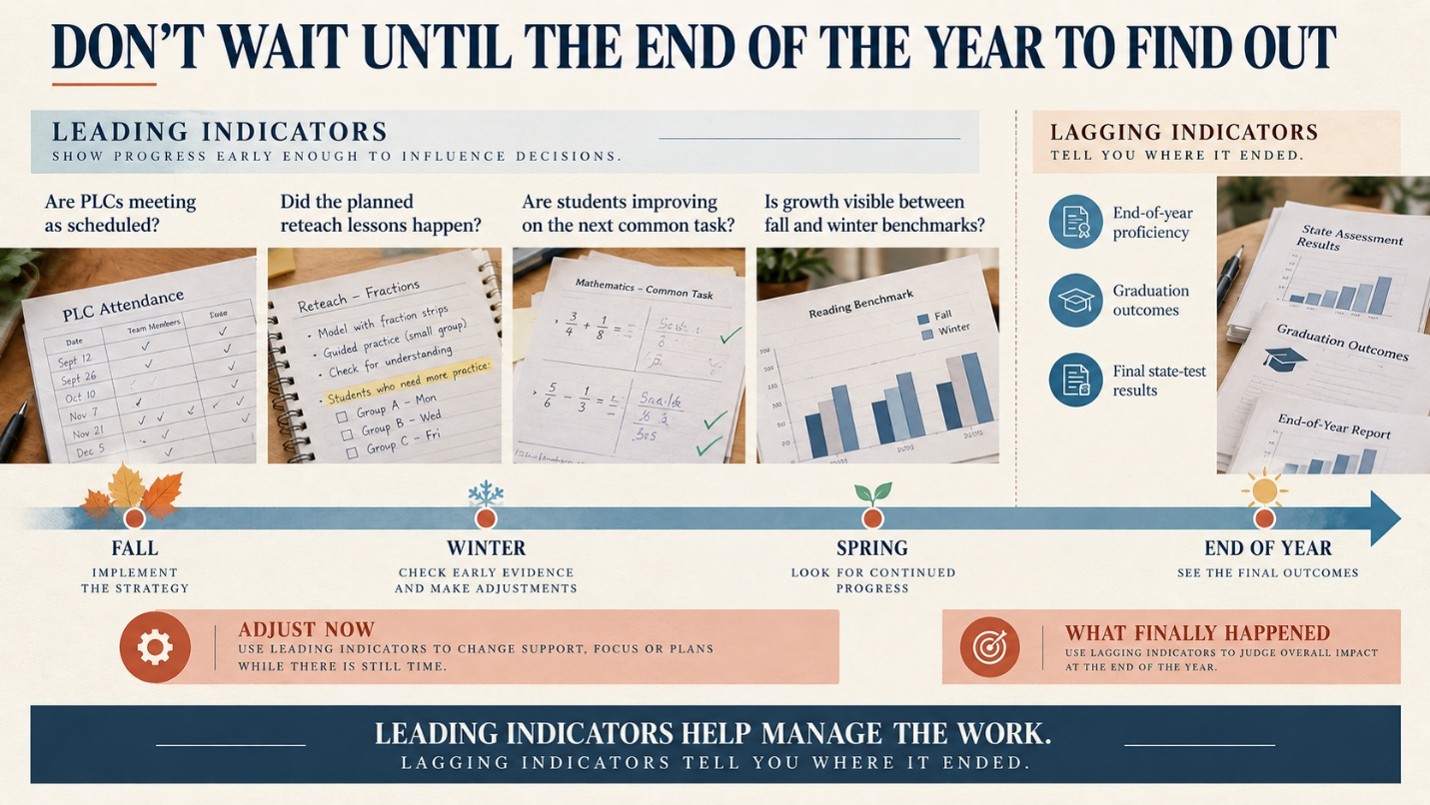
Plans that get implemented use two kinds of measures:
- Lagging indicators show whether the final outcome moved. Examples are end-of-year proficiency and graduation rates.
- Leading indicators show earlier whether the work is happening and starting to have an effect. Useful questions include:
- Are PLCs meeting as scheduled?
- Did the planned reteach lessons happen?
- Are students doing better on the next common task?
- Is growth visible between the fall and winter benchmarks?
Keep leading indicators few and easy to collect. For a closer look at which measures deserve space on the leadership agenda, see school improvement KPIs that show whether the work is paying off.
Put the Reviews on the Calendar Before the Year Starts
Most schools plan well and monitor poorly. The review stage is where a plan either adjusts or quietly fades, and it is the stage most often skipped. That pattern is discussed further in the stages of the school improvement cycle.
The fix is simple and mechanical:
- Before the year starts, book a 60-minute plan review on the leadership calendar every six to eight weeks.
- Time each review shortly after a common assessment or benchmark window, so fresh evidence is on the table.
- End every review with one decision for each action: continue, adjust or stop.
That third option matters. Stopping something that isn’t working shows the plan is being used. It doesn’t mean the plan has failed.
What would your school stop doing this year to make room for the one thing your plan says matters most?
A Plan Is a Promise About What Will Change
A school improvement plan is really a theory:
If we do these specific things, these students will learn this specific thing better.
That theory only gets tested when the actions happen. And the actions only happen when each one has an owner, a time and a place in the schedule.
Write the plan for the people who will carry it out. Keep it narrow. Measure early. Review it on a fixed rhythm. Plans built this way still face hard years, but they are far more likely to be in use in January instead of sitting in a binder.
Frequently Asked Questions
Q: What is a school improvement plan?
A: A school improvement plan is a document that sets out a school’s main priorities for raising student outcomes. It covers the strategies the school will use, who is responsible for each one and how progress will be measured. In many US states, schools must update the plan every year. Schools identified under ESSA must meet additional federal requirements.
Q: Why do most school improvement plans fail to get implemented?
A: Most plans stall because they have too many goals and vague strategies. Actions often have no named owner, and no time is protected for the work. Many plans are also written mainly to satisfy a template, so teachers don’t use them. Without scheduled reviews, problems go unnoticed until the year is nearly over.
Q: How many goals should a school improvement plan have?
A: Most schools are better served by one or two academic priorities, plus possibly one culture or attendance goal. Every additional goal competes for the same PD time, coaching hours and leadership attention. A narrow plan that teachers can name is more likely to change practice than a broad plan nobody remembers.
Q: How often should a school improvement plan be reviewed?
A: A good rhythm is a short leadership review every six to eight weeks, timed after common assessments or benchmark windows. Each review should end with a clear decision for every action: continue, adjust or stop. An annual review alone comes too late to change anything during the current school year.
Q: What is the difference between leading and lagging indicators in school improvement?
A: Lagging indicators, such as state test proficiency, show whether the final outcome changed, but only after the year ends. Leading indicators show earlier whether the planned work is happening and starting to help. Examples are PLC attendance, completion of reteach lessons, common task results and fall-to-winter growth. Strong plans track both.
Q: Who should be involved in writing a school improvement plan?
A: The principal usually leads the process. Teachers, instructional coaches and grade-level or department leads should help shape the priorities and actions, because they are the people who will carry them out. For schools under ESSA support and improvement status, families and other stakeholders also have a defined role in developing the plan.