
It is a Sunday night. A eighth-grade ELA teacher in Ohio has 128 argumentative essays to grade before Tuesday. Her district has just licensed a tool that promises to turn that pile into a single evening’s work. By winter, the promise has mostly held, and grading time is down. But when her team meets to plan the next unit, nobody can say with confidence which students are still quoting evidence without explaining it. The essays were scored. The thinking about them was skipped.
That is the risk inside every conversation about assessment workload reduction. Teachers are genuinely overloaded, and many assessment tasks deserve to be faster. The mistake is choosing what to streamline by how long a task takes, rather than by where the professional judgment sits inside it.
The short answer is this. Streamline the parts of assessment where the decision has already been made. That includes scoring closed questions, moving results into a record, scheduling, collating and producing first drafts. Protect the parts where a person decides what the evidence means. That includes interpreting open responses, choosing what to teach next, approving what students are tested on and ruling on integrity concerns.
What Teachers Report About Saving Time
The useful recent national evidence comes from the Walton Family Foundation and Gallup study Teaching for Tomorrow: Unlocking Six Weeks a Year With AI. Gallup ran the web survey from March 18 to April 11, 2025, with 2,232 teachers in US public K–12 schools, recruited through the RAND American Teacher Panel, a nationally representative panel. About six in ten teachers had used an AI tool for their work in the 2024–25 school year. Those using it at least weekly estimated saving 5.9 hours a week, which Gallup calculates as roughly six weeks over a 37.4-week school year.
The headline is time. The more revealing detail is quality. Among teachers who used AI for a given task, the share saying it improved their work ranged from 57% for grading and feedback up to 74% for administrative work. Grading and feedback sat at the bottom of that list. It was also the task where the largest share of teachers, 16%, said quality got worse. Usage follows the same pattern: 75% of teachers had never used AI to grade or give feedback, compared with 61% who had never used it for administrative work. gallupgallup
Two cautions apply. These figures are teachers’ own estimates from a survey, not measurements from an experiment. The study also describes time and perceived quality, not student learning. Still, the pattern is worth noticing. Teachers seem more comfortable speeding up the work around assessment than the work inside the act of judging it.
Every Assessment Task Has a Shell and a Core
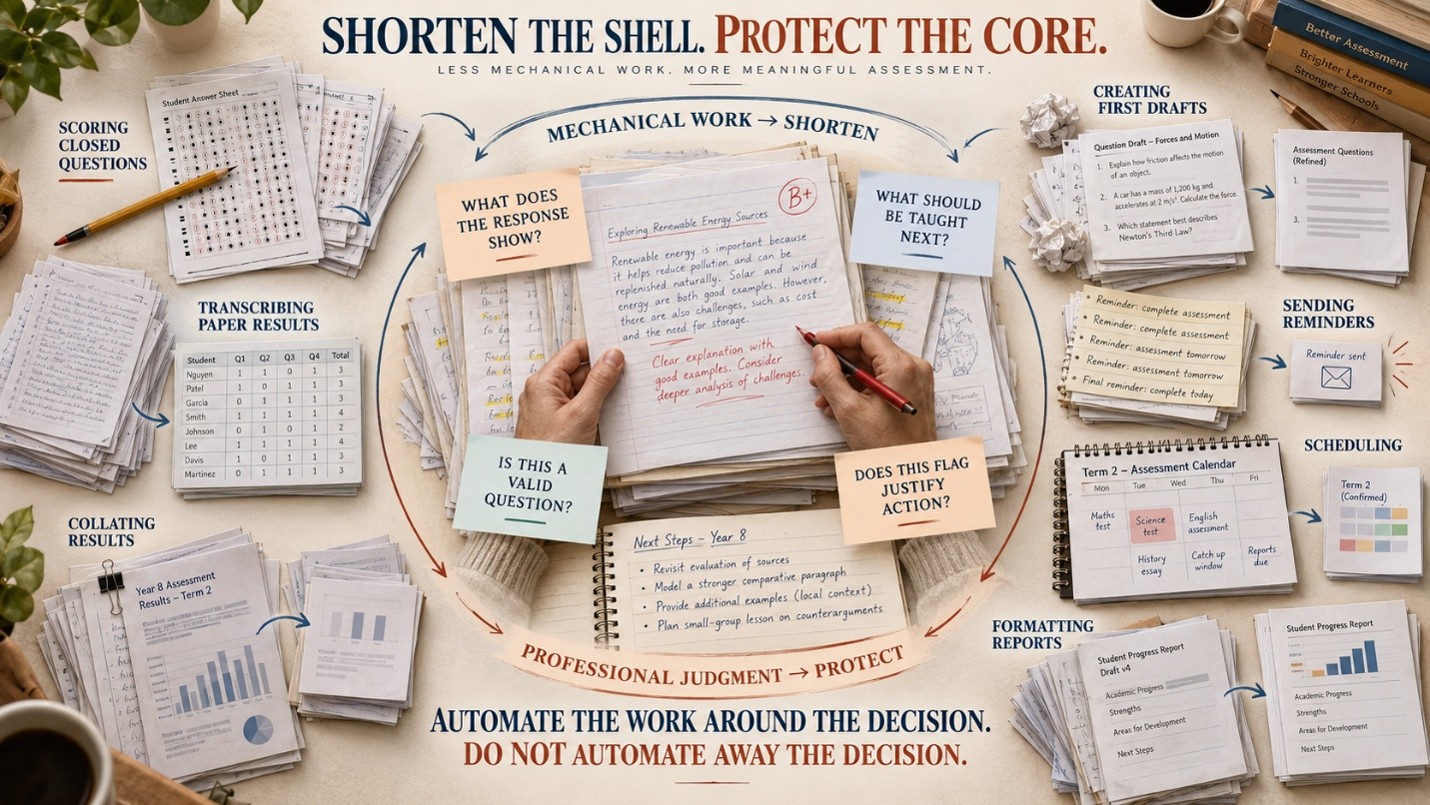
A helpful way to audit assessment workload is to split each task into two layers.
The shell is the mechanical work: printing, collecting, totaling, typing scores into a gradebook, formatting a report. The core is the decision: Is this answer correct? Does this response show understanding of the standard? What should happen in class tomorrow?
Shells can usually be streamlined hard. Cores can be supported, but the decision itself should stay with someone who knows the students and the curriculum.
Where Schools Can Safely Save Time
Scoring selected-response items. Multiple-choice and other closed items have a fixed answer key, so hand-scoring them adds no professional insight. What teachers need is the pattern, not the scoring. Which wrong answer did a third of the class choose, and why?
Moving paper results into the record. Many elementary classrooms and formal exams still run on paper, and hand-keying those scores is pure transcription. Scanning answer sheets into the same record as online tests is one of the clearest wins, provided the results stay comparable. This is where thoughtful paper and digital assessment integration pays off.
First drafts of items and rubrics. Generating a draft set of questions for a given standard and difficulty can save hours. The draft is not the judgment; approving it is. That is why a governed school item bank becomes more important as AI drafting becomes common.
Collating and formatting. Pulling class results into a department summary, building charts for a data meeting or preparing a progress note for families does not need a teacher working by hand.
Logistics. Assigning tests across sections, setting testing windows, sending reminders and routing retake requests to the right person are all good candidates for automation.
Where Speed Should Not Be the Goal
Interpreting open responses. AI can offer a first-pass score on short answers and essays, and many teachers say that saves time. But a score with no visible reasoning asks teachers to trust rather than to judge. Before relying on it, leaders should be clear about AI-assisted grading with human oversight. What does the teacher see, and how easy is it to disagree?
Deciding what to teach next. A report can show that a group struggles with fractions on a number line. Whether that calls for reteaching, more practice or a different representation is a professional call.
Approving what students are tested on. Every item that reaches a student makes a claim about what the standard requires. Someone accountable should sign off on that claim.
Ruling on integrity concerns. A flag is evidence, not a verdict. A student’s record should never change just because software was suspicious.
This raises an uncomfortable question for any leader celebrating hours saved.
If a tool cuts grading time in half but teachers can no longer describe what their class got wrong, was that time saved, or simply moved somewhere harder to see?
The Biggest Saving May Be an Assessment You Don’t Give
Most workload conversations jump straight to tools. But many US schools stack a district benchmark, a curriculum unit test and a state interim on top of one another, often covering overlapping standards within the same few weeks. Streamlining the calendar can save more time than streamlining the grading. Getting the formative vs summative assessment balance right helps leaders see which assessments do distinct jobs and which are duplicates.
A useful exercise for a leadership team is to list every assessment on the year’s calendar and ask:
Which of these, if removed, would change a decision someone actually makes?
Questions to Ask Before You Streamline
Before approving a new tool or process, district and school leaders might ask:
- Which part of this task is shell, and which part is core?
- After the change, can a teacher still see why a score was given?
- Who has the final say, and is overriding the system quick or awkward?
- Are results still comparable across classrooms and campuses?
- Where will the saved time go, and will anyone check?
The last question matters more than it looks. Gallup’s qualitative data suggest teachers reinvest saved time in more detailed student feedback, individualized lessons, parent emails and getting home at a reasonable hour. That is the best case. Without a plan, saved time can just as easily be swallowed by new paperwork.
Faster Is Only Better When Judgment Survives
Assessment workload reduction is worth pursuing. Teachers’ time is limited, and much of what fills it adds little value. But the goal is not to save the most hours. The goal is to remove the work that never needed a teacher, so teachers have more attention for the work that always will.
Frequently Asked Questions
Q: Which assessment tasks are safest to streamline?
A: Tasks with a fixed answer or no professional decision attached are safest. These include scoring multiple-choice items, entering paper results, scheduling, sending reminders and formatting reports. Any task where someone decides what a student’s work means needs a person to stay involved.
Q: Can AI grade student work reliably?
A: AI can give a useful first-pass score, especially when it shows its reasoning. In the 2025 Gallup study, grading and feedback was the task where teachers reported the lowest quality improvement from AI. Schools should treat AI scores as a starting point that teachers review, not a final decision.
Q: How much time can teachers save with AI?
A: In the 2025 Walton Family Foundation and Gallup survey, teachers who used AI at least weekly estimated saving 5.9 hours a week. These are self-reported estimates, and teachers who used AI less often reported smaller savings. gallup
Q: How can schools reduce assessment workload without buying new tools?
A: Start with the assessment calendar. Many schools give several tests that measure the same standards in the same few weeks. Removing duplicates often saves more time than speeding up grading.
Q: Who should have the final say on an AI-assisted score?
A: The teacher should. They know the student, the task and the curriculum. A good system makes the reasoning behind any automated score visible and makes overriding it quick and simple.